Are Large Crystal Geodes Worth the Investment in 2026?
Table of Contents
- The Real Case for Large Crystal Geodes as an Investment
- What Makes a Geode Valuable: The Six Factors That Drive Price
- Large Amethyst Geode Value: Why Color and Size Command a Premium
- How to Tell If a Geode Is Real: Authenticity and Provenance Checks
- Large Geodes vs. Smaller Specimens: A Practical Comparison
- Buying Large Crystal Geodes Online: What to Check Before You Pay
- Total Cost of Ownership: What Buyers Forget to Budget For
- Frequently Asked Questions
Last Updated: October 20, 2026
The Real Case for Large Crystal Geodes as an Investment
A large crystal geode is a hollow or partially hollow rock formation lined with crystals, and whether it deserves your money depends far more on display value than on resale math. At IG Crystal Archive, LLC, we have watched collectors talk themselves into "investment" purchases that never recovered their cost.

That distinction matters because crystal geodes sit at an awkward intersection. They are heavy, fragile, and hard to ship. They are also one-of-a-kind, which sounds like scarcity until you realize the buyer pool for a 40-pound amethyst cathedral is small and local.
Below, we break down exactly what drives value, how to spot a fake, and what ownership actually costs.
What Makes a Geode Valuable: The Six Factors That Drive Price
Six factors separate a valuable geode from an expensive rock: crystal quality, color, size, condition, rarity, and display quality.
Crystal quality covers clarity, termination, and how tightly the points are packed.
Crystal color is the second lever.
Crystal size and coverage describe how much of the interior is lined with crystal and how large the individual points are.
Condition is where buyers lose money. Chipped points, cracks through the matrix, repairs, and polishing that removes natural texture all reduce value.
Rarity and origin shape collector demand. Unusual mineral associations or well-documented localities carry a premium, but only when provenance is verifiable.
Display quality is the factor serious collectors weigh hardest.
Large Amethyst Geode Value: Why Color and Size Command a Premium
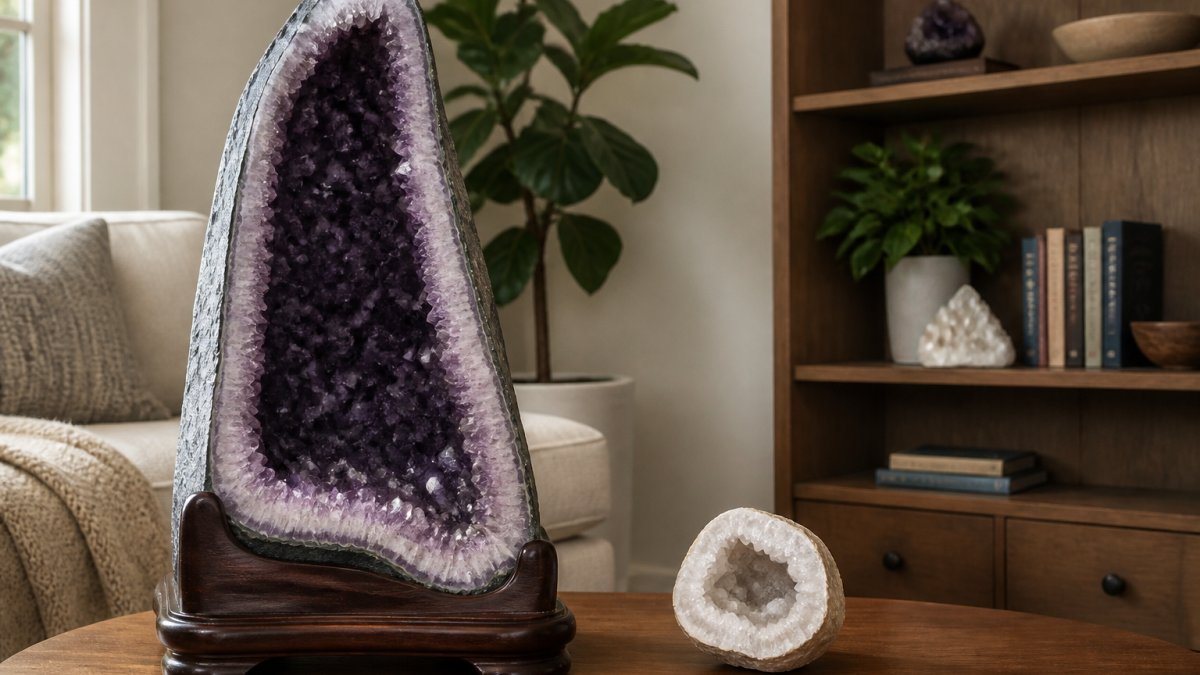
Large amethyst geode value comes down to saturation and cavity size, and both are easy to overpay for. Amethyst is the most recognizable crystal geode on the market, which means the supply is deep and the price spread is enormous.

Deep purple amethyst with cathedral-style spires earns the highest asking prices. Pale lavender amethyst, common in mass-market imports, sells at a fraction of that. The gap is not subtle.
Size cuts both ways. A large display piece has visual impact that a small specimen cannot match, but the pool of buyers with the space and budget shrinks fast as weight climbs.
What most guides miss is that amethyst geodes are frequently heat-treated to deepen color or dyed to fake rarity. Natural crystals with even, unforced color are the ones that hold value.
How to Tell If a Geode Is Real: Authenticity and Provenance Checks
You can tell if a geode is real by checking weight, temperature, crystal attachment, and dye residue. Real geodes feel heavier than expected for their size and stay cool to the touch. Crystals in a natural formation grow from the matrix, so they should be attached at the base, not glued in.
Run these checks before you pay:
- Look for dye pooling in cracks and along the matrix edges
- Check that crystal points show natural variation, not uniform color
- Confirm the piece is not a resin or concrete cast
- Ask whether the geode has been repaired, polished, or stabilized
- Request provenance: origin, seller history, and whether it was personally selected
Authenticity also means understanding treatments. Heat treatment is common and legal; dyeing is common and often undisclosed. Neither is automatically disqualifying, but both should be priced in.
Blue Celestite Crystal Geode – Smoky Blue Natural Mineral Cluster →
Provenance is the harder half. A seller who can tell you where a piece came from and why they chose it is giving you something a spec sheet cannot.
Large Geodes vs. Smaller Specimens: A Practical Comparison
Large geodes win on visual impact; smaller specimens win on liquidity, shipping, and display flexibility. The right choice depends on whether you are furnishing a room or building a collection, and the fastest way to see the trade-off is to compare pieces on a per-pound basis rather than on sticker price alone.
Price per pound: the number most listings hide
A large geode can look like a bargain next to a small one until you divide by weight. A 40-pound cathedral-style amethyst piece priced at $1,200 works out to roughly $30 per pound. A 3-pound open-cavity specimen at $90 is also about $30 per pound, but it ships in a padded box for a fraction of the freight, stores on a shelf, and resells to a national buyer pool instead of a local one. Price per pound is not a perfect measure (crystal quality and color still dominate), but it exposes when a large piece is priced for its size rather than its crystals.
Display impact per square foot
A large geode is a focal point: it anchors a console, a fireplace surround, or a retail window and reads from across a room. A smaller specimen is an accent, it rewards close inspection and works in groupings. If your goal is one statement piece, large wins on impact per dollar. If your goal is a collection that grows over time, small and mid-size pieces let you add variety without re-engineering your space or your insurance schedule.
Handling, shipping, and resale liquidity
- Weight and handling: A 40-pound geode needs two people, a load-rated surface, and a stand rated for the weight. A 3-pound piece moves in one hand.
- Shipping risk: Fragile, heavy specimens ship freight or in double-boxed foam, and damage claims are common. Small specimens ship in a padded box at a fraction of the cost.
- Resale liquidity: Large pieces sell slowly and locally because buyers want to inspect them in person. Small pieces ship easily and reach a national buyer pool, which shortens time-to-sale.
- Storage: Large pieces consume dedicated floor or console space; small pieces fit in a cabinet or on a shelf.
A side-by-side framework
| Factor | Large Geodes | Smaller Specimens |
|---|---|---|
| Visual impact | Strong focal point | Accent piece |
| Weight and handling | Heavy, needs help to move | Easy to handle |
| Shipping risk | High, fragile and costly | Low |
| Resale liquidity | Slow, local buyer pool | Faster, ships easily |
| Display space needed | Dedicated surface | Shelf or console |
| Price entry | Higher | Lower |
| Price per pound | Often similar to small pieces | Often similar to large pieces |
| Best buyer | Decorator or statement collector | First-time buyer or growing collection |
For most first-time buyers, a mid-size piece delivers most of the display value without the handling headaches. Our Natural White Crystal Geode on a gold-toned stand at $89.99 is a good example: a real open cavity, ready to display, and light enough to move without a second pair of hands.
If you want color and drama in a compact footprint, the Citrine Quartz Geode Sphere at $49.99 gives you a golden open cave at roughly 2 inches wide.

Buying Large Crystal Geodes Online: What to Check Before You Pay
Buying large crystal geodes online works when you treat the listing as evidence rather than marketing.
Check these before checkout:
- Exact-piece photos from multiple angles, not catalog shots
- Stated dimensions and weight in the listing
- Return window and who pays return shipping
- Packaging method for fragile specimens
- Whether a stand is included
The [U.S. Geological Survey's mineral resource information | usgs.gov] is a solid reference for understanding what a specimen actually is before you buy.
At IG Crystal Archive, LLC, every specimen is hand-selected and inspected, ships in secure professional packaging, and comes with a 30-day free return window. That return policy is the real protection when a piece looks different in your room than it did on screen.
Total Cost of Ownership: What Buyers Forget to Budget For
The purchase price is only part of what a large geode costs you. Budget for the stand, the surface it sits on, insurance, and shipping if you ever sell or move, and treat those as part of the investment case, not afterthoughts. A piece that costs $1,200 to buy can easily carry another few hundred dollars in ownership costs before it ever resells.
The line items most buyers miss
- Stand or mount: A proper display stand for a heavy specimen is often sold separately and can run from tens to a few hundred dollars depending on weight rating and finish. A piece without a rated stand is a tipping hazard.
- Load-bearing surface: A 40-pound geode plus stand needs a stable, load-rated console or floor plinth. Furniture that flexes or wobbles is a breakage risk, and replacing a damaged piece is rarely covered by the seller.
- Insurance: Standard renter's or homeowner's policies often cap coverage for fragile collectibles or require a scheduled rider. Check the per-item limit before you assume a large piece is covered.
- Shipping and freight: If you ever sell or move, fragile heavy specimens ship freight or in double-boxed foam. Freight cost and damage-claim risk can eat a meaningful share of the sale price.
- Storage and climate: Direct sun can fade some colors, and repeated temperature swings stress matrix and repairs. A stable interior wall away from HVAC vents is the low-cost default.
- Time cost: Photographing, listing, answering questions, and packing a large geode for resale takes real hours. That is the part nobody budgets for, and it is why so many "investment" geodes end up as permanent decor.
A simple ownership-cost worksheet
Before you buy, add up: purchase price + stand + any furniture upgrade + insurance rider (annualized) + estimated resale freight. Compare that total to what comparable completed sales suggest the piece would actually fetch. If the gap is thin or negative, you are buying decor, not an investment, and that is fine, as long as you know it going in.
Where large geodes do earn their keep
Large geodes earn their keep as display pieces you actually enjoy. A piece like our Blue Celestite Crystal Geode at $69.99, with its smoky blue formations against a golden-brown matrix, delivers daily visual value that no resale spreadsheet captures.
Frequently Asked Questions
Are large crystal geodes a good investment?
They can be, but treat them as a passion asset rather than a stock. Large crystal geodes hold value when they combine strong crystal color, full coverage, clean condition, and documented origin. Resale is slower than financial assets because buyers are limited to collectors and decorators. A $500 to $2,000 specimen may resell in weeks through the right channel, while a niche piece can sit for months. Buy what you love first, and let appreciation follow.
What makes a geode valuable?
Six factors do most of the work: crystal type, color intensity, crystal size and coverage, overall condition, size and weight, and origin or rarity. A large amethyst geode with deep purple spires and full cavity coverage outsells a same-size piece with pale, sparse crystals. Damage, repairs, and dye treatments cut value sharply. Provenance, meaning a known mine or documented seller history, adds a premium because it removes doubt about authenticity.
How can you tell if a crystal geode is authentic?
Check for natural variation first: real crystals show irregular growth, slight color shifts, and matrix texture that dye cannot replicate. Look at the rim where crystals meet the shell; dye pools there and looks unnaturally even. Ask for the exact piece pictured, close-up photos in natural light, and weight in pounds. A seller who cannot confirm the exact specimen or explain treatments is a risk. Reputable sellers disclose repairs and enhancements upfront.
What should you check before buying a large geode online?
Confirm the exact piece, not a stock photo. Ask for dimensions and weight in pounds, since shipping cost scales with both. Request photos under natural light and a short video rotating the piece. Read the return policy; 30-day free returns remove most of the risk. Check whether a stand is included, and ask how the geode is packed for transit. Finally, verify the seller's history and mission, because a business that stands behind its curation is easier to hold accountable.