Best Online Shops for Mineral Collectors in 2026
Table of Contents
- Why the Best Online Shops for Mineral Collectors Get Curation Right
- Quick Comparison: Pricing and Specimen Types at a Glance
- How to Identify Authentic Mineral Specimens Before You Buy
- Tips for Buying Crystals Online Without Getting Burned
- Best Practices for Mineral Collection Storage and Display
- Standout Specimens from IG Crystal Archive, LLC
- Ethical Sourcing and Mission-Driven Buying
- Conclusion: Building a Collection You Can Trust
- Frequently Asked Questions
Last Updated: September 21, 2026
Why the Best Online Shops for Mineral Collectors Get Curation Right
The best online shops for mineral collectors buy the way a collector would: one specimen at a time, quality over volume. IG Crystal Archive, LLC built its catalog on that principle, and this guide shows how to judge any shop by that standard.
Quick Comparison: Pricing and Specimen Types at a Glance
Catalog pricing varies widely by specimen type, and knowing the typical entry point for each helps you spot bargains and red flags.
| Specimen Type | Typical Price Range | Best For | What to Check |
|---|---|---|---|
| Polished towers and points | $50-$150 | Shelf and altar display | Natural banding, no dye |
| Crystal spheres | $45-$130 | Statement decor | Polish quality, inclusions |
| Raw clusters on matrix | $60-$100 | Serious collectors | Terminations, matrix integrity |
| Fossil specimens | $25-$95 | Natural history displays | Fossil pattern clarity |
| Treated aura quartz | $90-$110 | Bold statement pieces | Honest treatment disclosure |
| Small collector cubes | $45-$55 | Desk and office display | Natural scenic patterning |
How to Identify Authentic Mineral Specimens Before You Buy
Authentic mineral specimens are pieces whose material, origin, and any treatment are accurately described by the seller. Verification comes down to seller disclosure, the stone's physical properties, and what the photographs reveal. Most buyers only check the third, which is why so many end up with dyed quartz or lab-grown points sold as natural.

Stage 1: Read the Listing Like a Skeptic
Provenance is the documented history of where a specimen came from and how it moved from the ground to the shelf. Full provenance is rare in retail, but partial provenance, such as a country or region of origin, is standard for good sellers.
Read every listing for these signals:
- Named locality, even if it's just a country or mining region
- Explicit treatment disclosure, including dye, heat, irradiation, or coating
- Honest language about repairs, such as a reattached crystal point
- "You will receive the exact piece shown" rather than a stock photo
- Weight and dimensions in standard units, not vague descriptors like "large"
Stage 2: Ask the Seller Three Questions
Before checkout, send a short message. The answers, or the refusal to answer, tell you more than the listing.
- "What is the locality, and how confident are you in it?" A seller who says "Brazil, but I can't verify the specific mine" is more trustworthy than one who invents a mine name.
- "Is this piece treated in any way?" Heat treatment is common and often undisclosed for amethyst and citrine. Coating, dyeing, and irradiation should always be stated.
- "Is this the exact piece I'll receive?" If the answer is no, treat the listing as a sample, not a purchase.
Stage 3: Photo Forensics
Photographs reveal more than most buyers realize. Look for:
- Uniform color across a batch. Natural amethyst and fluorite vary piece to piece. Identical saturation across ten listings suggests dye or lab growth.
- Color concentrated in cracks. Dye pools in fractures. If the color is darker along every fissure, it's dyed.
- Missing matrix. Natural specimens often retain a bit of host rock. A perfectly clean, floating crystal at a low price is a warning sign.
- Inconsistent lighting. A single bright spotlight hides inclusions and surface flaws. Ask for a photo in diffuse daylight.
- Scale references. A hand or ruler in the frame tells you the true size. Listings without scale are often smaller than they appear.
Stage 4: Physical Checks After Arrival
The Mohs hardness scale ranks minerals from 1 (talc) to 10 (diamond) by scratch resistance, and it's the fastest way to sanity-check a claim. Quartz sits at 7 and resists a steel file; calcite sits at 3 and won't.
A few practical checks at home:
- Hardness: Quartz should scratch glass. If a "quartz" point doesn't, suspect a substitute.
- Crystal structure: Natural quartz terminates in six-sided points. Perfectly uniform, identical points across a whole batch suggest lab growth.
- Temperature: Real stone feels cool to the touch and warms slowly. Resin and glass warm fast.
- Dye check: Wipe a cotton swab with acetone on an inconspicuous spot. Color transfer means dye.
- Weight: Glass and resin substitutes feel light for their size compared to natural stone.
Common Fakes and How to Spot Them
A few substitutions show up again and again:
- Dyed agate slices sold as "rare" banded agate. The dye sits in the cracks and the color is too even.
- Heat-treated amethyst sold as citrine. Natural citrine is pale yellow to smoky gold; heat-treated material is often a harsh orange.
- Lab-grown quartz sold as natural points. Look for perfectly clear, flawless clusters with no matrix.
- Aura-coated quartz sold without disclosure. The metallic sheen is a coating, not a natural property.
- Carved "fossils" sold as natural specimens. Real fossil coral shows irregular polyp patterns; carvings repeat.
None of these are inherently bad purchases. The problem is paying natural-specimen prices for treated or synthetic material, or reselling it later as something it isn't.

Keep a Verification Record
For valuable pieces, keeping a simple record including the listing screenshot, seller's answers, arrival date, and your own photos can be beneficial. It takes five minutes, protects you in a dispute, and becomes the provenance documentation that raises resale value later.
Tips for Buying Crystals Online Without Getting Burned
Buying crystals online safely comes down to matching the piece to your budget tier, understanding return terms before checkout, and insuring anything fragile. Most disputes trace back to one of those three.
Budget-Friendly vs. Investment-Grade Tiers
Think in two tiers. Budget pieces are for enjoyment, decor, and learning. Investment-grade pieces are where provenance, condition, and resale matter.
| Tier | Typical Range | What You're Buying | What to Do Before Checkout |
|---|---|---|---|
| Budget / hobbyist | Under $75 | Decor, learning pieces, small specimens | Buy what you love; don't over-research |
| Mid-range | $75-$250 | Display centerpieces, matched pairs | Confirm exact-piece listing and return terms |
| Investment-grade | $250 and up | Provenance, condition, resale potential | Request documentation, ask about repairs, insure shipping |
Read the Return Terms Before You Pay
Return policy is the most underrated factor in online mineral buying. A generous return window says the seller trusts their own descriptions.
What to look for:
- Window length. Thirty days is generous; fourteen is standard; seven is tight for a piece you need to inspect.
- Who pays return shipping. On a heavy sphere, return shipping can run $20-$40. A "free returns" policy that excludes shipping is not free.
- Condition requirements. Most policies require the piece returned in original packaging and condition. Keep the box and packing material until you're sure.
- Exclusions. Custom-cut, made-to-order, and clearance pieces are often final sale. Read the fine print before you fall in love with a listing.
Shipping Insurance and Fragile Item Logistics
Minerals are heavy, brittle, and unforgiving of poor packing. A polished sphere dropped from waist height is a pile of shards, and a crystal point that shifts in transit snaps at the base.
What good shops do:
Matching Lace Agate Tower Pair | Large →
- Wrap specimens in bubble wrap and foam, not loose tissue
- Double-box fragile pieces with a cushioning gap between boxes
- Ship with tracking and offer insurance on higher-value orders
- Photograph the packed item before sealing
- Use rigid outer boxes; padded envelopes are for flat, unbreakable items only
For high-value pieces, consider these logistics decisions:
- Signature required. A $300 sphere left on a porch is a $300 loss. Request signature confirmation.
- Declared value. Insurance only covers what you declare. Declaring a $50 value on a $300 piece caps your claim at $50.
- Carrier choice. For heavy or fragile items, a carrier with a local pickup option reduces the time the box sits unattended.
- Seasonal timing. Extreme heat and cold can stress some minerals. If you're shipping a temperature-sensitive piece, ask the seller to hold it during a cold snap.
Receiving a Fragile Specimen
How you open the box matters as much as how it was packed. Cut tape rather than pulling it, open the outer box on a padded surface, and lift the inner box out rather than tipping it. Unwrap over a soft surface, inspect before discarding packaging, and photograph the piece in the packing material if anything is wrong.
Best Practices for Mineral Collection Storage and Display
Proper mineral collection storage protects both the specimen and its value. The three threats are ultraviolet light, humidity swings, and physical contact, and all three are manageable with basic household precautions.
For physical protection:
- Use museum putty or acrylic stands so pieces can't topple
- Keep harder minerals from rubbing against softer ones; a quartz point will scratch calcite
- Dust with a soft brush rather than a cloth, which can drag grit across a polished face
- Store undisplayed pieces in padded boxes, not loose in drawers
Standout Specimens from IG Crystal Archive, LLC
Every piece in the IG Crystal Archive, LLC catalog is hand-selected and inspected before listing, and the shop photographs the exact specimen you receive. Here are five standouts that show the range of what's available.
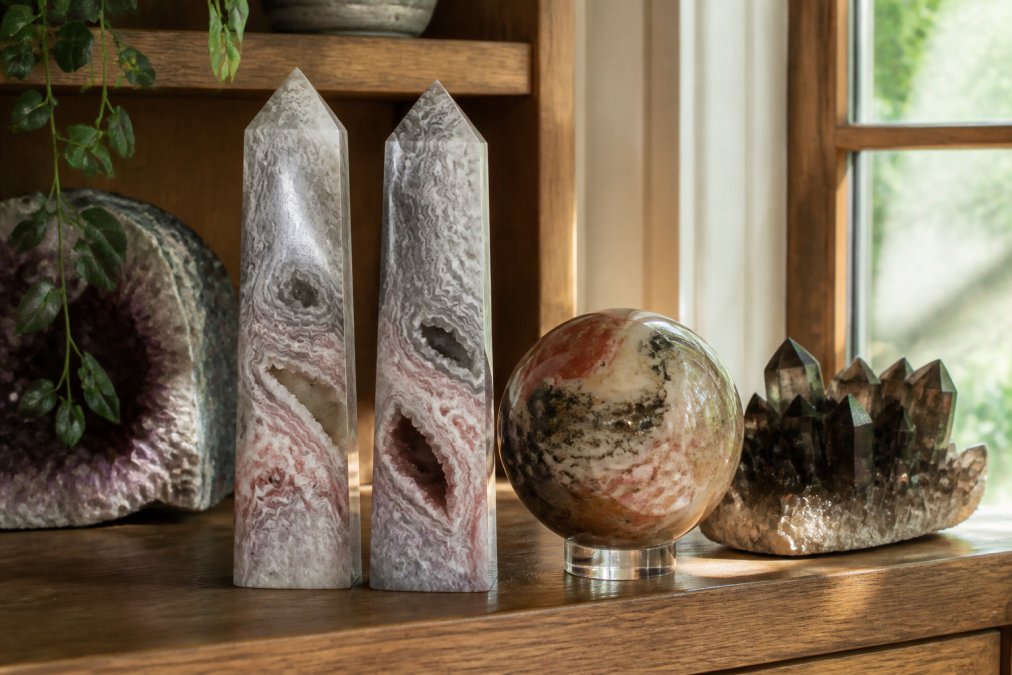
Matching Lace Agate Tower Pair ($129.99)
Two natural lace agate towers, each roughly 11 inches tall, sold as a matched set. Soft lavender gray, cream, and taupe banding runs through both pieces with subtle druzy accents and polished six-sided points. Matched pairs at this height are uncommon because most agate is cut into single towers.
Scenic Jasper Crystal Sphere ($120.99)
A polished orb where natural mineral veining reads like a landscape: desert tones, mossy inclusions, and dramatic seam features. Each side shows something different. This is the piece to buy if you want one object that rewards close looking.
Titanium Aura Quartz Cluster ($99.99)
Iridescent flashes in violet, green, blue, and silver across a natural druzy cluster. The listing states plainly that the piece is titanium aura treated, which is exactly the disclosure you should expect from any seller. A bold display specimen rather than a quiet one.
Natural Fossil Coral Tower ($90.00)
An 8-inch polished tower of agatized fossil coral, with hundreds of preserved coral polyps forming floral and circular patterns against charcoal gray. This is a genuine fossil, not a carving, and the pattern is the fossil itself.
Rare Picture Jasper Cube ($49.99)
A polished cube where each face reveals its own miniature landscape. Rich desert tones and painterly inclusions make it mineral art as much as a specimen. Good entry point for a new collector, and a natural desk piece.
Ethical Sourcing and Mission-Driven Buying
Ethical sourcing in the mineral trade means knowing where material comes from and avoiding supply chains tied to unsafe or unregulated mining. It's hard to verify fully, which is why seller transparency matters so much.
Conclusion: Building a Collection You Can Trust
The hard part of collecting isn't finding beautiful stones. It's finding a seller who tells you the truth about them, year after year, and stands behind the pieces when something goes wrong.
Shop IG Crystal Archive's hand-selected mineral specimens
Frequently Asked Questions
What are the best online shops for serious mineral collectors?
Serious collectors should look for shops that sell one-of-a-kind specimens, provide exact photos of the piece you will receive, and disclose any treatments. IG Crystal Archive, LLC hand-selects each specimen and ships the exact item pictured. Their inventory ranges from a $24.99 Orthoceras fossil starfish set to a $129.99 matching lace agate tower pair, so both new and advanced collectors can find museum-quality pieces without guessing what will arrive.
How can I verify the authenticity of minerals purchased online?
Ask for provenance details, treatment disclosure, and multiple angle photos before buying. Reputable shops will tell you if a specimen is natural, treated, or dyed. For example, titanium aura quartz is a treated crystal, and honest sellers say so upfront. You can also check hardness and crystal structure against known references. If a shop cannot answer basic sourcing questions, treat that as a red flag and move on to a dealer who can.
What should I look for when buying mineral specimens online?
Focus on four things: exact-piece photography, clear measurements, treatment disclosure, and a return policy. A shop that shows the actual specimen you will receive removes the biggest risk in online buying. Also confirm shipping insurance for fragile items and whether the seller uses professional packaging. IG Crystal Archive, LLC offers 30-day free returns and secure packaging, which takes the anxiety out of ordering delicate pieces like an 8-inch fossil coral tower.
Are there reputable online shops that support social causes?
Yes. Some mineral shops tie purchases to a mission. IG Crystal Archive, LLC supports autistic adults and their families, and customer Jessica T. noted that knowing her purchase supports that mission made her crystal more special. When evaluating a mission-driven shop, ask how the business is structured and whether it has been around long enough to stand behind its products. A small family business with real customer reviews and a clear return policy is a safer bet than a pop-up store with vague promises.