Buy Unique Ethically Sourced Minerals: 2026 Guide
Table of Contents
- Why Ethically Sourced Minerals Matter in 2026
- How to Identify Ethical Mineral Sellers
- The Benefits of Buying Ethically Sourced Gemstones
- Verification Checklist for Conscious Consumers
-
10 Unique Ethically Sourced Minerals Worth Collecting
- Citrine Quartz Geode Sphere
- Calligraphy Jasper Tower
- Rare Picture Jasper Cube
- Scenic Jasper Crystal Sphere
- Large Raw Black Tourmaline Chunk
- Natural Druzy Agate Tower
- Natural Moss Agate Crystal Tower
- Natural Agate Geode Turtle Carving
- Natural Smoky Quartz Crystal Cluster
- XL Blue & Earth Tone Crystal Tower
- The Blood Crystal Trade and Supply Chain Transparency
- Certifications and the Carbon Footprint of Shipping
- Conclusion: Building a Collection You Can Trust
- Frequently Asked Questions
Last Updated: October 4, 2026
Why Ethically Sourced Minerals Matter in 2026
Buying unique ethically sourced minerals is now the baseline expectation for serious collectors. You are paying for a documented chain of custody, fair labor conditions, and environmental stewardship at extraction.
Conscious consumerism has moved from marketing slogan to purchasing filter, and buyers now ask questions sellers rarely had to answer five years ago.
An ethical label proves nothing on its own.
How to Identify Ethical Mineral Sellers
Identifying ethical mineral sellers comes down to one test: can they answer specific questions about a specific stone without hiding behind marketing language? A seller who knows their supply chain answers in detail; one who does not pivots to vague reassurance.
Questions to Ask Before You Buy
Ask these before checkout, and watch how the seller responds:
- Where was this specimen extracted, and can you name the region or the mine?
- Was it sourced through artisanal mining, industrial extraction, or a wholesale distributor?
- Is the piece treated, dyed, or heat-altered in any way?
A seller who answers all six earns trust; one who answers two and deflects the rest is telling you something.
The Verification Checklist Buyers Rarely Get
Here is what transparency looks like when you verify it yourself:
- Ask for the mine name, not just the country. "Brazil" covers thousands of operations. A named mine, cooperative, or licensed claim is a real data point you can cross-reference.
- Ask who issued any certification and check it directly. If a seller claims a piece is "fair trade certified," ask for the certifying organization's name and certificate number, then look it up on that organization's own site. A certificate you cannot independently verify is marketing, not certification.
- Ask whether the piece is treated, and get it in writing. Dyed agate, heat-treated amethyst, and irradiated quartz are extremely common. A seller who cannot state treatment status plainly is either uninformed or avoiding the question.
- Ask for the actual piece's photo, not the category photo. If the same image appears across ten listings, you are buying a category, not a specimen.
- Ask what happens if the origin claim turns out to be false. A written return or refund policy tied to authenticity claims is a real commitment. A verbal promise is not.
Red Flags That Signal Greenwashing
Greenwashing follows predictable patterns:
-
Vague origin claims. "Sourced responsibly" with no country, region, or mine named.
-
Borrowed certification language. Implying certification without naming the certifying body or providing a certificate number.
-
Invented or unverifiable seals. A logo that looks official but does not correspond to any organization you can find and contact.
-
Price that does not add up. Fair wages and traceable supply chains cost money. A price far below market usually means someone upstream absorbed the difference.
-
No named human on the other end. A shop that cannot say who selects its specimens, or where its buying team is based, is usually reselling from an aggregator.
The difference between a transparent seller and a greenwashed one is specificity: vague language, and refusing to put a claim in writing.
The Benefits of Buying Ethically Sourced Gemstones
The benefits of buying ethically sourced gemstones extend beyond personal satisfaction: traceable sourcing protects workers, reduces ecological damage at extraction sites, and preserves your collection's long-term value.
A specimen with documented gemstone provenance holds its story, and story separates a display piece from an investment.
At IG Crystal Archive, each specimen is hand-selected and inspected before listing, and we support autistic adults and their families.
Verification Checklist for Conscious Consumers
Use this checklist before any purchase. It takes five minutes and prevents most bad buys.
- Seller names the country or region of origin for the specific piece
- Treatment status is stated plainly (natural, dyed, heat-treated, or unknown)
- Seller can describe their sourcing relationship, not just their supplier's name
10 Unique Ethically Sourced Minerals Worth Collecting
Every piece below is a one-of-a-kind specimen. Here is what makes each worth collecting.
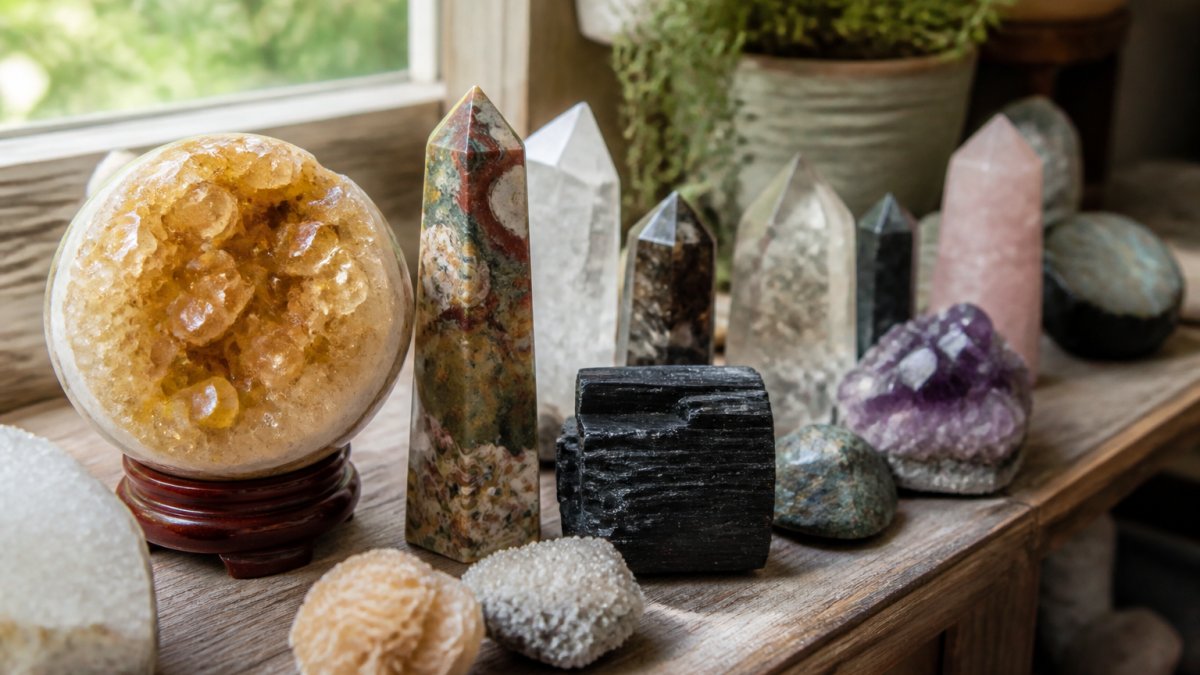
Citrine Quartz Geode Sphere
A citrine-colored quartz geode with an open crystal cave of golden, honey, and deep amber points. The dark outer matrix creates real contrast, and at roughly 2 inches wide it works as a desk or shelf accent. One-of-a-kind. $49.99.
Calligraphy Jasper Tower
Calligraphy jasper, sometimes called script or Mariyam jasper, forms natural patterns resembling flowing handwriting. Each side of this polished tower shows a different design in brown, gold, and tan tones. $69.99.
Rare Picture Jasper Cube
A polished picture jasper cube where each face reveals its own miniature landscape. Desert tones and painterly inclusions make it read as mineral art, and it doubles as a desk object or paperweight. $49.99.
Scenic Jasper Crystal Sphere
A polished collector sphere with landscape patterning, earthy mineral veining, and desert tones throughout. It displays like a miniature world. This is the statement piece in the group at $120.99.
Large Raw Black Tourmaline Chunk
Raw black tourmaline with natural vertical striations and a substantial, weighty feel. Perfect for an entryway, a grounding practice, or a collector who prefers unpolished specimens. $109.99.
Natural Druzy Agate Tower
Soft gray, cream, and white banding surrounds a sparkling quartz druzy center. Polished into a six-sided tower roughly 5 inches tall while preserving the raw crystal cavity. $54.99.
Citrine Quartz Geode Sphere | Golden Crystal Cluster | Open Cave Quartz Display →
Natural Moss Agate Crystal Tower
Deep forest green tones with white and gray inclusions that look like moss frozen in stone. About 5 inches tall, six-sided, high polish, and the most affordable entry point in the list at $34.99.
Natural Agate Geode Turtle Carving
Hand-carved from natural agate and quartz, with a dramatic geode cavity running through the shell. Roughly 4.25 inches long. Turtles carry associations with longevity, grounding, and patience, which makes this a strong gift piece. $89.00.
Natural Smoky Quartz Crystal Cluster
A dense cluster of dark brown translucent points on natural matrix, about 3 inches tall by 2.5 inches wide. Unpolished, with glossy terminations and visible translucency when lit. $64.00.
XL Blue & Earth Tone Crystal Tower
At roughly 15 inches tall, this is the largest piece here. Deep blue washes over olive, tan, and rust-toned matrix, with veining that changes on every side. $119.99.
| Specimen | Price | Size | Best For |
|---|---|---|---|
| Citrine Quartz Geode Sphere | $49.99 | Approx. 2" | Desk and shelf accents |
| Calligraphy Jasper Tower | $69.99 | Tall polished point | Statement decor |
| Rare Picture Jasper Cube | $49.99 | Geometric cube | Desk display, paperweight |
| Scenic Jasper Crystal Sphere | $120.99 | Collector orb | Centerpiece display |
| Large Raw Black Tourmaline | $109.99 | Substantial raw chunk | Entryway, grounding |
| Natural Druzy Agate Tower | $54.99 | Approx. 5" | Bookshelf, office |
| Natural Moss Agate Tower | $34.99 | Approx. 5" | Entry-level collecting |
| Agate Geode Turtle Carving | $89.00 | Approx. 4.25" | Gifting, symbolism |
| Smoky Quartz Cluster | $64.00 | Approx. 3" x 2.5" | Raw specimen collectors |
| XL Blue & Earth Tone Tower | $119.99 | Approx. 15" | Large-scale statement |
The Blood Crystal Trade and Supply Chain Transparency
A stone can pass through four or five hands before reaching a retail listing, and each hand blurs origin.
That reflects how fragmented small-scale mining is, not bad faith.
Asking a seller where a piece came from really asks which model they operate in. The answer tells you almost everything.
Certifications and the Carbon Footprint of Shipping
Certification in the mineral trade is less standardized than in coffee or diamonds, so scrutinize any product-page label before relying on it.
Which Certifications Actually Hold Weight
No single global certification covers all minerals the way Fairtrade covers coffee or the Kimberley Process covers rough diamonds. What exists is a patchwork:
- Kimberley Process Certification Scheme. A government-backed program that applies specifically to rough diamonds and keeps conflict diamonds out of legitimate trade. It does not cover colored gemstones, quartz, jasper, or most collector minerals. If a seller implies it covers a non-diamond specimen, that is a misunderstanding or a misrepresentation.
- Fairmined and Fairtrade Gold. These programs certify gold from artisanal and small-scale mines and include environmental and labor standards. They apply to gold, not gemstones or mineral specimens.
- Responsible Jewellery Council (RJC). A membership and certification body for companies in the jewelry supply chain, covering business practices, human rights, and environmental performance. It certifies businesses, not individual stones, so a member's certification does not automatically extend to every specimen it sells.
The takeaway: if a seller names a certifying body, look it up on that body's own website and confirm the certificate number. If they say "certified" without naming anyone, treat it as unverified. If they claim a certification covers a mineral type it does not, that is a red flag about everything else they say.
The Carbon Footprint of Shipping
The carbon footprint of shipping matters more than most collectors consider, because minerals are heavy and travel far. A large specimen can weigh several kilograms, and air freight multiplies the impact per kilogram versus sea freight.
What actually reduces the footprint per piece:
-
Consolidated shipping. Combining multiple pieces into one parcel cuts packaging waste and emissions per specimen. Ask before checkout; many small shops will accommodate the request.
-
Sea freight for bulk orders. Slower, but far lower emissions per kilogram than air. Buyers ordering in volume can ask whether sea freight is an option.
-
Buying closer to the source region. A specimen that travels one border crossing has a smaller logistics footprint than one that crosses three.
The Trade-Off Nobody Names
There is real tension between traceability and carbon footprint. A seller buying directly from a small mine may have a shorter, more transparent chain but ships small batches by air. A large distributor may consolidate by sea but blur origin. Neither is automatically better. Ask which trade-off a seller made, and whether they will tell you honestly.
Conclusion: Building a Collection You Can Trust
The hard part of collecting is not finding beautiful stones but finding stones whose story you can stand behind.
We built IG Crystal Archive around that idea.
Get started with IG Crystal Archive and build a collection where you know exactly what you own and why it matters.
Frequently Asked Questions
What does it mean for minerals to be ethically sourced?
Ethically sourced minerals are extracted and traded in ways that protect workers, communities, and the environment. This includes fair wages, safe labor conditions, no child labor, and minimizing ecological damage. For crystals, it also means knowing the geological origin and having supply chain transparency from mine to market. When you buy unique ethically sourced minerals, you are supporting responsible sourcing practices and can feel confident the specimen was not tied to conflict or exploitation.
How can I verify if a crystal shop is ethical?
Start by asking where their specimens come from and whether they can name the geological origin or mine. Look for clear supply chain transparency, third-party certifications, and a willingness to answer questions about labor conditions. A trustworthy seller will not hesitate to share details. You can also check for membership in fair trade organizations or read independent reviews. If a shop cannot explain its sourcing, treat that as a red flag.
Are there certifications for ethically sourced minerals?
Yes, several certifications and standards exist, though they are not as widespread as in other industries. Look for fair trade certification, conflict-free designations, and responsible sourcing programs. Some organizations verify mine-to-market traceability and ethical certification for small-scale mining. Always check that a certification is legitimate and applies to the specific mineral. A certification database can help you confirm a seller's claims rather than relying on marketing language alone.
Why is ethical sourcing important in the mineral trade?
Ethical sourcing prevents human rights abuses, child labor, and environmental destruction. Traditional extraction can pollute water, damage ecosystems, and put workers at risk. By choosing ethically sourced minerals, you support fair wages, safer labor conditions, and environmental stewardship. It also protects the long-term availability of unique specimens. Conscious consumerism pushes the entire industry toward better practices, from small-scale mining to retail sustainability.
How does ethical sourcing impact the price of minerals?
Ethically sourced minerals often cost more because fair wages, safer working conditions, and environmental protections add expense. You may pay a premium compared to unverified or mass-market stones. However, that higher price reflects responsible sourcing and often better specimen quality. For collectors, the extra cost supports a supply chain you can trust and ensures your purchase does not fund exploitation. Think of it as an investment in both the specimen and the people who mined it.