Crystal Curation: Confidence in Holistic Wellness Quality
Table of Contents
- Why Crystal Curation Matters for Holistic Wellness
- How to Identify Quality Crystals Before You Buy
- How to Choose Crystals for Home Decor
- Crystal Decor Ideas for Living Room Spaces
- Meaningful Crystal Gifts That Match the Person
- Matching Crystals to Your Wellness Goals
- Measuring Outcomes and Reassessing Your Collection
- Frequently Asked Questions
Last Updated: October 21, 2026
Why Crystal Curation Matters for Holistic Wellness
Confidence in quality through crystal curation for holistic wellness starts with one truth: the person who selects your crystal matters as much as the stone.
Curation is the filter between a mine and your shelf, answering what buyers actually ask: Is this authentic? Was it dyed or heat-treated?
Holistic wellness means caring for the whole person, body, mind, and spirit.
Crystal buying is a trust question, not a taste question.
How to Identify Quality Crystals Before You Buy
Quality crystals show natural variation, honest weight, and clear treatment disclosure. A stone identical to every other on the page is usually dyed, reconstituted, or mass-produced.
Reading Natural Inclusions and Color Variation
Inclusions, the tiny lines, clouds, and flecks inside a stone, are proof of natural formation, not flaws. A cheap clear quartz with no inclusions deserves a second look.
Color should shift slightly across a piece: Rainbow Fluorite bands in purple, white, and golden yellow; Bloodstone shows gray with red flecks. Flat, uniform color means you should ask how it got that way.
Questions to Ask About Sourcing and Treatment
Ask these before you pay:
- Where was this piece mined or sourced?
- Has it been dyed, heat-treated, irradiated, or stabilized?
- Can you send additional photos or a short video of the exact piece?
A seller who answers these clearly is telling you something. A seller who dodges them is telling you more.
How to Choose Crystals for Home Decor
Choose crystals for home decor by starting with the room, not the stone. Match size to the surface, color to the palette, and finish to the light.
Work through it in order:
- Measure the surface and note the height available above it.
- Photograph the space in daylight to see the true wall and furniture colors.
- Pick a color family that either blends or deliberately contrasts.
- Choose a shape that fits: towers for vertical space, spheres for low bowls, hearts for shelves.
- Check the finish. Polished pieces catch light; raw pieces read more natural.
Our Natural Crystal Tower Set of 3 ($74.99) is a good example of a coordinated choice: Caribbean Calcite, Rainbow Fluorite, and Bloodstone at roughly 3 to 3.25 inches tall, sized to sit together without crowding.

Crystal Decor Ideas for Living Room Spaces
Living room crystal decor works best in groups of three or fewer, placed where the eye already rests: shelf ends, coffee table trays, mantel corners.
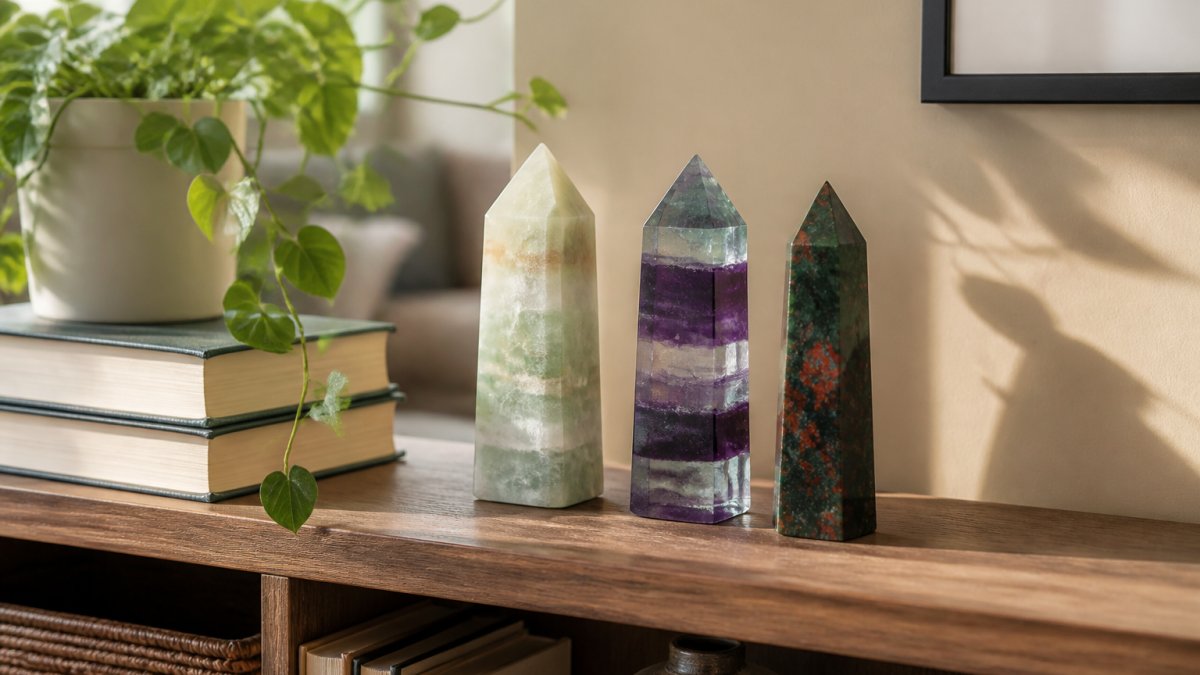
A few arrangements that hold up in practice:
- Shelf trio: three towers of different heights on one shelf, spaced a hand-width apart.
- Coffee table anchor: one sphere on a stand, paired with a low bowl or a candle.
- Bookend pair: a heart and a tower flanking a short stack of books.
Keep deep-colored pieces out of all-day sun and off the floor in high-traffic rooms. Rotate seasonally, because a collection you can see fully stops being interesting.
The Amazonite Gift Set with Opalite Sphere ($80.99) solves the arrangement problem for you: a sphere, a tower, a heart, and a matching stand in one ocean-toned palette.

Meaningful Crystal Gifts That Match the Person
Meaningful crystal gifts start with the recipient's space and temperament, not the stone's reputation. A gift that fits someone's shelf gets displayed; one that fits a trend gets drawer storage.
Match the gift to the person:
- For a new collector: a small coordinated set, so they have a starting display.
- For someone who wears jewelry: a beaded bracelet in a color they already wear.
- For a decor-focused friend: a tower or sphere with a stand.
Our Tiger's Eye Crystal Bracelet ($22.00) is traditionally associated with confidence, courage, grounding, and protection, which makes it an easy gift for a graduate, a new job, or a big move. The Mixed Gemstone Crystal Bracelets ($16.00) let you pick a color story: Peach Sunstone, Earthy Jasper, or a mixed palette.

Matching Crystals to Your Wellness Goals
Match crystals to wellness goals by naming the goal first, then choosing a stone and a practice together. A crystal on a shelf with no routine is decor; one you handle or meditate with daily becomes a wellness practice. What separates a used piece from an ignored one is whether the choice fit the person's actual life.
A simple framework:
Mixed Gemstone Crystal Bracelets | Natural Stone Stretch Bracelet | Chunky →
- Name the goal in plain words. "I want to feel calmer at night." "I want more confidence before meetings." Vague goals produce vague practices.
- Pick one stone, not five. Tiger's Eye for confidence, for example, or a calming blue-green piece for evening wind-down. A single piece is easier to attach to a habit and easier to evaluate later.
- Attach it to an existing habit. Hold it during your evening meditation. Keep it by your desk for stressful calls. The habit is the mechanism; the stone is the cue.
- Set a review date. Thirty days out, ask whether the practice stuck.
Decision Criteria Beyond the Stone
Most guides stop at "pick a stone for your intention." The harder part is matching a piece to your health context, preferences, and access, the factors that determine whether a wellness practice survives a normal week.
- Health context. If you manage a diagnosed condition, are pregnant, or take prescription medication, treat any wellness purchase as a complement to care, not a substitute. Ask your clinician before building a routine around it; the routine can crowd out sleep, movement, or treatment if you let it.
- Sensory preferences. Some find polished spheres soothing; others find them distracting. Raw clusters offer texture; tumbled stones fit in a pocket. Choose the finish you will actually touch, handling turns a display piece into a practice.
- Space and accessibility. A piece on a high shelf you cannot reach will not become a habit. If mobility or reach is a constraint, choose a smaller piece for a desk or nightstand rather than a large cluster for a mantel.
A Practical Matching Table
Use this as a starting point, not a prescription. The right column is the part most guides skip.
| Goal in plain words | Stone to consider | Practice to attach it to | What to check first |
|---|---|---|---|
| Calmer evenings | A blue-green or fluorite piece | Hold during a 5-minute wind-down | Does it fit your nightstand and your sleep routine? |
| Confidence before meetings | Tiger's Eye | Keep by the desk; hold before calls | Is it small enough to stay out of the way? |
| Grounding during transitions | Bloodstone or a dark, grounded tone | Pocket or tray by the door | Will you actually carry it? |
| A gift for a new collector | A coordinated small set | Display, then build a routine | Does the recipient have shelf space? |
Where Wellness Support Ends and Medical Care Begins
Crystals can support a routine but do not diagnose, treat, cure, or prevent any condition. For persistent anxiety, low mood, sleep problems, or pain, talk to a qualified health professional, a primary care physician, licensed therapist, or registered dietitian.
A useful test: if a seller implies a stone can replace treatment, that is a reason to walk away, not a reason to buy. Confidence in quality starts with honest boundaries.
This is where personalized care beats generic advice. A stone that suits your routine gets used. A stone that suits a trend gets ignored.
Measuring Outcomes and Reassessing Your Collection
Measure outcomes by tracking the practice, not the stone. The value of a piece often comes from the habit it anchors, and habits are measurable in ways metaphysical claims are not, the honest way to know whether your curation is working.
Try a simple log:
| What to track | How to record it | Why it matters |
|---|---|---|
| Practice frequency | Days per week you used the piece | Shows whether the routine stuck |
| Mood before and after | A 1-5 rating, morning and evening | Reveals patterns over weeks |
| Display satisfaction | Does the piece still fit the space? | Flags pieces to rotate or gift |
| Sleep quality | Rough hours and restfulness | Connects evening routines to rest |
Keep the log four to six weeks before judging anything. A single day tells you nothing; a month-long pattern tells you whether the practice is working.
A Stop, Adjust, or Continue Rule
Reassess every few months. Ask three questions: Is this piece still displayed? Is it still part of a routine? Would I choose it again today?
Then apply a simple rule so the decision is not a matter of mood:
- Continue if the piece is displayed, the practice is happening at least a few times a week, and your log shows a stable or improving trend on the outcome you named.
- Adjust if the piece is displayed but the practice is not happening. Change the habit anchor, move the stone to where the routine already occurs, before you blame the stone.
- Stop if the piece is stored, the practice has lapsed for a month or more, and the log shows no change. Gift it, store it, or move it to a different room. A curated collection is one you keep choosing, not one you accumulate.
If the answer to two or more of the three questions is no, rotate the piece out. That is not failure; it is the curation process working.
How to Judge Evidence Quality Before You Buy
Most wellness guides skip this, yet it separates confidence from marketing. Before building a routine around any product or practice, ask how the claim is supported.
- Distinguish traditional use from tested claims. Tiger's Eye has a long traditional association with confidence, cultural context, not clinical evidence. Both can be meaningful; they are not the same.
- Look for specific, checkable language. "Traditionally associated with calm" is honest. "Clinically proven to reduce anxiety" is a claim that requires a citation, and a seller who makes it should be able to provide one.
- Check the sourcing and treatment disclosure. A trustworthy listing tells you where a piece was sourced and whether it was dyed, heat-treated, irradiated, or stabilized. If that information is missing, ask.
Curation Conflicts of Interest and Disclosure
A curated collection is only as trustworthy as the disclosure behind it.
Ask any seller, including us, three questions:
- How are pieces selected? Is there a stated standard, inspection for chips and cracks, sourcing verification, treatment disclosure, or is selection a matter of what sells?
- What is excluded, and why? A curator who can name what they reject is more credible than one who claims everything is premium.
- Are there affiliate or sponsorship relationships? If a recommendation earns the seller money, say so. Disclosure does not weaken a recommendation; hiding it does.
At IG Crystal Archive, LLC, every piece is hand-selected and inspected, and we tell you what we look for. We do not claim neutrality, we sell what we select.
Quality standards, safety standards, and transparent sourcing are the backbone of a collection you can trust. Ask about them every time, from every seller, including us.
Frequently Asked Questions
How do I know a crystal is authentic and not dyed or treated?
Look for natural variation: uneven color, visible inclusions, and slight differences between pieces. Dyed stones usually show color pooling in cracks and identical saturation across every bead. Ask the seller directly whether a specimen has been treated, and check whether the listing shows the exact piece you'll receive. IG Crystal Archive photographs each hand-selected specimen, and customer Emily R. noted her crystal 'arrived exactly as pictured.' If a seller won't answer sourcing questions, that silence tells you something.
What should I look for when buying a crystal specimen online?
Start with clear photos of the actual piece, stated dimensions, and a description of any natural chips or inclusions. Confirm the seller's return policy before checkout. IG Crystal Archive offers a 30-day free returns window, which removes much of the risk of buying a specimen you haven't held. Also check whether the listing specifies the exact piece versus a representative photo, and whether the seller explains why they selected it. That context is what separates crystal curation from a random drop-ship listing.
How do I choose a meaningful crystal gift for someone else?
Match the stone to the person's situation rather than your own taste. Tiger's Eye is traditionally associated with confidence and grounding, which suits someone starting a new job or facing a big transition. For a gift that works in almost any home, a coordinated set like the Amazonite Gift Set with Opalite Sphere ($80.99) gives the recipient a complete display out of the box. Ask about the recipient's existing decor colors so the piece fits their space, and include a note explaining why you chose it.
Why do curated crystals cost more than loose stones from big retailers?
Curation adds labor: inspecting each specimen, photographing the exact piece, describing its natural features, and packing it securely. A $74.99 three-tower set includes Caribbean Calcite, Rainbow Fluorite, and Bloodstone, each checked for chips and photographed individually. That work is what lets you buy with confidence instead of hoping the piece matches a stock photo. Customer Amanda L. put it plainly: 'I've ordered crystals from many shops, and IG Crystal Archive stands out.'