Crystals That Cannot Be Together: A Pairing Guide
Table of Contents
- Understanding Crystal Pairing and Energy
- Crystal Combinations to Avoid and Why
- What Not to Pair with Black Tourmaline
- Which Crystals Can You Wear Together
- How to Store Crystals Together Safely
- Physical Compatibility and Mineral Properties
- What to Do If You've Already Combined Incompatible Crystals
- Evaluating Crystal Pairings: A Practical Method
- Frequently Asked Questions
Last Updated: October 19, 2026
Understanding Crystal Pairing and Energy
Understanding which crystals that cannot be together matters more than most guides acknowledge. The idea that certain crystals clash isn't just spiritual belief, it's also rooted in how mineral properties interact when stored or worn in proximity.
Collectors often combine stones without considering whether their energetic or physical properties align. Some crystals amplify each other; others are thought to cancel each other out.
Crystal pairing means combining two or more stones intentionally, wearing, meditating with, or storing them together. Some combinations enhance your intention; others may dilute it.
Crystal Combinations to Avoid and Why
Certain crystal pairings are widely considered incompatible because they're believed to carry opposing energies.
Clashing energies center on the idea that crystals vibrate at different frequencies. Pair an energizing crystal with a deeply calming one and they may work against each other rather than in harmony, especially when worn or meditated with actively.
Carnelian and Amethyst
Carnelian is known for its warm, energizing properties. It's often used to boost motivation, courage, and creative fire. Amethyst, by contrast, is a calming stone associated with peace, spiritual awareness, and restful energy.
Worn or meditated with simultaneously, their opposing energies can create confusion, you're asking your mind and body to be both activated and calm at once. Many practitioners recommend keeping them separate when using them intentionally.
If you want both energies, wear Carnelian during the day for motivation and switch to Amethyst in the evening for relaxation, letting each stone work without competing vibrations.
Citrine and Amethyst
Citrine is prized for its bright, uplifting energy and its association with abundance and manifestation. Amethyst again appears here as the calming counterpart, a stone of introspection and spiritual depth.
The dynamic mirrors Carnelian and Amethyst: one stone pushes outward, the other draws inward. If you're manifesting abundance, Amethyst's introspective energy may dilute Citrine's outward power; if you're seeking peace, Citrine's stimulating vibration works against you.
A practical alternative is to use Citrine in your workspace or carry it when you need motivation, then place Amethyst on your nightstand or meditation altar for evening and reflective practices.
Red Jasper and Blue Lace Agate
Red Jasper carries grounding, stabilizing energy. It's associated with strength, endurance, and root chakra work. Blue Lace Agate, conversely, is linked to communication, throat chakra clarity, and gentle expression.
These stones don't cancel each other out, but they address different energetic needs, and combining them without intention can scatter your focus. If you're working on grounding, Blue Lace Agate's communicative energy may pull your attention upward.
Use Red Jasper when you need stability and grounding. Save Blue Lace Agate for times when you're working on clear communication or need to soften your expression.
Moldavite and Most Other Crystals
Moldavite is a rare, high-vibration stone formed from a meteorite impact. Collectors describe its energy as intense and transformative, so it's often considered incompatible with gentler, slower-vibration stones.
Pairing Moldavite with softer crystals like Rose Quartz or Lepidolite can feel jarring, its intensity tends to overpower more delicate energies, making the other stone almost unnoticeable.
If you work with Moldavite, use it alone or pair it only with other high-vibration stones like Clear Quartz or Black Tourmaline, so its power doesn't overshadow gentler stones.
What Not to Pair with Black Tourmaline
Black Tourmaline is a protective stone used to shield against negative energy and create psychic boundaries. The table below follows the same pattern as the Carnelian and Amethyst pairings: the claimed conflict, why practitioners say it happens, and a compatible alternative.
| Pairing | Claimed conflict | Why practitioners say it clashes | Compatible alternative |
|---|---|---|---|
| Black Tourmaline + Rose Quartz | Shielding vs. heart-opening | Black Tourmaline sets boundaries; Rose Quartz invites emotional openness. Used together, the boundary can feel like a wall against the very vulnerability Rose Quartz is meant to encourage. | Pair Black Tourmaline with Smoky Quartz for grounding protection, and keep Rose Quartz for personal spaces. |
| Black Tourmaline + Moonstone | Boundary-setting vs. emotional flow | Moonstone is linked to intuition and emotional flow; Black Tourmaline's heavy, shielding quality can feel like it damps that flow. | Use Moonstone with Clear Quartz to amplify intuition, and reserve Black Tourmaline for entryways or desks. |
| Black Tourmaline + Selenite | Heavy grounding vs. crown-chakra clarity | Selenite is associated with crown-chakra clarity and a light, upward energy; Black Tourmaline pulls attention downward and inward. | Keep Selenite on a meditation altar or windowsill; use Black Tourmaline in a protective grid instead. |
| Black Tourmaline + Citrine | Protection vs. outward manifestation | Citrine pushes outward toward abundance and action; Black Tourmaline's shielding energy can feel like it holds that outward push back. | Pair Citrine with Green Aventurine for abundance work, and use Black Tourmaline separately when you need protection. |
A useful rule of thumb: Black Tourmaline pairs best with stones sharing its grounding, protective character, such as Smoky Quartz, Hematite, or Obsidian. Stones that ask you to open up, flow, or reach upward are the ones practitioners most often separate from it.
If you're using Black Tourmaline for protection, keep it separate from heart-opening or intuitive stones. Place it in your entryway, on your desk, or in a protective grid, and reserve Rose Quartz and Moonstone for personal spaces.
Which Crystals Can You Wear Together
Not every crystal pairing is incompatible. Many stones work beautifully together, amplifying each other's effects or creating balanced energy.
Clear Quartz is one of the most versatile crystals to wear with others.
Green Aventurine and Tiger's Eye complement each other well. Green Aventurine brings calm, heart-centered abundance, while Tiger's Eye adds confidence and grounding. Together, they support both emotional openness and practical action.
Smoky Quartz and Black Tourmaline work together because they share similar protective, grounding energy. Wearing both enhances your sense of safety and stability without creating conflicting vibrations.
Consider your intention first. To balance two energies, choose stones sharing a similar vibration or chakra focus, pairing Selenite (crown chakra clarity) with Amethyst (spiritual awareness), rather than mixing crown and root chakra stones.
How to Store Crystals Together Safely
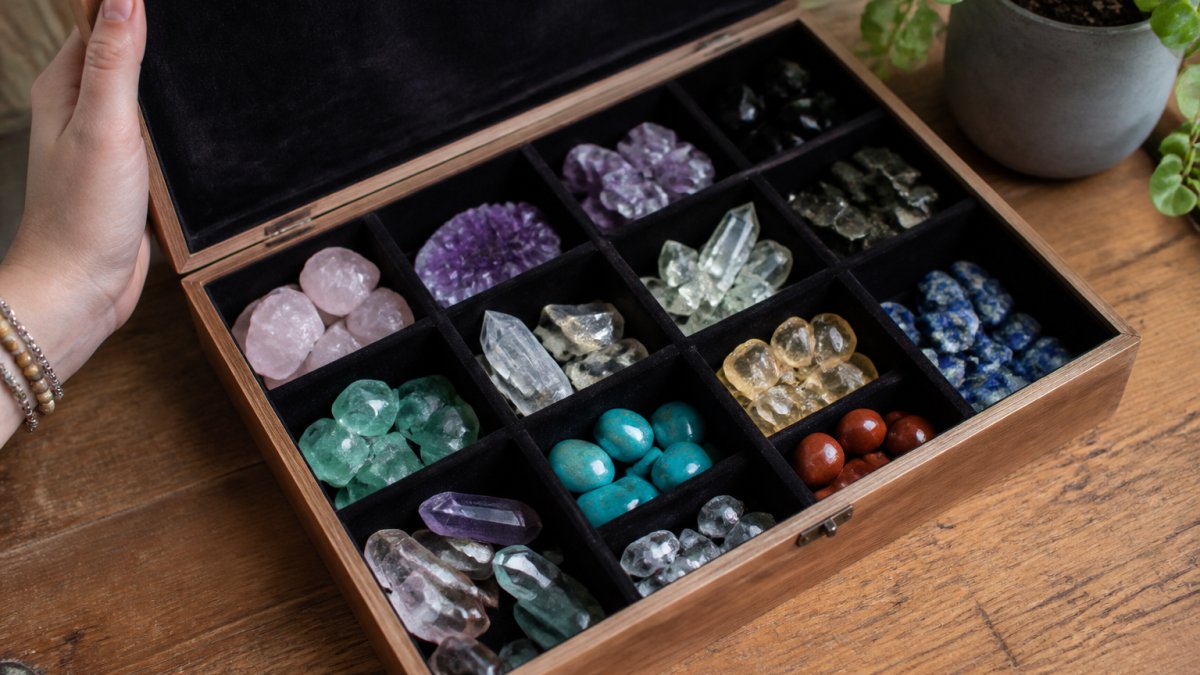
Storage matters as much as wearing or meditating with crystals, and it's the one area where the advice is practical rather than spiritual. Two questions often get mixed together: whether stones are energetically compatible, and whether they're physically safe to store side by side. The second has concrete, checkable answers.
Separate by hardness, not just by energy
The Mohs hardness scale runs from 1 (talc) to 10 (diamond) (Mohs Hardness Scale). A stone can scratch any stone with a lower number. Selenite sits around 2, so it is easily scratched by Quartz (7), Tourmaline (7-7.5), or any harder stone it shares a compartment with. Keep soft stones in their own pouch or compartment.
| Stone | Approximate Mohs hardness | Storage note |
|---|---|---|
| Selenite | 2 | Soft; scratches easily and dissolves in water |
| Malachite | 3.5-4 | Soft; sensitive to heat and acids |
| Fluorite | 4 | Soft; chips and scratches easily |
| Amethyst | 7 | Durable, but fades in prolonged direct sunlight |
| Citrine | 7 | Durable, but heat-treated color can fade in sunlight |
| Quartz | 7 | Hard; can scratch softer stones |
| Black Tourmaline | 7-7.5 | Hard; safe with other hard stones |
Watch for moisture-sensitive stones
Selenite can dissolve if exposed to water for extended periods, and Malachite is sensitive to moisture and heat. Storing either near stones that might accumulate condensation, or cleaning them with water, can cause gradual damage. Keep moisture-sensitive stones in a dry compartment away from windows and humid rooms.
Protect color from light
Amethyst and Citrine both fade in direct sunlight. Keep the entire collection away from bright windows to preserve color and vibrancy. A closed box or a shelf away from direct sun solves this for the whole collection at once.
Keep temperature stable
Rapid temperature changes can cause some stones to crack or shift. Store your collection in a stable environment, not near heating vents, air conditioning units, or windows where temperature varies throughout the day.
Then apply the energetic rule
Once the physical risks are handled, separate energetically incompatible pairs the same way: store them in separate compartments or containers. In a divided wooden box, place Carnelian in one section and Amethyst in another. For high-vibration stones like Moldavite, consider individual pouches or wrapped storage.
If you're storing crystals that do complement each other, like Clear Quartz with other stones, or Black Tourmaline with Smoky Quartz, group them intentionally, a "protection grid" corner or a "heart chakra" section of your storage space.
Physical Compatibility and Mineral Properties
Temperature fluctuations can also affect crystals. Rapid temperature changes can cause some stones to crack or shift. Store your collection in a stable environment, not near heating vents, air conditioning units, or windows where temperature varies throughout the day.
What to Do If You've Already Combined Incompatible Crystals
If you've already paired crystals considered incompatible, don't panic, separating them is straightforward, with no lasting damage to worry about.
First, identify which crystals you want to keep together and which to separate. If you've worn Carnelian and Amethyst together without noticing negative effects, you may simply prefer their combined energy, a valid choice.
If you do want to separate incompatible pairs, simply move one stone to a different location. Wear it at a different time of day, store it in a separate container, or gift it to someone else.
Some collectors reconsider pairings based on current intention. You may have paired two stones months ago for one purpose, but your intention has shifted; separating them now lets you use each stone more intentionally.
Evaluating Crystal Pairings: A Practical Method
Rather than memorizing lists of incompatible crystals, develop a simple method for evaluating any pairing yourself.
Step 1: Identify the primary energy of each stone. Is it energizing or calming? Grounding or uplifting? Protective or open?
Step 2: Check for opposition. Do the energies work against each other, or do they complement each other?
Step 3: Consider your intention. What do you want to accomplish by pairing these stones?
Step 4: Test the pairing. Wear the stones together for a few days or meditate with them. Notice how you feel.
Understanding which crystals that cannot be together helps you build a collection that serves your intentions effectively.
Frequently Asked Questions
Which crystals can you wear together?
Crystals with complementary energies typically pair well together. Clear Quartz amplifies most stones, making it a versatile pairing option. Green Aventurine works well with Rose Quartz for emotional balance, while Tiger's Eye combines nicely with Black Tourmaline for grounding and protection. The key is choosing stones whose intended purposes support rather than oppose each other. If you're uncertain, wearing a single crystal is always a safe starting point, especially when building your collection.
Is it bad to keep crystals together?
Storing crystals together is generally safe when you're mindful of physical compatibility and energetic intentions. Hard stones like Clear Quartz and Black Tourmaline can be stored side by side without damage. However, softer minerals such as Selenite or Moonstone need separate compartments to prevent scratching. From an energetic perspective, pairing crystals with opposing intentions, like energizing Citrine with calming Amethyst, may reduce their individual effects, so grouping stones by intention often works better for practitioners.
What not to pair with black tourmaline?
Black Tourmaline is a protective, grounding stone that works best alone or with other grounding stones like Smoky Quartz or Red Jasper. Avoid pairing it with highly energizing or uplifting crystals like Citrine or Carnelian, as their active energy may conflict with tourmaline's stabilizing purpose. Moldavite is particularly incompatible due to its intense, transformative energy. If you want to combine Black Tourmaline with another stone, choose grounding alternatives like Hematite or Obsidian to maintain its protective function.
Can different crystals be stored in the same container?
Yes, different crystals can share storage space if you use proper separation methods. Compartmentalized storage boxes with velvet dividers work well to keep stones from touching and prevent physical damage. Softer minerals like Selenite, Moonstone, and Blue Lace Agate should have their own sections away from harder stones. For collectors building their practice, grouping crystals by intention, protection stones together, calming stones together, makes it easier to select complementary pairings when you need them.