Curated Crystal Sets for New Collectors: 2026 Guide
Table of Contents
- What Makes a Curated Crystal Set Different
- Quick Comparison: Curated Crystal Sets for New Collectors
- How to Start a Mineral Collection Without Overwhelm
- Crystal Identification Guide: What Beginners Need to Know
- How to Display Crystal Collections in Your Home
- Authenticity and Budget: What New Collectors Often Miss
- Frequently Asked Questions
Last Updated: October 1, 2026
What Makes a Curated Crystal Set Different
Curated crystal sets are hand-selected groups of stones chosen to work together as a collection, rather than a random assortment pulled from bulk bins. That distinction matters more than most beginners realize. At IG Crystal Archive, we offer curated sets where every piece earns its place.
The difference shows up in three ways. First, intention: a curated set has a reason for existing, whether that's chakra alignment, grounding, or simple home decor. Second, quality control: each specimen is inspected before it ships. Third, coordination: the pieces are finished to display well together.
Most budget bundles fail on all three.
Quick Comparison: Curated Crystal Sets for New Collectors
Here's how the main options from IG Crystal Archive compare for someone just starting out.
| Set | Price | Pieces | Best For |
|---|---|---|---|
| Amazonite & Opalite Gift Set | $80.99 | 4 | Calming blue-green displays |
| Carnelian Crystal Gift Set | $45.99 | 4 | Warm, bold color statements |
| Natural Crystal Tower Set of 3 | $74.99 | 3 | Tower collectors and shelf styling |
| Chip Bracelets (single) | $8.00 | 1 | Testing a stone before committing |
How to Start a Mineral Collection Without Overwhelm
The fastest way to start a mineral collection is to pick one theme and buy three to five pieces that fit it. Beginners who buy randomly end up with a drawer of unrelated stones and no display.

Here's the sequence that works:
- Choose a color family. Blues and greens, warm reds and oranges, or neutrals. This alone cuts the market in half.
- Pick a purpose. Decor, meditation tools, or metaphysical practice. Each points to different stones.
- Start with one set, not ten singles. A set gives you instant variety with a built-in theme.
- Add one piece per month. This keeps spending controlled and your collection intentional.
Crystal Identification Guide: What Beginners Need to Know
Crystal identification starts with three observable traits: color, transparency, and surface pattern. You don't need a lab to tell common stones apart, but you do need to know which traits are natural and which are added after mining.
How to Spot Dyed, Heat-Treated, and Imitation Stones
This is where most beginner guides stop short, and it is the single biggest source of buyer regret. Four checks catch the majority of problem stones:
- Look at the color in the cracks. Dye concentrates in fractures and pits. If the color is darker in the crevices and lighter on the flat faces, it is almost certainly dyed. Natural color follows the crystal structure, not the damage.
- Check for a uniform neon tone. Real Amethyst, Citrine, and Turquoise vary. A perfectly even, saturated hue across every piece in a bundle is a manufactured look, not a mined one.
- Ask about heat treatment. Heat-treated Amethyst is sold as Citrine, and heat-treated stones are common and legal, but sellers should disclose it. Untreated Citrine is pale yellow to smoky gold; the bright orange "Citrine" in most budget kits started as Amethyst.
- Test weight and temperature. Glass imitations feel lighter and warm to the touch faster than quartz-family stones, which stay cool longer. This is a rough field test, not a lab result, but it filters obvious fakes.
What Sellers Should Tell You Before You Buy
A trustworthy listing answers four questions without you having to ask:
- Is this the exact piece I will receive, or a representative photo? One-of-a-kind stones should be photographed individually.
- Is the stone natural, treated, or synthetic? "Natural" and "genuine" are not the same claim.
- What is the return window? A real return policy is the cheapest authenticity insurance you can get.
- Where did it come from? Origin is not always disclosed, but a seller who knows their supply chain usually states it.
Learn the four-question seller checklist before you learn stone names. Identification protects your display; verification protects your wallet.
How to Display Crystal Collections in Your Home
Display works best when you group by height and let natural light do the work. A shelf with one tall tower, one sphere, and one flat piece reads as intentional. Three spheres of the same size read as clutter.
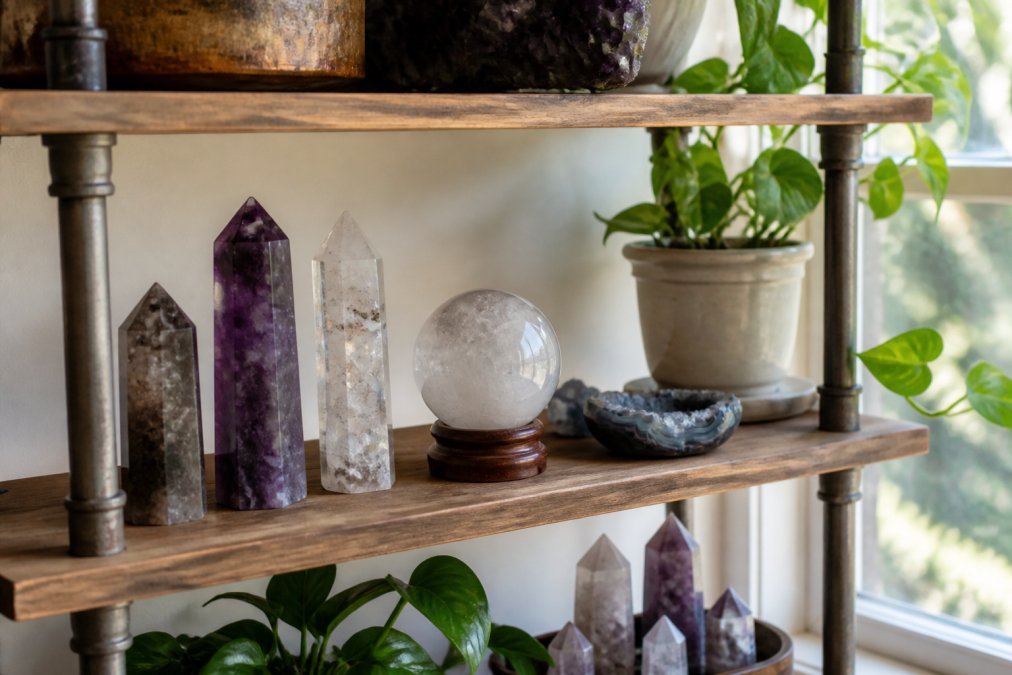
Practical display rules:
Amazonite Gift Set with Opalite Sphere →
- Vary heights. Towers at the back, spheres and hearts in front.
- Use stands. A wooden or stone stand lifts a sphere and prevents rolling.
- Keep it to five to seven pieces per surface. More than that and nothing stands out.
- Avoid direct sunlight. Prolonged UV exposure can fade Amethyst, Rose Quartz, and Fluorite over months, not days. A north-facing shelf or a spot a few feet back from a window is safer than a sunny sill.
- Separate hardness levels. Quartz (Mohs 7) will scratch Selenite (Mohs 2) and Fluorite (Mohs 4) if they rub together. Keep soft stones on their own tray or felt pad.
- Add one functional piece. A bowl doubles as a trinket dish. The Natural Blue Gray Agate Bowl at $34.99 is a good example: decor that earns its shelf space.
Storage That Protects Your Investment
Display is only half the job. Stones you are not showing still need a home:

- Soft stones get individual pouches. Selenite, Fluorite, and Calcite scratch easily. A cloth pouch per piece prevents shelf rash.
- Keep them out of humid rooms. Long-term moisture exposure can dull polished surfaces and, on porous stones like raw Pyrite, encourage oxidation.
- Label as you store. A small card with the stone name and where you bought it turns a drawer into a reference collection and makes future identification easier.
Cleansing and Charging Without Damaging the Stone
Most beginners are told to "cleanse" their crystals but not which methods are safe. The method matters as much as the intention:
- Water-safe stones: Quartz, Amethyst, and Agate tolerate a rinse. Dry fully before storing.
- Water-sensitive stones: Selenite dissolves, Halite dissolves, and Pyrite can rust. Use a dry method instead.
- Dry methods: Sound (a singing bowl or bell), smoke (incense or dried herbs), or simply resting the stone on a clean cloth overnight.
- Moonlight vs. sunlight: Moonlight is the safer charge for color-sensitive stones. Direct sun can fade the same stones you are trying to energize.
Photograph your shelf after each rotation. Over a year, the photos become a visual record of how your taste and collection have grown, useful when you decide what to add next.
Authenticity and Budget: What New Collectors Often Miss
| Stage | Budget | What to Buy |
|---|---|---|
| Week 1 | Under $20 | One chip bracelet to test a stone |
| Month 1 | $45-$80 | One curated set as your foundation |
| Month 3+ | $15-$35 | One statement piece per quarter |
Buy the set that matches a color you already love in your home. You'll display it more, and you'll learn faster because you're looking at it daily.
The scientific and metaphysical sides don't have to compete here. You can appreciate a stone for its geological origin and mineralogy while also using it for intention setting or meditation. Most collectors do both. The U.S. Geological Survey's mineral resources program is a useful reference if you want to understand where a specimen likely formed.
Frequently Asked Questions
What should be included in a crystal starter pack?
A good starter pack includes three to five pieces that give you variety without overwhelming you. Look for a mix of shapes (a tower, a sphere, a heart or freeform) and a few different stones. For example, the Natural Crystal Tower Set of 3 at $74.99 includes Caribbean Calcite, Rainbow Fluorite, and Bloodstone, giving you three distinct colors and mineral formations in one purchase. A display stand or small bowl helps you arrange them right away.
Are curated crystal sets better than buying individual stones?
Curated crystal sets save you the guesswork of matching pieces that look good together. When someone hand-selects a set, the colors, sizes, and finishes are already coordinated. Individual stones let you chase specific specimens, but for new collectors, a set like the Amazonite Gift Set with Opalite Sphere ($80.99) gives you four coordinated pieces plus a display stand in one order, which is simpler than sourcing each item separately.
How do I know these crystals are authentic and not treated or dyed?
Ask the seller directly about sourcing and treatment. Reputable shops describe natural variations openly, such as color banding, inclusions, and irregular patterns, because these are signs of genuine stone. If a listing shows uniform color with no natural variation, that's a red flag. Request photos of the exact piece you'll receive. Sellers who photograph each item individually, rather than using stock images, give you a clearer picture of what's actually arriving.
How do you organize and display a new crystal collection?
Start with one dedicated surface: a shelf, windowsill, or tray. Group pieces by height so taller towers sit at the back and smaller hearts or spheres sit in front. Use a display stand or a shallow bowl to anchor the arrangement. Rotate pieces seasonally to keep the display fresh. Keep crystals out of prolonged direct sunlight, and dust with a soft dry cloth rather than water.
What crystal is best for new beginnings?
Many collectors associate certain stones with new chapters, though these are personal and cultural associations rather than scientific claims. Amazonite, with its calm blue-green tones, is a popular choice for fresh starts. Carnelian, with its warm red-orange color, is often chosen for motivation. If you're drawn to a particular color or texture, that instinct is a fine starting point. The stone you enjoy looking at daily is the one you'll actually keep on display.
Starting a collection is easy. Building one you actually love takes a little guidance, and that's the gap IG Crystal Archive was built to close. Every specimen is hand-selected and inspected before it ships, backed by fast, reliable shipping and a 30-day free return policy. Each purchase also supports autistic adults and their families, so the piece on your shelf carries a story beyond its geology. Shop crystals at IG Crystal Archive and start with a set that was chosen, not just stocked.