High Quality Mineral Statement Pieces: 2026 Buyer's Guide
Table of Contents
- What Makes High Quality Mineral Statement Pieces Worth Buying
- Quick Comparison: 10 Hand-Selected Specimens
- Large Crystals for Home Decor: Room-by-Room Picks
- How to Identify Authentic Crystals and Spot Treatments
- Mineral Specimen Display Ideas That Showcase Natural Beauty
- Crystal Decor Gift Ideas for Every Occasion
- Care, Cleaning, and Light Sensitivity for Lasting Display
- Conclusion: Choosing Your Statement Piece
- Frequently Asked Questions
Last Updated: October 6, 2026
What Makes High Quality Mineral Statement Pieces Worth Buying
High quality mineral statement pieces are large, naturally formed or carved stone specimens selected for their visual impact, structural integrity, and one-of-a-kind character. At IG Crystal Archive, we hand-select every specimen in our collection, inspect it for quality, and photograph the exact piece you will receive. That last detail matters more than most buyers realize.
The difference between a filler crystal and a true statement piece comes down to four things: size, formation, surface condition, and how the stone behaves in the room where you plan to display it. A tower that stands 7 to 15 inches tall anchors a shelf. A smaller piece disappears into it.
Here is what most guides get wrong: they treat rarity as the only measure of value. In practice, a well-formed specimen with honest natural character often displays better than a rare stone with a dull surface. We grade on presence first.
Quick Comparison: 10 Hand-Selected Specimens
Every piece below is one of a kind. You receive the exact tower or specimen pictured.
| Piece | Height | Price | Best For |
|---|---|---|---|
| XL Blue & Earth Tone Crystal Tower | 15" | $119.99 | Floor or tall bookcase focal point |
| Honey Calcite on Gold Stand | Display height varies | $139.00 | Console or entryway, museum-style display |
| Veinless Orbicular Ocean Jasper Tower | 7.25" | $119.00 | Collectors wanting unusual patterning |
| Large Blue Kyanite Tower | 7.25" | $99.00 | Blue-toned modern interiors |
| Dark Agate with Quartz Druzy Tower | 8" | $179.00 | High-contrast shelves, up-close detail |
| Polished Fossil Coral Tower | 9.5" | $75.00 | Coastal and neutral palettes |
| Large Hematoid Quartz Tower | 8.5" | $79.99 | Warm-toned rooms, painterly veining |
| Multicolor Jasper Crystal Tower | 6" | $94.00 | Desks and smaller shelves |
| Clear Quartz Tower with Golden Inclusions | 5" displayed | $89.00 | Bright windowsills, light play |
| Natural Pyrite Druzy Freeform | 2.5" | $79.00 | Collector cabinets, metallic accents |
Prices reflect our current listings. Every order ships with our 30-day free return policy.

Large Crystals for Home Decor: Room-by-Room Picks
Living rooms reward height. A 15-inch tower like our XL Blue & Earth Tone Crystal Tower gives a bookcase or media console a vertical anchor that smaller pieces cannot match.
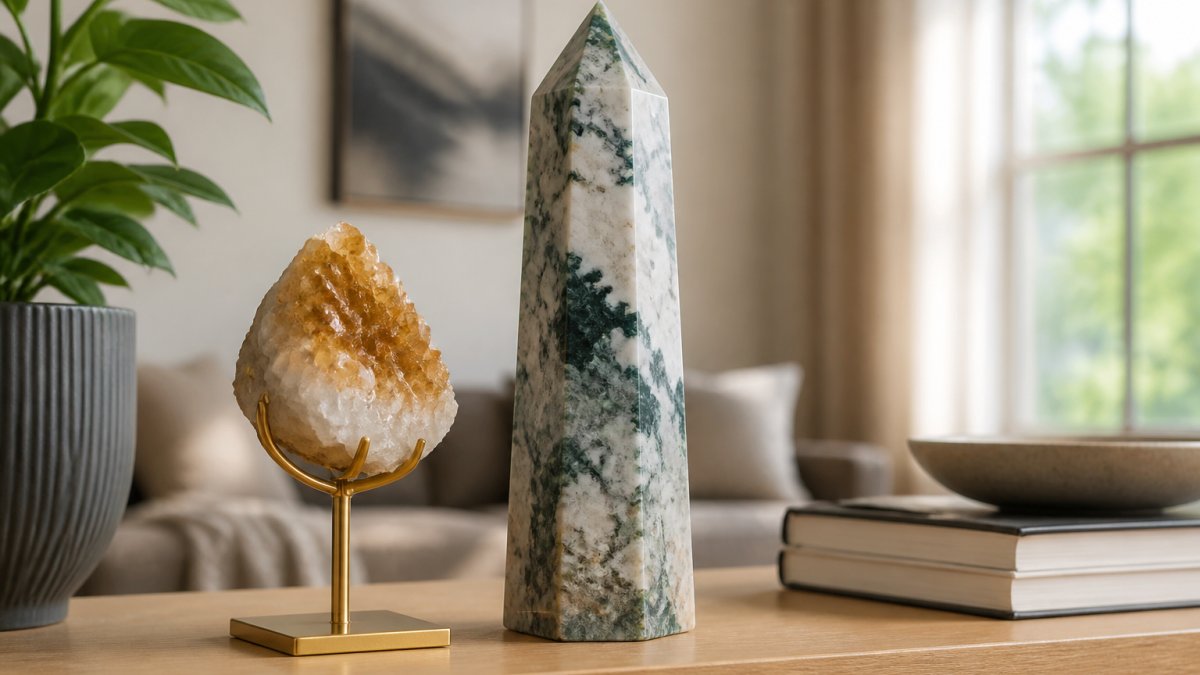
Bedrooms suit softer tones. Honey Calcite on its gold stand reads warm and calm, and the internal rainbow flashes only appear when you turn the piece toward a lamp. That is a deliberate design choice, not a flaw.

Home offices handle contrast well. Dark Agate with Quartz Druzy pairs a charcoal body with sparkling crystal pockets, so it stays interesting on video calls without dominating the frame.
Entryways and dining consoles want a single confident piece. The Polished Fossil Coral Tower in warm taupe and cream blends into almost any palette while still holding its own.
How to Identify Authentic Crystals and Spot Treatments
Authenticity questions come up in nearly every conversation we have with new customers. Here is the honest answer: natural stone shows irregularity, and treatments usually hide it. The gap most guides leave open is naming the treatments themselves, because "is it real?" is the wrong question. The right question is "what has been done to it, and did the seller say so?"
The treatments you will actually encounter
- Dyeing. Common in agate, howlite sold as turquoise, and low-grade quartz. Dye pools in fractures and follows cracks rather than the stone's growth structure. On a dyed agate slice, color is often darker along the outer rim and in every hairline crack.
- Heat treatment. Amethyst heated to roughly 700-900°F turns citrine-orange; most commercial citrine is heat-treated amethyst, not a separate natural find. Heat-treated amethyst often shows a reddish-brown tip fading to pale yellow at the base.
- Irradiation. Clear or smoky quartz can be irradiated to deepen color. The result is usually uniform and slightly metallic-looking rather than the uneven tone of natural smoky quartz.
- Coating and luster treatments. A thin metallic or resin film on quartz, pyrite, or agate adds shine or a rainbow effect. Look for a film that scratches with a fingernail, a color that only appears on the surface, or a rainbow that shifts with the light rather than sitting inside the stone.
- Reconstitution. Ground stone mixed with resin and pressed into a tower or sphere. These pieces are unusually uniform, feel lighter than expected for their size, and often have a faint plastic or resin smell.
- Misidentification. "Ruby" for dyed glass or garnet, "jade" for serpentine, "onyx" for dyed banded calcite. If the price is far below the market for the named material, the name is the first thing to verify.
A practical authenticity checklist
- Look for internal fractures, veils, and inclusions. Real quartz almost always has them.
- Check whether color is concentrated in cracks. Dye pools in fractures; natural color follows the stone's structure.
- Compare color across multiple angles. Dyed and coated pieces look flat from every side.
- Weigh the piece in your hand if you can. Reconstituted stone feels light for its volume.
- Smell it. A resin or plastic odor is a red flag.
- Ask whether the seller photographs the exact piece or uses stock images.
- Confirm the listing discloses treatments, if any.
- Request the specimen's origin when provenance matters to you.
A common mistake is assuming that a perfectly uniform stone is higher quality. Uniformity is often the first sign of treatment. Natural specimens vary side to side, and that variation is what makes them collectible.
What sellers should disclose
A reputable listing states, in plain language, whether the piece is natural, dyed, heat-treated, irradiated, coated, or reconstituted, and whether the species name is accurate.
Mineral Specimen Display Ideas That Showcase Natural Beauty
Display comes down to light and negative space. A specimen needs room to breathe and a light source that reveals its structure.
Three arrangements that work in real homes:
The single anchor. One large piece alone on a console or mantel. Nothing competes with it. Best for towers over 9 inches.
The odd-number trio. Three pieces of different heights grouped together, with the tallest off-center. Works well on bookshelves.
The lit cabinet. A curio cabinet with a small warm-toned light. Honey Calcite and Clear Quartz with Golden Inclusions both reward this setup because internal flashes only appear under directed light.
Rotate your pieces quarterly. Turning a tower 90 degrees reveals a completely different face, and most collectors forget this is possible. Our Veinless Orbicular Ocean Jasper Tower, for example, changes pattern entirely as you turn it.

Crystal Decor Gift Ideas for Every Occasion
Gifting crystals works when the piece matches the recipient's space, not just their taste in stones.
XL Blue & Earth Tone Crystal Tower 15” | Large Natural Stone Obelisk →
For housewarmings, choose neutral tones. The Polished Fossil Coral Tower and Multicolor Jasper Crystal Tower fit nearly any interior palette, which lowers the risk of a mismatch.
For collectors, go unusual. Veinless Ocean Jasper and Dark Agate with Quartz Druzy appeal to people who already own the common material and want something they have not seen before.
For sympathy and remembrance, softer pieces tend to land better. Honey Calcite's warm translucency suits quiet spaces.
For weddings and anniversaries, a matched-height pair displayed together reads as intentional rather than random.
One customer, Jessica T., told us that knowing her purchase supports our mission to assist autistic adults and their families made her crystal more meaningful.
If you are new to collecting, tell us the room and the shelf. We will point you toward two or three pieces rather than leaving you to guess.
Care, Cleaning, and Light Sensitivity for Lasting Display
Care is simple, but a few mistakes cause real damage. The gap most guides leave open is that "mineral care" is not one routine.
Start with hardness. On the Mohs scale, talc is 1 and diamond is 10. Quartz, agate, jasper, and amethyst sit at 7.
Water-sensitive specimens. Not every mineral tolerates water. Halite (rock salt), selenite and other gypsum varieties, and many zeolites will dissolve, pit, or cloud with repeated washing.
Water-safe specimens. Quartz, agate, jasper, amethyst, and most polished towers tolerate lukewarm water with a drop of mild dish soap.
What never to use. Vinegar, ammonia, lemon juice, and abrasive cleansers. Acid attacks carbonate minerals like calcite and malachite, and ammonia can dull a polished surface.
Light sensitivity. Amethyst, rose quartz, and some fluorite can fade with prolonged direct sunlight, so keep purple and pink tones out of south- and west-facing windows.
Handling and storage. Lift with two hands from the base, never the point.
Conclusion: Choosing Your Statement Piece
Choosing well comes down to three questions: where will it live, how much light does that spot get, and do you want a quiet piece or a bold one? Answer those and the shortlist writes itself.
IG Crystal Archive exists to make that choice easier. Every specimen is hand-selected and inspected for quality, shipped in secure professional packaging with fast, reliable delivery, and backed by our 30-day free returns. Because we are a small family business with a mission to support autistic adults and their families, your purchase carries weight beyond the shelf.
Shop crystals and find the piece that fits your space.
Frequently Asked Questions
What makes a mineral specimen high quality?
High quality mineral statement pieces are judged by clarity, color saturation, crystal formation, and condition. Look for natural veining and inclusions that show the stone formed organically, not uniform color that suggests dye. A piece should be free of cracks that compromise structure, though internal fractures and surface pits are normal. The best specimens are hand-selected, individually photographed, and sold as the exact piece you receive.
How can you tell if a crystal is authentic or treated?
Authentic crystals retain natural color variation, internal veils, and irregular surface texture. Dyed stones often show color concentrated in cracks or a uniform hue that looks painted. Heat-treated amethyst can turn yellow but usually keeps its original crystal shape. Ask sellers for disclosure on treatments and provenance. Reputable shops photograph each specimen individually and state whether any treatment was applied.
How do you choose a crystal statement piece for home decor?
Start with scale. A 15-inch tower works on a floor or large console, while a 6-inch piece suits a shelf or desk. Match the stone's palette to your room: neutral fossil coral blends with coastal or minimalist interiors, while deep blue or burgundy jasper adds contrast to light walls. Consider weight for safe placement on sturdy surfaces away from high-traffic areas.
How should you display large crystals and mineral specimens?
Place large crystals where they can be seen from multiple angles, since natural specimens look different on every side. Use a stable base or stand, especially for top-heavy towers. Keep pieces out of direct sunlight if the mineral is light-sensitive, and avoid humid areas like bathrooms. A curated grouping of three to five pieces at varying heights creates a focal point without clutter.
What are good crystal decor gift ideas?
Crystal decor gift ideas work best when matched to the recipient's style. A clear quartz tower with golden inclusions suits minimalist spaces, while multicolor jasper or ocean jasper appeals to collectors who want unusual patterns. Smaller pieces like pyrite freeforms make thoughtful gifts for desks or bookshelves. Pair the crystal with a note about its origin and natural features to add meaning.