How to Build a Purposeful Crystal Collection
Table of Contents
- Start With Intention: How to Choose Crystals That Fit Your Goals
- Crystal Collecting for Beginners: Building a Starter Collection
- Stone Meanings and Properties: What Each Crystal Represents
- How to Combine Crystals and Build a Crystal Grid
- Crystal Collection Display Ideas for Your Home
- How to Clean and Store Crystals by Mineral Type
- Budgeting, Authenticity, and Ethical Sourcing for Your Crystal Collection
- Frequently Asked Questions
Last Updated: October 7, 2026
Start With Intention: How to Choose Crystals That Fit Your Goals
A purposeful crystal collection begins with a clear intention, not a shopping spree. Before you buy anything, write down what you want the stone to support: calm, focus, protection, or self-love. That single step separates a curated collection from a drawer full of impulse buys.
At IG Crystal Archive, we curate every specimen by hand, so we see the difference intention makes. A beginner who starts with one goal ends up with pieces they actually display and use.
Use this simple framework:
- Name your goal. Pick one word, such as "grounding" or "clarity."
- Match the stone. Choose a crystal tied to that goal (more on meanings below).
- Set a limit. Decide your budget before you browse.
- Note the source. Ask where the piece came from and how it was selected.
Crystal Collecting for Beginners: Building a Starter Collection
Crystal collecting for beginners works best as a sequence, not a shopping list. Most guides hand you five stone names and stop. A purposeful collection needs a repeatable loop you can run for years: define a theme, set criteria, buy one piece, live with it, evaluate, then decide what is actually missing.
Step 1: Pick a collection theme. A theme is broader than a single intention. Common beginner themes include "calm and sleep," "focus and work," "grounding and protection," or "one stone per color of the rainbow." A theme gives every future purchase a reason to exist. If a stone does not serve the theme, it does not come home yet.
Step 3: Start with a five-stone core. Five stones cover most beginner goals: clear quartz for clarity, rose quartz for self-love, black tourmaline for protection, citrine for energy, and amethyst for calm. Start with tumbled stones, they cost less, feel smooth in the hand, and work for grids and pocket carry.
Step 4: Add one stone at a time and live with it. A workable first-quarter cadence:
- Week 1: buy clear quartz and set a daily intention with it.
- Week 2: add rose quartz for self-love work.
- Week 3: add black tourmaline for protection.
- Week 4: review which stone you used most, then plan month two.
- Month 2: add citrine or amethyst, whichever matches the theme you actually kept.
- Month 3: add one "stretch" piece, such as labradorite or sunstone, to test whether your taste is expanding.
Step 5: Evaluate before you add. At the end of each month, ask three questions: Did I use this stone? Does it still fit my theme? What is genuinely missing? If a stone sits untouched for a full month, that is data, either your theme is wrong or the stone was an impulse buy. Adjust the theme, not the collection size.
Step 6: Log every addition. A one-line entry per stone, name, origin if known, price, date, and the intention you assigned, turns a pile of rocks into a collection you can actually review. The log is also what stops you from buying a fourth piece of amethyst because you forgot you already had three.
Our Natural Crystal Tower Set of 3 gives beginners three polished points in one curated set, which is a low-risk way to test what you like before committing to a theme.

Stone Meanings and Properties: What Each Crystal Represents
Stone meanings are traditional associations, not medical claims. Think of them as prompts for intention. Clear quartz is linked to clarity and amplification. Rose quartz is tied to self-love and relationships. Black tourmaline is associated with protection. Citrine is connected to energy and confidence. Amethyst is linked to calm and intuition.
| Crystal | Common Association | Best For |
|---|---|---|
| Clear quartz | Clarity, focus | Goal setting, grids |
| Rose quartz | Self-love, connection | Daily wear, gifts |
| Black tourmaline | Protection, grounding | Entryways, workspaces |
| Citrine | Energy, confidence | Morning rituals |
| Amethyst | Calm, intuition | Bedrooms, meditation |
Sunstone, carnelian, and labradorite round out a starter collection. Sunstone and carnelian bring warmth and motivation. Labradorite is prized for its shifting flash and is often linked to transformation.
How to Combine Crystals and Build a Crystal Grid
Combining crystals works by pairing stones whose associations support one goal. For a calm-and-clarity grid, pair amethyst with clear quartz. For a grounding grid, pair black tourmaline with rose quartz.
A crystal grid is an arrangement of stones placed in a geometric pattern around a center stone. The center stone is called the anchor stone. It holds the grid's main intention.
To build a simple grid:
- Choose one intention and one anchor stone.
- Lay a geometric pattern with a printed grid cloth or tape.
- Place the anchor stone in the center.
- Add complementary stones at each point.
- Sit with the grid, state your intention, then leave it in place.
Start with a three-stone line or a six-point star. Keep it simple, and change it when your goal changes.
Crystal Collection Display Ideas for Your Home
Crystal collection display ideas should protect the stones and fit your space. Group pieces by color or height, keep them out of harsh direct sun, and use stands so towers and spheres stay stable.
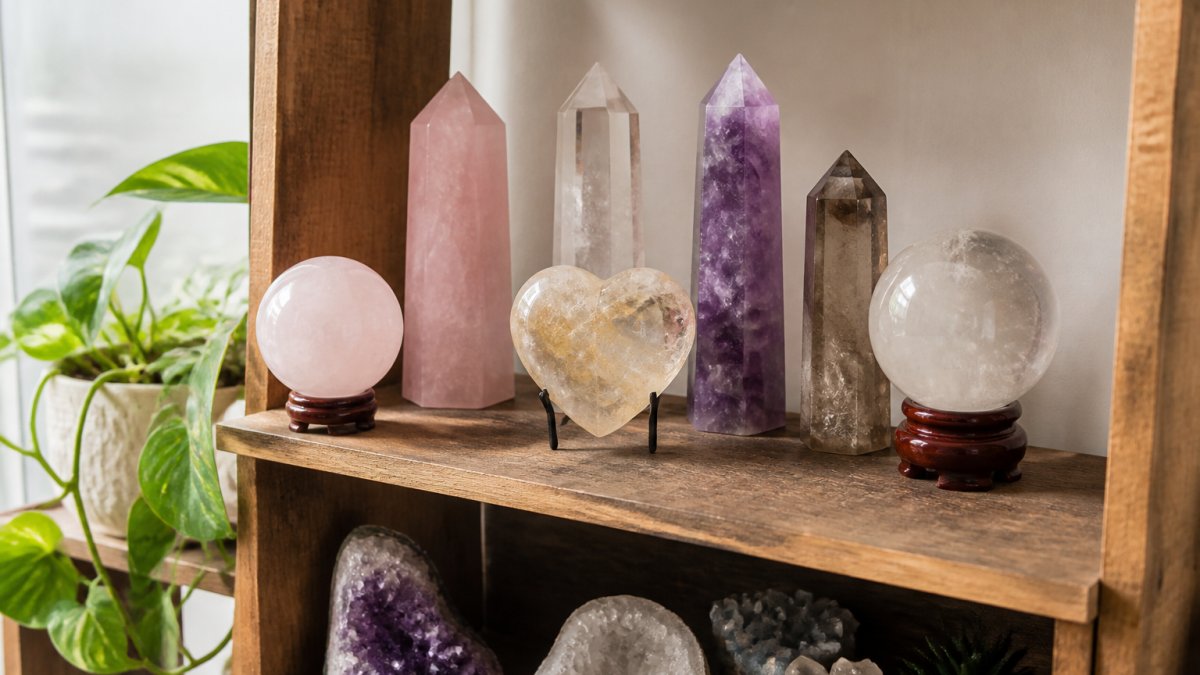
Try these setups:
Natural Crystal Tower Set of 3 | Caribbean Calcite, Rainbow Fluorite →
- Bookshelf: line towers by height, tallest in back.
- Desk: one sphere on a stand plus a heart for self-love.
- Entryway: black tourmaline for protection.
- Bedroom: amethyst on a nightstand for calm.
Our Amazonite Gift Set with Opalite Sphere includes a matching display stand, which makes a polished shelf setup easy. The Carnelian Crystal Gift Set adds warm color with a wooden stand included. For a statement piece, our Matching Lace Agate Tower Pair works as a centerpiece.


How to Clean and Store Crystals by Mineral Type
How you clean and store a crystal depends on its mineral family, not on a single rule. The two variables that matter most are hardness and solubility. Hardness is measured on the Mohs scale, which runs from 1 (talc) to 10 (diamond) (Natural Gemstones). Quartz sits at 7, so it resists scratching and tolerates water. Gypsum, the mineral that makes up selenite, sits at 2, which means a fingernail can mark it and water will slowly dissolve it. Halite (rock salt) is even softer and dissolves quickly in water.
The two rules that prevent most damage:
- If it is softer than quartz (below 7 on Mohs), do not scrub it. Use a dry soft brush or a microfiber cloth.
- If it is water-soluble or porous, keep it away from water entirely. Selenite, halite, and many dyed or porous agates fall into this group.
| Mineral Type | Example | Hardness (Mohs) | Cleaning Method | Storage |
|---|---|---|---|---|
| Hard (quartz family) | Clear quartz, amethyst | 7 | Rinse with water, dry fully | Padded box or open shelf |
| Soft (sulfates, halides) | Selenite, halite | 2-2.5 | Dry brush only, no water | Sealed container, away from moisture |
| Porous / dyed | Some agates, dyed stones | Varies | Wipe with soft cloth | Keep out of direct sun |
| Metallic / fragile | Pyrite, mica | 6-6.5 (pyrite), 2.5-4 (mica) | Dry dust only | Cushioned, low humidity |
| Carbonate | Calcite | 3 | Dry or barely damp cloth | Away from acids and vinegar |
Sunlight. Amethyst, rose quartz, and many dyed stones fade with prolonged direct sun. A shelf that gets a few hours of indirect light is fine; a south-facing windowsill in summer is not. If a stone's color matters to you, rotate it out of direct sun every few weeks.
Water and heat. Skip water on soft, porous, or metallic pieces. Pyrite can rust, mica can flake, and calcite can etch when exposed to acidic cleaners. Never use ultrasonic cleaners or steam on any specimen unless the seller explicitly says the stone is safe for them.
Handling. Oils from your hands are fine on quartz but can dull a soft stone's surface over time. Wash your hands before handling fragile pieces, and hold towers and spheres by the base, not the tip.
Energy cleansing. Many collectors use moonlight, sound, or smoke instead of water. These methods are safe for every mineral type because they add no moisture and no abrasion. If you want to use water for energetic reasons, reserve it for quartz-family stones only.
Budgeting, Authenticity, and Ethical Sourcing for Your Crystal Collection
Budgeting and authenticity matter more than most guides admit. Set a monthly cap, prioritize one meaningful piece over several cheap ones, and ask sellers about treatments before you buy.
How to spot treated or dyed stones:
- Color that's too uniform. Natural stones usually show variation.
- Dye in cracks. Look for darker color pooling in fractures.
- Price that's too low. Rare minerals at bargain prices deserve suspicion.
- Vague sourcing. A seller who can't say where a piece came from is a red flag.
On ethical sourcing, ask whether the piece was hand-selected and how it was obtained. The U.S. Federal Trade Commission guidance on advertising claims sets the standard for honest product descriptions, which applies to how stones and their properties are marketed.
A short buying checklist:
- Does the seller describe the exact piece?
- Are treatments or dyes disclosed?
- Is the origin stated?
- Can you return it if it's not right?
We hand-select each specimen at IG Crystal Archive and inspect it for quality before shipping. Every order includes fast shipping and 30-day free returns, and a portion of our work supports autistic adults and their families. As verified buyer Jessica T. put it, "Knowing my purchase supports such a heartfelt mission made this crystal even more special."
Building a crystal collection that means something takes intention, patience, and a clear plan. Most people stall because they buy on impulse and lose track of why they started. At IG Crystal Archive, we make that easier with hand-selected specimens, careful quality checks, and secure packaging, plus fast shipping and 30-day free returns. Every purchase also supports our mission to help autistic adults and their families. Get started with IG Crystal Archive and build a crystal collection you'll actually love.
Frequently Asked Questions
How many crystals should a beginner collect?
Start with three to five stones tied to clear intentions rather than buying in bulk. A common starter set includes clear quartz for clarity, rose quartz for self-love, and black tourmaline for protection. Add pieces slowly as you learn what you actually reach for. This keeps your crystal collection intentional and prevents the pile of impulse buys many collectors end up with.
How can I tell whether a crystal specimen is authentic?
Look for natural variation in color, inclusions, and pattern. Dyed stones often have color concentrated in cracks, and glass imitations feel uniformly smooth with no internal structure. Ask sellers whether pieces are treated, and buy from shops that photograph the exact specimen you receive. Hand-selected sellers who inspect each piece for quality make authenticity far easier to verify.
What are some creative ways to display a crystal collection?
Group pieces by color story, like the blue and white tones of Caribbean Calcite, or by height so towers anchor a shelf. Use a matching stand, add a sphere beside a tower, and leave negative space so each piece reads as a specimen rather than clutter. Rotating displays seasonally keeps a crystal collection feeling fresh without buying more stones.
How should I clean and store different crystals?
Most polished quartz-family stones, including clear quartz and citrine, handle lukewarm water and a soft cloth. Softer minerals like fluorite, calcite, and selenite scratch easily, so dust them dry. Store tumbled stones in a padded tray and keep towers upright on a stable shelf away from direct sun, which can fade amethyst, rose quartz, and citrine over time.