How to Identify Dyed Quartz Specimens: 8 Tests
Table of Contents
- Start With Visual Inspection: Color That Sits in Cracks
- The Acetone Test and Other Solvent Checks for Dyed Quartz
- Growth Zoning, Inclusions, and Natural vs Artificial Color
- How to Spot Fake Crystals: Scratch, Chip, and Fracture Clues
- Signs of Heat Treated Quartz vs. Dye: What Changes and What Doesn't
- How to Test Crystal Authenticity: UV Light, Loupe, and Disclosure Records
- Commonly Dyed Varieties and How to Identify Dyed Quartz Specimens in Tumbled Stones
- Conclusion: Buying With Confidence and Asking the Right Questions
- Frequently Asked Questions
Last Updated: September 20, 2026
Start With Visual Inspection: Color That Sits in Cracks
Dyed quartz gives itself away fast if you know where to look. Learning how to identify dyed quartz specimens starts with one simple rule: real color lives inside the stone, fake color sits on top of it.
At IG Crystal Archive, LLC, we inspect every specimen by hand before it reaches a customer, and color pooling in cracks is the first thing we check.
Here is what to look for:
- Color concentrated in fractures, crevices, and bead holes
- A darker rim around chipped edges
- Uneven saturation, bright in some spots and pale in others
- Dye pooling where the stone was polished
Natural quartz gets its color from mineral impurities spread through the crystal structure. That color looks soft and even. Dye looks painted on, because it is.
The Acetone Test and Other Solvent Checks for Dyed Quartz
The acetone test is the fastest home check for surface dye. It takes about two minutes and costs almost nothing.
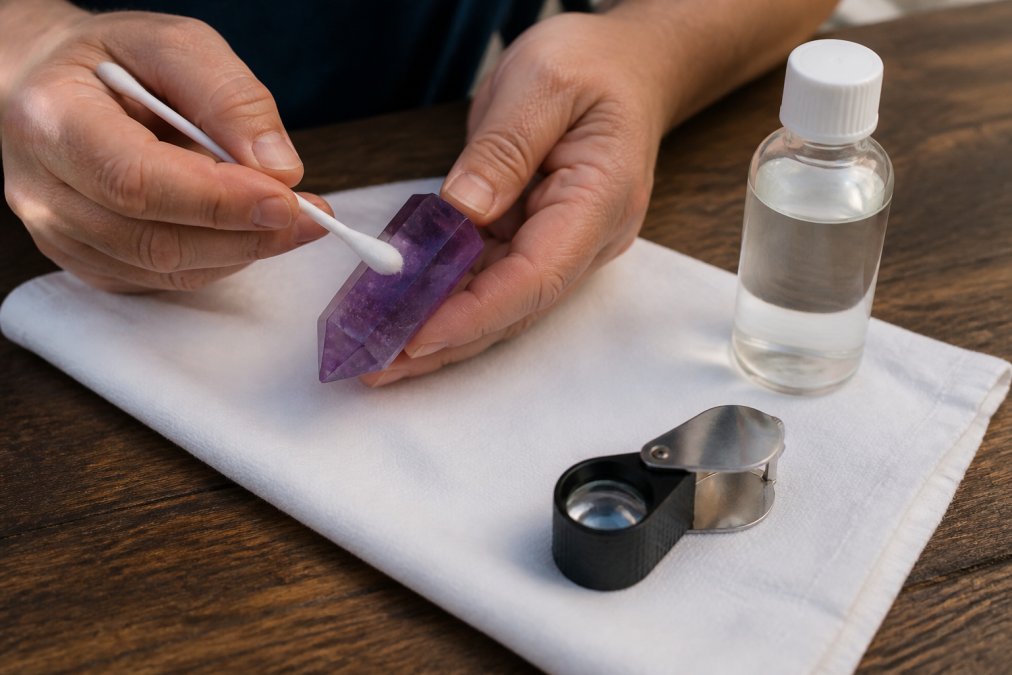
Here is how to run it:
- Soak a cotton swab in pure acetone.
- Rub it firmly on an inconspicuous spot, like the base of a point.
- Check the swab for color transfer.
- Repeat on any cracks or bead holes.
If the swab picks up pink, purple, or blue, the stone is dyed.
Growth Zoning, Inclusions, and Natural vs Artificial Color
Natural quartz grows in layers, and those layers tell a story. This is where the difference between natural and artificial color becomes obvious.
Natural inclusions are another giveaway. Look for:
- Bubbles, veils, or tiny mineral specks trapped inside
- Rainbow flashes at internal fractures
- Cloudy patches mixed with clear areas
How to Spot Fake Crystals: Scratch, Chip, and Fracture Clues
Quartz ranks 7 on the Mohs hardness scale, which means it scratches glass and resists most everyday wear. Fakes often do not.
Try these checks:
- Scratch test: Gently scratch the underside of a glass jar. Real quartz leaves a mark. Glass or resin fakes do not.
- Chip inspection: Look at chipped edges. Dyed stones show a pale core under the colored surface.
- Fracture check: Real quartz breaks with a curved, shell-like pattern. Resin and glass fakes often break differently or feel warm and light.
Signs of Heat Treated Quartz vs. Dye: What Changes and What Doesn't
Heat treatment and dyeing are different processes, and they leave different marks. Knowing the signs of heat treated quartz keeps you from confusing the two, and knowing the difference between dye types keeps you from misreading a deep treatment as natural color.
Here is how to tell them apart:
- Dye: color pools in cracks, rubs off with acetone, looks uneven, often concentrated at the surface
- Heat treatment: color is even throughout, no dye transfer, sometimes shows a reddish or smoky tint that natural citrine rarely has
- Both: some stones get heated first, then dyed, which is why you run more than one test
Not All Dyes Behave the Same Way
Most guides treat "dyed" as one category. It is not. The two main types behave very differently under testing, and confusing them is why collectors sometimes clear a stone that is actually treated.
Why This Matters for Value
Heat treated quartz is common and widely accepted in the trade. It is stable, does not fade, and is routinely disclosed as "heated." Dye is different. It can bleed, fade in sunlight, and rub off on skin, and it changes the stone's value far more. The Federal Trade Commission's guidance on jewelry advertising requires sellers to disclose treatments that affect a stone's value.
How to Test Crystal Authenticity: UV Light, Loupe, and Disclosure Records
A UV light and a jeweler's loupe turn a casual collector into a sharp one. Both tools cost less than a nice specimen and last for years. This is the part of identification most guides skip, and it is where you separate a guess from a diagnosis.
Ultraviolet Light: Reading Fluorescence Correctly
Under a longwave UV lamp (around 365 nm, the common blacklight range), some dyes glow brightly while most natural quartz stays inert or shows only a faint response. The mechanism is straightforward: many dye molecules absorb UV and re-emit it as visible light, so a dyed stone can light up with a color that seems to come from nowhere.
A few cautions keep you from misreading the result:
- A positive glow is a strong signal, not proof. Some dyes are non-fluorescent, so a stone that stays dark under UV can still be dyed.
- A negative result proves nothing. Absence of fluorescence is not evidence of natural color.
- Natural minerals can fluoresce too. Some specimens show genuine fluorescence from trace minerals, so compare the glow color to the stone's body color. A glow that matches the dye color is suspicious; a glow that is a different hue may be natural.
- Use a dark room. Ambient light washes out faint fluorescence and makes everything look inert.
The Jeweler's Loupe: Seeing What the Eye Misses
A 10x loupe is the single best upgrade for a collector. At 10x, dye stops looking like color and starts looking like a stain. Here is what to hunt for:
- Dye trails running along fractures and cleavage planes, where color is darker than the surrounding stone
- Color that stops dead at a crystal boundary or fracture instead of fading gradually
- Bubbles or flow lines that suggest glass or resin rather than crystalline quartz
- Surface film visible at the edge of a polished face, where dye has pooled and dried
Disclosure Records and Ethical Sourcing
Tools only get you so far. The third check is the paper trail, and this is where most buyers leave value on the table.
Commonly Dyed Varieties and How to Identify Dyed Quartz Specimens in Tumbled Stones
Tumbled stones are the hardest to judge because they lack the natural points and faces of raw specimens. Here is a quick reference for the varieties you will see most.
| Variety | Common Treatment | Key Sign of Dye |
|---|---|---|
| Amethyst | Dye, heat | Purple pools in cracks |
| Citrine | Heat, dye | Too-orange color, dye transfer |
| Rose quartz | Dye | Pink sits in crevices |
| Clear quartz | Dye, coating | Color rubs off with acetone |
| Agate | Dye | Bright bands, color in fractures |
| Howlite | Dye | Turquoise-blue sits on surface |
Conclusion: Buying With Confidence and Asking the Right Questions
The hardest part of collecting is not the testing. It is trusting the seller.

Ask these questions before you buy:
- Is this stone dyed, heated, or untreated?
- Can you show me close-up photos of the cracks and edges?
- What is your return policy if the stone is not as described?
Frequently Asked Questions
Can quartz be dyed, and how common is it?
Yes, quartz is commonly dyed, especially varieties like agate, tumbled stones, and low-grade crystal points sold as decorative pieces. The dye fills natural fractures, bead holes, and surface crevices to create vibrant hues that do not occur naturally. It is most frequent in budget-friendly specimens and novelty items. Recognizing this helps you ask better questions and inspect pieces more carefully before buying.
How can you tell if quartz has been artificially dyed?
Look for color concentration in cracks, crevices, and bead holes, which is a telltale sign of dyed quartz. Natural color follows growth zoning and stays consistent through the crystal structure. An acetone test can also reveal dye: if color wipes off onto a cotton swab, the specimen is treated. A jeweler's loupe helps you see dye pooling in fractures that natural mineral impurities would not fill so unevenly.
Does dyed quartz lose its color over time?
Dyed quartz can fade, especially with prolonged exposure to sunlight or repeated handling. The dye sits in surface fractures and pores rather than being part of the crystal lattice, so it is more vulnerable to fading and wear than natural color. Heat treated quartz, by contrast, changes color through internal structural shifts and generally holds its hue. If a dyed piece fades, that is a strong confirmation it was artificially colored.
What tools help identify treated quartz?
A jeweler's loupe is the most useful tool for seeing dye concentration in fractures and growth zoning. A UV light can reveal fluorescence patterns that differ between natural and treated specimens. Acetone and cotton swabs provide a simple chemical solvent test for surface dye. For higher-value pieces, a gemological lab can confirm treatments. These tools help you test crystal authenticity without damaging the specimen.
Dye tests take minutes, but a bad purchase sticks around. If you want specimens that have already passed the acetone test, the chip check, and a close look under a loupe, shop with a seller who inspects every piece by hand. IG Crystal Archive, LLC offers hand-selected specimens, a 30-day free return policy, and a mission to support autistic adults and their families with every order. Get started with IG Crystal Archive, LLC and build a collection you can trust.