How to Spot Fake Crystals: A 2026 Guide
Table of Contents
- Why Fake Crystals Are So Widespread
- Physical Signs That Reveal Fake Crystals
- Crystal Authenticity Testing Tools You Can Use at Home
- Identifying Heat Treated Crystals vs. Naturally Formed Stones
- Common Fake Crystals List: The Most Counterfeited Specimens
- Advanced Methods: Microscopic Analysis and Solvent Testing
- How to Spot Fake Crystals When Buying Online
- Frequently Asked Questions
Last Updated: September 1, 2026
Why Fake Crystals Are So Widespread
Knowing how to spot fake crystals has become essential for serious collectors. At IG Crystal Archive, LLC, we hand-select every specimen we carry, and we've seen firsthand how many imitation stones circulate in the market, often sold as authentic at premium prices.
The crystal market has expanded rapidly, attracting sellers who prioritize volume over integrity. Glass, resin, and plastic imitations are molded to mimic genuine gemstones. Synthetic lab-grown versions are passed off as natural. Heat-treated stones have their colors artificially intensified and sold without disclosure. Fake crystals aren't just a scam, they undermine the entire collecting experience by stripping away geological authenticity.
The good news: most fakes reveal themselves if you know what to look for. This guide covers physical inspection, at-home testing tools, and a practical decision framework to help you verify any specimen before purchase.
Physical Signs That Reveal Fake Crystals
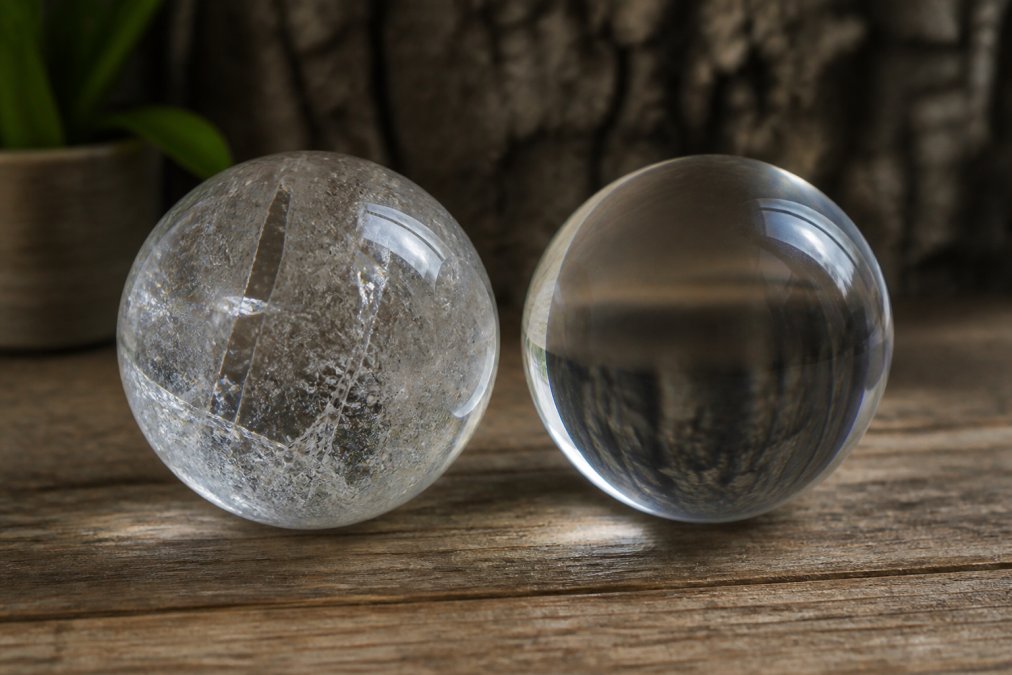
Most fake crystals fail a basic physical inspection. Real crystals form over thousands to millions of years under specific geological conditions, leaving behind evidence: internal fractures, mineral inclusions, growth patterns, and surface irregularities that no factory can perfectly replicate. Imitation stones tend to look too perfect.
Temperature and Thermal Conductivity
Real crystals feel cold to the touch, even at room temperature. This is one of the most reliable quick tests because genuine crystalline minerals conduct heat away from your skin faster than glass or plastic.
Pick up the specimen and hold it in your palm for five seconds. A real quartz or amethyst will feel noticeably cold and warm slowly. Glass warms quickly. Plastic warms almost immediately. Resin often feels slightly tacky or light.
Air Bubbles vs. Natural Inclusions
Natural inclusions and air bubbles can look similar at a glance, but they behave completely differently under light.
Air bubbles are perfectly round, uniformly sized, and distributed in patterns that follow the flow of molten glass or resin. Under a loupe, they appear as spherical voids.
Natural inclusions are irregular, mineral deposits, rutile needles, fracture planes, or zones of cloudiness caused by trapped fluid. They have no predictable geometry and often create internal rainbows when light hits a fracture at the right angle, something glass imitations rarely replicate convincingly.
According to the Gemological Institute of America's gemology resources, natural inclusions are a key diagnostic feature that gemologists use to distinguish natural stones from synthetic or imitation materials.
Weight, Density, and Feel
Genuine crystals are denser than most people expect. A real quartz sphere will feel noticeably heavier than a glass or resin imitation of the same size. Plastic fakes are easiest to catch this way, they feel almost hollow by comparison. Glass imitations are closer in density to quartz but still tend to feel lighter.

Real stones also have a specific surface texture. Polished natural crystals feel smooth but not slick. Resin imitations often have a slightly waxy or soft feel. Glass has a harder, more clinical smoothness.
Crystal Authenticity Testing Tools You Can Use at Home
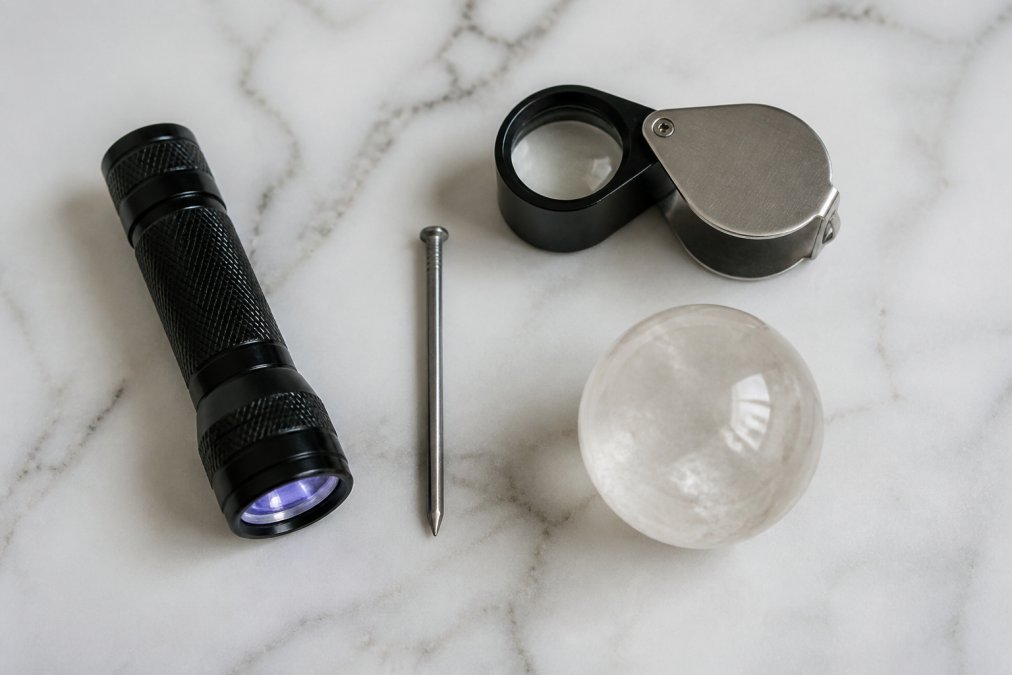
A basic testing kit doesn't require a gemological lab. A few inexpensive tools cover the most common authenticity checks:
- A steel nail or copper coin (for hardness testing)
- A UV flashlight (for fluorescence testing)
- A small loupe magnifier, 10x minimum (for inclusion inspection)
- A penlight or small flashlight (for refractive index checks)
Hardness Testing with the Mohs Scale
The Mohs hardness scale ranks minerals from 1 (talc) to 10 (diamond) based on their resistance to scratching. This is a reliable authenticity test because genuine minerals have predictable hardness values that imitations often fail to match.
Quartz registers 7 on the Mohs scale, meaning it will scratch glass (hardness 5.5) and most metals, but a steel file (hardness 6.5) will not scratch it. A genuine quartz crystal should resist scratching from a steel nail. If your "quartz" scratches easily with a fingernail (hardness 2.5), it's resin or plastic.
| Crystal | Mohs Hardness | What It Resists |
|---|---|---|
| Quartz / Amethyst | 7 | Steel nail, glass |
| Topaz | 8 | Steel file |
| Calcite | 3 | Copper coin only |
| Selenite | 2 | Fingernail |
| Moldavite | 5.5-6 | Steel nail (barely) |
Test carefully in an inconspicuous spot, as hardness testing leaves marks. For polished collector pieces, use this test only when other methods are inconclusive.
UV Light and Fluorescence Testing
Many natural minerals fluoresce under ultraviolet light in ways that glass and resin imitations do not replicate. Genuine calcite often fluoresces pink or orange. Some natural quartz varieties show a faint blue glow. Dyed imitations or resin fakes may fluoresce brightly and uniformly, which is actually a red flag, natural fluorescence tends to be uneven and concentrated in specific zones.
As documented in the Mineralogical Society of America's mineral properties database, fluorescence in natural minerals is caused by trace element substitutions and structural imperfections, factors that synthetic and glass imitations don't share.
Flashlight and Refractive Index Checks
Hold a flashlight directly against a crystal and observe how light passes through it. Natural crystals with a high refractive index will scatter light internally, creating depth and complexity. Glass tends to transmit light more uniformly.
Genuine quartz also exhibits birefringence in some orientations, a doubling of light rays visible when looking through the stone at a fine line or dot. Glass is optically isotropic and won't produce this effect. This check works best with a loupe, looking for the internal complexity that comes from genuine crystalline structure.
Identifying Heat Treated Crystals vs. Naturally Formed Stones
Heat treatment is a legitimate gemological practice, but it becomes problematic when sellers present treated stones as naturally colored without disclosure. Heat treatment is used most commonly on amethyst (to create citrine), smoky quartz (to deepen color), and agate (to intensify banding).
Signs of heat treatment include:
- Unnaturally vivid color saturation that looks more like a dyed stone
- White or chalky inclusions that appear "cooked" rather than crystalline
- Color concentrated near fractures rather than distributed through growth zones
- Citrine with a reddish tint at the base, often indicating conversion from amethyst
Natural citrine is pale yellow to honey-colored with a warm, even tone. Heat-treated amethyst-turned-citrine tends toward orange-yellow with a burnt quality. Natural smoky quartz has a cool, grey-brown transparency. Artificially darkened smoky quartz often appears too uniformly dark.
The International Gem Society's guide to heat treatment notes that heat treatment is widespread in the commercial gem trade and is considered acceptable when disclosed.
Common Fake Crystals List: The Most Counterfeited Specimens
Some crystals attract more counterfeiting than others, typically because they're rare, expensive, or visually distinctive.
Moldavite is arguably the most faked crystal in the current market. Genuine moldavite is a tektite formed by a meteorite impact roughly 15 million years ago, found primarily in central Europe. Real moldavite has a distinctive wrinkled, pitted, and irregular surface texture and a rich forest-green color with internal flow patterns visible under magnification. Fake moldavite is typically green glass with a smoother surface and uniform color. The weight-to-size ratio is also a reliable check: genuine moldavite is lighter than glass of comparable size.
Larimar is a rare blue pectolite found only in one specific location. Fakes are typically dyed howlite or blue-dyed calcite. Genuine larimar has a distinctive blue-white pattern resembling ocean waves, with natural variation in color saturation. Dyed imitations show color concentrated along fracture lines.
Clear quartz is frequently replaced with glass. The thermal conductivity test and air bubble check are your best tools. Our Clear Quartz Crystal Sphere Set features natural inclusions and internal fractures that are the hallmark of genuine quartz.

Turquoise is one of the most commonly faked gemstones. Dyed howlite, plastic, and resin imitations are sold routinely. Genuine turquoise has a waxy luster, natural matrix patterns, and a hardness of 5-6 on the Mohs scale. Dyed howlite is softer and shows color bleeding when rubbed with acetone.
Citrine sold as natural is often heat-treated amethyst. See the heat treatment section above for diagnostic details.
Advanced Methods: Microscopic Analysis and Solvent Testing
When standard tests are inconclusive, two advanced methods can resolve most remaining questions: microscopic analysis and chemical solvent testing.
Microscopic analysis involves examining the crystal under magnification of 30x or higher. A jeweler's loupe at 10x is a starting point, but a basic USB digital microscope provides far more detail. Under magnification, genuine crystals reveal irregular fracture planes with natural conchoidal patterns, mineral inclusions with defined crystalline edges, growth zones showing color variation, and surface features reflecting natural formation history. Glass and resin imitations show smooth, featureless interiors. Air bubbles become clearly spherical.
Solvent testing is specifically useful for identifying dyed stones. Acetone (nail polish remover) applied to an inconspicuous area with a cotton swab will lift surface dye from treated stones. If the swab picks up color, the specimen has been dyed. This test works reliably on dyed howlite, dyed agate, and surface-treated imitations. For valuable pieces, consult a professional gemologist before testing.
How to Spot Fake Crystals When Buying Online
Buying crystals online presents a specific challenge: you can't hold the piece, test its temperature, or examine it under a loupe before purchasing. Photographs tell you more than most buyers realize. Look for:
- Multiple angles, including shots of the interior under light
- Natural imperfections, inclusions, fractures, surface irregularities
- Consistent color that doesn't look digitally saturated or artificially enhanced
- Scale reference showing the actual size of the piece
Sellers who show only one flattering angle, use heavily filtered photos, or can't provide close-up shots of the interior are worth approaching with caution.
Ethical Sourcing and Seller Transparency
A seller who can tell you where a piece came from, how it was extracted, and why they selected it is demonstrating transparency that counterfeit sellers simply can't match. Ask directly: Where was this specimen mined? Has it been treated in any way? Can you describe what makes this piece genuine?
A seller who can't answer these questions or becomes defensive is a meaningful signal. Legitimate sellers with hand-selected inventory know their pieces. At IG Crystal Archive, LLC, every specimen is personally chosen, which means we can speak to the character of each piece rather than just listing generic specifications.
Our Large Clear Quartz Sphere is a good example: it features icy veils, natural internal fractures, and shimmering inclusions that you can see in the product photos, exactly the kind of internal complexity that distinguishes genuine quartz from glass imitations.
Quick Decision Guide: Real or Fake?
Use this framework when evaluating any crystal specimen, whether in person or online.
| Test | Real Crystal | Likely Fake |
|---|---|---|
| Temperature | Cold, warms slowly | Warms quickly (glass/resin) |
| Air bubbles | None or irregular inclusions | Spherical, uniform bubbles |
| Weight | Heavy for its size | Lighter than expected |
| Hardness | Resists scratching per Mohs scale | Scratches easily |
| UV light | Uneven, zone-specific fluorescence | Uniform bright glow (dye) |
| Surface texture | Slight irregularity, natural feel | Too smooth, waxy, or slick |
| Seller transparency | Origin, treatment history available | Vague or evasive answers |
No single test is conclusive on its own. The more tests a specimen passes, the more confidence you can have in its authenticity. When multiple tests raise concerns, trust your instincts and ask for more information before purchasing.
It's also worth noting that transparency cuts both ways. We carry an Opalite Glass Crystal Bowl that is clearly labeled as man-made opalite glass. There's nothing wrong with glass or synthetic pieces when they're sold as exactly what they are. The problem is misrepresentation.

For further reading on gemstone authentication standards, the American Gem Society's consumer resources provides practical guidance on working with reputable sellers and understanding gemological terminology.
Frequently Asked Questions
What crystals are most commonly faked in the market?
Moldavite, Larimar, clear quartz, citrine, and turquoise top the list of counterfeited specimens. Moldavite is frequently replaced with green glass; citrine is often just heat-treated amethyst sold as natural citrine; turquoise is commonly dyed howlite. Any gemstone with high demand and limited natural supply is a prime target for synthetic or imitation substitutes.
How can you use a flashlight to identify real crystals?
Shine a flashlight through the specimen and look at the internal structure. Genuine crystals like clear quartz show natural inclusions, fractures, veils, and uneven clarity. Glass imitations typically display perfectly uniform translucency with small, round air bubbles trapped inside. The refractive index of real quartz also creates distinct light bending and rainbow flashes that glass rarely replicates convincingly.
What are the physical signs of glass or plastic imitations?
Glass fakes warm up quickly in your hand, real quartz stays cold-to-the-touch longer due to its thermal conductivity. Plastic imitations feel lighter than they look, scratch easily with a steel nail (below Mohs hardness 5), and often show mold seams along the edges. Both glass and plastic lack the conchoidal fracture patterns and natural crystalline structure found in genuine mineral specimens.
How do heat-treated stones differ from natural crystals?
Heat treatment itself is not always fraudulent, sellers should disclose it. Treated amethyst sold as natural citrine is the most common example: natural citrine has pale yellow to honey tones, while heat-treated material shows an orange-brown hue concentrated at the tips. Under magnification, heat-treated stones may show altered inclusion patterns or stress fractures from rapid temperature change that differ from natural fractures formed over geological time.
Crystal collecting is deeply rewarding, but the counterfeit market makes informed buying essential. IG Crystal Archive, LLC hand-selects every specimen in our collection, personally inspecting each piece for quality, authenticity, and natural character. Our 30-day free returns policy means you can buy with confidence, and our secure packaging ensures your specimen arrives exactly as pictured. Shop Crystals at IG Crystal Archive, LLC and get a piece you can trust.
This article was written using GrandRanker