How to Start a Crystal Collection: A 2026 Guide
Table of Contents
- What to Know Before You Start a Crystal Collection
- Best Crystals for Beginners: Where to Start
- How to Identify Authentic Crystals (and Avoid Fakes)
- How to Clean Crystals and Keep Them in Top Condition
- Ethical and Budget-Friendly Sourcing for Your Crystal Collection
- How to Organize Your Crystal Collection: Display and Cataloging
- Building Your Collection with Intention Over Time
- Frequently Asked Questions
Last Updated: August 31, 2026
What to Know Before You Start a Crystal Collection
Starting a crystal collection looks simple until you begin. The biggest mistake we see is buying without any framework, you end up with a drawer full of unidentified tumbled stones. This guide walks you through choosing your first specimens, identifying authentic pieces, caring for them properly, sourcing ethically, and building an organized collection that grows with intention rather than impulse.
A crystal collection is a curated set of mineral specimens selected for their geological, aesthetic, or metaphysical properties. The best collections aren't the biggest ones. They're the most intentional ones.
Raw Stones vs. Tumbled Stones vs. Clusters
The form factor of a specimen matters for both display and care.
Tumbled stones are small, polished pieces smoothed in a rock tumbler. They're affordable, durable, and easy to handle, great for pockets or learning what different minerals look and feel like.
Raw stones are uncut, unpolished specimens in their natural state. They show more geological character but are often more fragile and require careful storage.
Crystal clusters and geodes are multi-point formations still attached to a base matrix. These make striking display pieces but are the most fragile of the three forms. A single cluster can chip if dropped.
Knowing which form you prefer before you buy saves money and frustration.
Understanding Crystal Energy and Metaphysical Properties
Crystal energy is the idea that minerals carry a vibrational frequency that interacts with human energy fields. Many crystals have measurable physical properties: piezoelectricity in quartz, fluorescence in certain minerals, and distinct electromagnetic characteristics tied to their crystalline structure. The metaphysical properties attributed to crystals, chakra alignment, emotional healing, intention setting, are part of a long spiritual tradition that many collectors find deeply meaningful.
You don't have to choose between the scientific and the spiritual. Most serious collectors appreciate both dimensions. The geological story of a specimen, how it formed, where it came from, how old it is, adds meaning that purely metaphysical descriptions miss.
Best Crystals for Beginners: Where to Start
The best crystals for beginners are widely available, reasonably priced, easy to identify, and versatile enough for both display and spiritual practice.
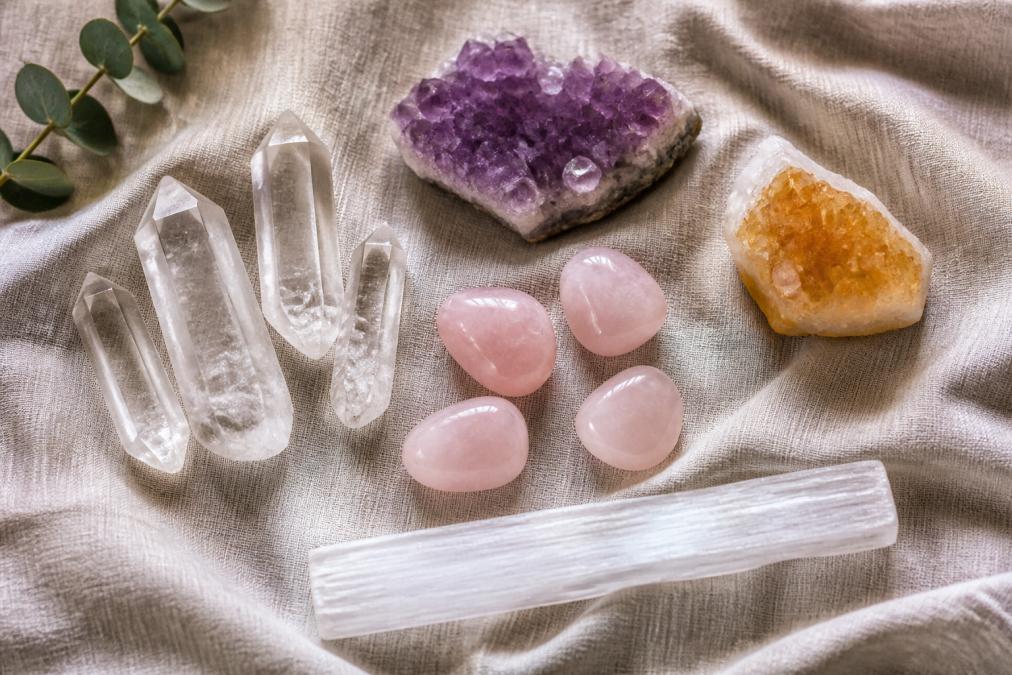
Clear Quartz, Amethyst, and Rose Quartz
Clear quartz is the foundational crystal for any collection. It scores a 7 on the Mohs hardness scale, making it durable and scratch-resistant. Metaphysically, it's considered an amplifier for other stones and intentions. Clear quartz is also one of the easiest minerals to identify: transparent to translucent, with a glassy luster and hexagonal crystal structure.
Amethyst is a purple variety of quartz, ranging from pale lavender to deep violet. Its color comes from iron impurities and irradiation. Associated with calm, intuition, and spiritual awareness, amethyst is widely available as tumbled stones and stunning cluster specimens.
Rose quartz carries a soft pink hue caused by trace amounts of titanium, iron, or manganese. Associated with love, compassion, and emotional healing, it's typically found in massive form rather than well-defined crystals, so most specimens are tumbled or carved. It's abundant, affordable, and immediately recognizable.
Citrine, Selenite, and Smoky Quartz
Citrine is a yellow to orange variety of quartz. Natural citrine is rarer than most realize; much of what's sold is heat-treated amethyst. Genuine citrine tends to be pale yellow and less saturated. Both natural and heat-treated citrine are valid starting points.
Selenite is a form of gypsum that scores only a 2 on the Mohs hardness scale, it can be scratched with a fingernail. Prized for its silky, fibrous luster and association with clarity and cleansing, selenite should never be submerged in water, as it will dissolve.
Smoky quartz ranges from light gray to deep brown-black, colored by natural irradiation. Associated with grounding and protection, smoky quartz points and clusters make excellent display specimens and are durable enough to handle regularly.
| Crystal | Mohs Hardness | Form Available | Primary Use |
|---|---|---|---|
| Clear Quartz | 7 | Points, clusters, tumbled | Amplification, clarity |
| Amethyst | 7 | Clusters, geodes, tumbled | Calm, intuition |
| Rose Quartz | 7 | Tumbled, massive, carved | Love, emotional healing |
| Citrine | 7 | Points, tumbled | Abundance, energy |
| Selenite | 2 | Wands, plates, raw | Cleansing, clarity |
| Smoky Quartz | 7 | Points, clusters, tumbled | Grounding, protection |
How to Identify Authentic Crystals (and Avoid Fakes)
Fake and misrepresented crystals are a real problem in the market. Basic geological knowledge gives you tools to spot most fakes without specialized equipment.
Using the Mohs Hardness Scale as a Basic Test
The Mohs hardness scale from the Mineralogical Society of America ranks minerals from 1 (talc) to 10 (diamond) based on scratch resistance.
Here's how to apply it:
- A fingernail has a hardness of about 2.5. If a "quartz" specimen scratches easily with your nail, it's not quartz.
- A copper coin sits around 3.5. Glass is approximately 5.5.
- Genuine quartz (including amethyst, citrine, smoky quartz, and rose quartz) scores a 7 and will scratch glass easily.
- Selenite scores a 2 and will scratch with a fingernail. That's expected and correct.
This test won't catch everything, but it eliminates a large category of glass imitations and misidentified soft minerals.
Spotting Dyed, Treated, or Synthetic Specimens
Dyed stones are common, particularly in agate slices and howlite sold as turquoise. Look for color that concentrates unnaturally along cracks, overly saturated hues that don't match the natural range, or color that rubs off on a damp cloth.
Heat treatment is standard practice for some minerals (amethyst to citrine) and is not deceptive when disclosed. The problem is when treated stones are sold as naturally occurring rare specimens at a premium.
Synthetic crystals are laboratory-grown with the same chemical composition as natural ones, but they lack geological history. According to the Federal Trade Commission guidelines on gemstone disclosure, sellers are required to disclose treatments and synthetic origins. Ask directly, and trust sellers who answer clearly.
How to Clean Crystals and Keep Them in Top Condition
Knowing how to clean crystals is as important as knowing which ones to buy. Physical cleaning and metaphysical cleansing are two distinct practices.
Physical Cleaning and Long-Term Preservation
Physical cleaning removes dust, oils, and surface debris. The right method depends on the mineral's hardness and composition.
Safe for most hard specimens (Mohs 6 and above):
- Soft-bristle brush and lukewarm water
- Mild soap for stubborn residue, followed by thorough rinsing
- Air dry completely before storage
Never use water on:
- Selenite, gypsum, halite, and other water-soluble minerals
- Malachite (toxic if ingested)
- Pyrite (oxidizes and and can rust)
- Calcite (water can dull the surface)
For dusty specimens, a soft artist's brush or compressed air works well without introducing moisture.
Cleansing and Charging for Spiritual Practice
Cleansing refers to clearing a crystal's energetic field, and charging refers to restoring or amplifying its vibrational frequency.
Common cleansing methods include:
- Moonlight: Placing crystals under a full moon overnight is gentle and universally safe.
- Sunlight: Effective but risky for color-sensitive stones. Amethyst, rose quartz, and citrine can fade with prolonged exposure.
- Sound: Singing bowls, tuning forks, or bells cleanse through vibrational resonance. Safe for all specimens.
- Selenite plate: Placing other crystals on a selenite charging plate is popular, since selenite is believed to both cleanse and charge without needing cleansing itself.
- Smoke: Passing crystals through sage, palo santo, or incense smoke is a traditional method. Safe for all specimens.
Intention setting is the practice of holding a crystal, focusing your attention, and mentally directing a purpose into the stone.
Ethical and Budget-Friendly Sourcing for Your Crystal Collection
The crystal and gemstone industry has documented supply chain issues, including mining operations with poor labor practices and environmental damage. As noted in reporting on mineral supply chain transparency, responsible sourcing requires asking questions.
When evaluating a seller, ask:
- Where was this specimen mined?
- Was it sourced from an artisanal miner or large commercial operation?
- How was it acquired?
Sellers who answer with specifics are operating with transparency.
Budget-friendly sourcing strategies:
- Gem and mineral shows: Regional shows often feature direct sellers and miners at wholesale-adjacent prices.
- Buy raw over polished: Raw specimens are often less expensive and show more geological character.
- Start small: A small, high-quality specimen from a trustworthy source is worth more than a large collection of dubious provenance.
- Buy fewer, better pieces: A curated collection built slowly from verified sources holds more value than a pile of cheap stones.
IG Crystal Archive, LLC hand-selects every specimen personally, so each piece comes with context for why it was chosen.
How to Organize Your Crystal Collection: Display and Cataloging
Organization is where many collectors fall behind. Specimens pile up, labels get lost, and the collection becomes a source of anxiety rather than joy.
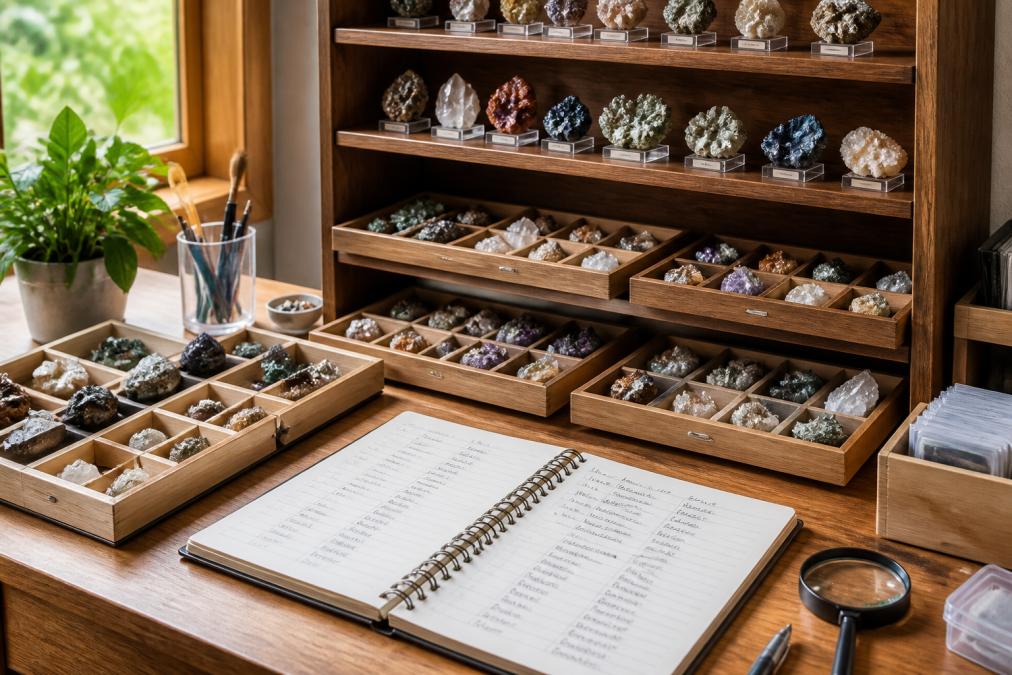
Storing Specimens Safely by Hardness and Fragility
The core principle is simple: harder minerals scratch softer ones. Never store a quartz point loose in the same tray as selenite or fluorite.
Storage guidelines:
- Wrap delicate specimens individually in soft cloth or foam
- Store specimens of similar hardness together
- Keep clusters and geodes elevated on stands to protect terminations
- Avoid direct sunlight for color-sensitive specimens
- Maintain consistent humidity
For a growing collection, shallow wooden trays with individual compartments work well. Museum putty can stabilize smaller pieces without damaging them.
Building a Simple Inventory and Cataloging System
A catalog transforms a pile of rocks into a real collection.
Minimum information to record for each specimen:
- Mineral name (and variety if applicable)
- Origin (country and region if known)
- Form (raw, tumbled, cluster, geode)
- Approximate size and weight
- Date acquired and source
- Purchase price
- Any notable features or inclusions
- Photo reference
A simple spreadsheet works. So does a dedicated notebook. The Mindat.org mineral database is an invaluable free reference for identifying specimens and recording accurate geological data.
Label each specimen with a small number that corresponds to its catalog entry. Museum-quality number labels are inexpensive and don't damage specimens.
Building Your Collection with Intention Over Time
A crystal collection built with intention means knowing what you're drawn to and making purchases that serve that vision rather than reacting to whatever catches your eye.
Practical principles for intentional collecting:
- Set a theme or focus: Some collectors specialize in a single mineral family. Others focus on specimens from a specific region.
- Establish a budget: Decide in advance what you're willing to spend per piece and per month.
- Build relationships with trusted sellers: A seller who knows your taste will alert you to pieces you'd actually want.
- Rotate your display: A collection that's always changing keeps you engaged and helps you notice which pieces you keep returning to.
- Document your reasons: When you acquire a piece, write down why. That note tells you more about your own taste than the specimen itself.
The best crystal collections are personal. They reflect the collector's eye, values, and evolving knowledge.
Starting a crystal collection means making dozens of small decisions that compound over time. The collectors who end up with something genuinely meaningful are the ones who slow down, ask questions, and buy from sources they trust. IG Crystal Archive, LLC offers hand-selected specimens, personally curated for quality and natural beauty, backed by 30-day free returns and secure professional packaging. Every purchase also supports our mission of assisting autistic adults and their families. Shop Crystals and start building something worth keeping.
=== FAQ ANSWERS (audit these too, same rules) ===
[1] Q: What are the best crystals for a beginner collection? A: Clear quartz, amethyst, and rose quartz are the most recommended starting points for new collectors. Clear quartz is versatile and widely available, amethyst is visually striking with strong metaphysical properties tied to calm and clarity, and rose quartz is associated with compassion and heart chakra alignment. Adding selenite and citrine rounds out a solid starter crystal kit. These five gemstones cover a broad range of vibrational frequencies and are easy to find in both raw and tumbled stone forms.
[2] Q: How do I identify high-quality, authentic crystals? A: Start with the Mohs hardness scale: genuine minerals have predictable hardness ratings you can test at home with common objects. Authentic crystals also show natural inclusions, color variation, and imperfections. Be cautious of stones with unnaturally vivid, uniform color, these are often dyed. Glass imitations feel warmer than real quartz and lack natural striations. Buying from curators who hand-select and personally inspect each specimen, and who can explain why they chose each piece, is one of the most reliable ways to avoid fakes.
[3] Q: How should I clean and maintain my crystal specimens? A: Physical cleaning depends on hardness. Hard minerals like quartz can be gently rinsed under lukewarm water and dried with a soft cloth. Softer stones like selenite (Mohs 2) should never be submerged, wipe them with a dry or barely damp cloth instead. Avoid harsh chemicals on any specimen. For spiritual cleansing, common methods include placing crystals in moonlight, using sound vibration, or setting them near selenite overnight. Store specimens away from direct sunlight to prevent fading, especially for amethyst and citrine.
[4] Q: Are there ethical considerations when buying crystals? A: Yes. Crystal mining can have significant environmental and labor impacts depending on the source country and extraction method. When building a crystal collection, look for sellers who are transparent about where their specimens come from and how they were sourced. Small, mission-driven businesses that hand-select their inventory are more likely to prioritize quality and accountability over volume. Asking sellers about their sourcing process is a reasonable and worthwhile step before purchasing, especially for higher-value specimens.
[5] Q: What is the best way to organize and display a crystal collection? A: Group specimens by hardness first to prevent damage, softer stones scratch easily when stored near harder minerals. Use small labeled trays, shadow boxes, or tiered shelving for display. For cataloging, a simple spreadsheet or notebook with each crystal's name, origin, date purchased, and Mohs hardness rating gives you a useful reference over time. Photographing each piece when you acquire it also helps track your collection and is especially useful if you ever want to insure high-value specimens.
[6] Q: How do I determine the value of a crystal specimen? A: Crystal value depends on several factors: rarity, size, clarity, color saturation, formation type (crystal cluster vs. raw stone vs. tumbled), and origin. A well-formed crystal cluster from a notable locality is generally worth more than a comparable tumbled stone. Condition matters too, chips and fractures reduce value. For pricing guidance on your own collection, check recent sold listings from reputable mineral shows or dealers. For pieces you are considering purchasing, pricing varies widely, so visit the seller's website for current figures rather than relying on generic estimates.
Frequently Asked Questions
What are the best crystals for a beginner collection?
Clear quartz, amethyst, and rose quartz are the most recommended starting points for new collectors. Clear quartz is versatile and widely available, amethyst is visually striking with strong metaphysical properties tied to calm and clarity, and rose quartz is associated with compassion and heart chakra alignment. Adding selenite and citrine rounds out a solid starter crystal kit. These five gemstones cover a broad range of vibrational frequencies and are easy to find in both raw and tumbled stone forms.
How do I identify high-quality, authentic crystals?
Start with the Mohs hardness scale: genuine minerals have predictable hardness ratings you can test at home with common objects. Authentic crystals also show natural inclusions, color variation, and imperfections. Be cautious of stones with unnaturally vivid, uniform color, these are often dyed. Glass imitations feel warmer than real quartz and lack natural striations. Buying from curators who hand-select and personally inspect each specimen, and who can explain why they chose each piece, is one of the most reliable ways to avoid fakes.
How should I clean and maintain my crystal specimens?
Physical cleaning depends on hardness. Hard minerals like quartz can be gently rinsed under lukewarm water and dried with a soft cloth. Softer stones like selenite (Mohs 2) should never be submerged, wipe them with a dry or barely damp cloth instead. Avoid harsh chemicals on any specimen. For spiritual cleansing, common methods include placing crystals in moonlight, using sound vibration, or setting them near selenite overnight. Store specimens away from direct sunlight to prevent fading, especially for amethyst and citrine.
Are there ethical considerations when buying crystals?
Yes. Crystal mining can have significant environmental and labor impacts depending on the source country and extraction method. When building a crystal collection, look for sellers who are transparent about where their specimens come from and how they were sourced. Small, mission-driven businesses that hand-select their inventory are more likely to prioritize quality and accountability over volume. Asking sellers about their sourcing process is a reasonable and worthwhile step before purchasing, especially for higher-value specimens.
What is the best way to organize and display a crystal collection?
Group specimens by hardness first to prevent damage, softer stones scratch easily when stored near harder minerals. Use small labeled trays, shadow boxes, or tiered shelving for display. For cataloging, a simple spreadsheet or notebook with each crystal's name, origin, date purchased, and Mohs hardness rating gives you a useful reference over time. Photographing each piece when you acquire it also helps track your collection and is especially useful if you ever want to insure high-value specimens.
How do I determine the value of a crystal specimen?
Crystal value depends on several factors: rarity, size, clarity, color saturation, formation type (crystal cluster vs. raw stone vs. tumbled), and origin. A well-formed crystal cluster from a notable locality is generally worth more than a comparable tumbled stone. Condition matters too, chips and fractures reduce value. For pricing guidance on your own collection, check recent sold listings from reputable mineral shows or dealers. For pieces you are considering purchasing, pricing varies widely, so visit the seller's website for current figures rather than relying on generic estimates.
This article was written using GrandRanker