Is Synthetic Amethyst Worth Buying? 2026 Guide
Table of Contents
- Synthetic vs Natural Amethyst: What You're Actually Comparing
- How Lab-Created Amethyst Is Made
- Natural, Lab-Created, and Imitation Stones Compared
- Synthetic Amethyst Value: What It Costs and What It's Worth
- Are Synthetic Gemstones Worth Anything? Resale and Long-Term Expectations
- How to Tell If Amethyst Is Real: Tests and Warning Signs
- Buy or Don't Buy: Matching the Stone to Your Goal
- A Practical Buying Checklist and Questions to Ask Sellers
- Conclusion: When Synthetic Amethyst Is the Right Call
- Frequently Asked Questions
Last Updated: October 8, 2026
Synthetic vs Natural Amethyst: What You're Actually Comparing
Is synthetic amethyst worth buying? For most jewelry and decor buyers, yes, if you want the amethyst look at a lower cost and know what you're getting.
At IG Crystal Archive, we handle natural specimens daily, and the questions we get most often are about authenticity: whether the stone came out of the earth.
Natural amethyst is purple quartz formed over long periods in the earth, with internal features that record how it grew. Lab-created amethyst is purple quartz grown quickly under controlled conditions, chemically identical but without that geological history. Imitation amethyst is neither: it is usually colored glass or another material dressed up to look like the real thing.

The distinction matters because these three categories have different price points, durability, and long-term value.
U.S. Federal Trade Commission guidance on jewelry advertising and disclosure
How Lab-Created Amethyst Is Made
Lab-created amethyst is grown from a quartz solution in a controlled environment, where temperature and chemistry are managed to produce purple crystals on purpose, mimicking natural conditions but compressing years into a much shorter window.
The result has the same hardness and basic optical properties as natural amethyst, and cuts, polishes, and wears the same way.
The trade-off: you get the material and the look, but lose the geological story and rarity. For a piece you'll wear or display, that trade is often good. For resale or passing down, it usually is not.
Natural, Lab-Created, and Imitation Stones Compared
The three categories differ in origin, price, and how they hold value. Here is the side-by-side picture.
| Type | What It Is | Relative Price | Holds Value? |
|---|---|---|---|
| Natural amethyst | Mined purple quartz | Highest | Yes, for quality pieces |
| Lab-created amethyst | Grown purple quartz | Low to moderate | Rarely |
| Imitation (glass) | Colored or dyed glass | Lowest | No |
Natural amethyst commands the highest prices because supply is limited and quality varies. Lab-created amethyst is affordable because it can be produced on demand. Imitation stones are cheapest and easiest to spot once you know what to look for.
One point buyers often miss: lab-created amethyst is still a real gemstone, not fake. "Fake" belongs to imitation stones, which are not quartz at all. Confusing these two categories is the most common mistake we see.
Synthetic Amethyst Value: What It Costs and What It's Worth
Synthetic amethyst value is low on purpose: unlimited production means no scarcity to drive prices up.
Here is the range most buyers encounter in the retail market, typical asking prices, not appraisals, which move with the seller, setting, and season.
| Stone | Natural (mined) | Lab-created | Imitation (glass) |
|---|---|---|---|
| 1-carat faceted round | $20-$80 | $2-$15 | Under $2 |
| 5-carat faceted oval | $80-$400 | $10-$40 | $3-$10 |
| 10-carat faceted cushion | $200-$1,200 | $20-$80 | $5-$20 |
| Polished tower, 4-6 in. | $40-$250 | $15-$60 | $10-$30 |
| Collector specimen, large | $300-$3,000+ | Rarely sold as specimens | Not applicable |
The pattern is consistent: lab-created amethyst typically runs 80-95% below natural stone of comparable size and color.
Three variables move the natural price more than anything else:
- Color saturation. Deep, even "Siberian"-grade purple commands a premium. Pale or brownish amethyst sits at the bottom of the range.
- Clarity. Eye-clean stones with no visible inclusions price higher. Heavily included material is often sold as tumbled or decor stock.
- Size. Natural amethyst is plentiful in small sizes and increasingly scarce above roughly 20 carats of clean material. That is where the price curve steepens.
That doesn't make lab-created amethyst worthless, it makes it cheap, which is different.
Are Synthetic Gemstones Worth Anything? Resale and Long-Term Expectations
Are synthetic gemstones worth anything on resale? Generally, no, and the mechanism explains the whole category.
Lab-created amethyst has no scarcity: any buyer can order a new one tomorrow at roughly the price you paid, so the secondary market has no reason to pay near retail.
Natural amethyst behaves differently, but only at the higher end. The resale picture breaks into three tiers:
- Commercial-grade natural amethyst. Common color, common size, visible inclusions. Resale is limited and typically well below retail. This is the bulk of what is sold, and it does not function as an investment.
- Fine natural amethyst. Strong saturation, eye-clean clarity, larger sizes, well cut. This tier holds value better and can resell near or occasionally above original retail in a strong market.
- Exceptional specimens. Deep color, large clean crystals, unusual formations, documented origin. This is the tier where collectors compete, and where value can grow over years.
A few practical realities shape what you recover:
- Jewelry resale is not stone resale. A lab-created amethyst in a gold setting may recover some value through the metal, but the stone itself contributes little. Buyers price the setting, not the gem.
- Documentation matters. Natural stones with a gemological report from a recognized lab resell more easily and at better prices than undocumented stones of equal appearance. Without paperwork, buyers discount for uncertainty.
- Time is not on the lab-created side. Unlike natural material, lab-created supply does not shrink. If production costs fall, retail prices fall with them, which drags resale down further.
- Specimen resale is its own market. Natural crystal specimens sell to collectors on condition, locality, and aesthetics. Lab-created material is rarely collected this way, so it has almost no specimen resale channel.
If resale matters, buy natural and buy quality. If not, buy lab-created and enjoy the savings. The mistake is buying lab-created while expecting natural-stone returns, a category error, not bad luck.
Treat lab-created amethyst as a purchase, not an investment. Treat natural amethyst as a purchase that may also hold value, but only when color, clarity, size, and documentation are all strong.
Amethyst Crystal Sphere | Dreamy Lavender Quartz Ball (~2.5 inches) →
How to Tell If Amethyst Is Real: Tests and Warning Signs
Learning how to tell if amethyst is real starts with knowing "real" has two meanings: a lab-created stone is real quartz, an imitation stone is not. So the first question isn't real versus fake, it's natural versus lab-created versus glass.
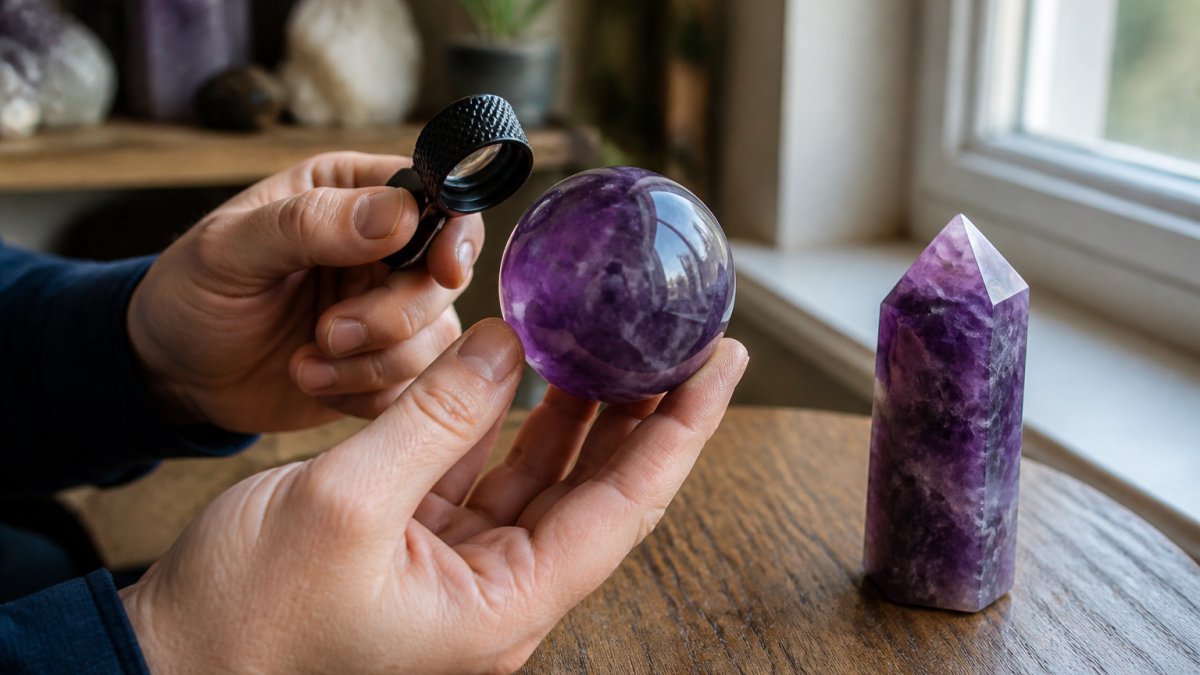
A few practical checks help at home:
- Look for color zoning. Natural amethyst often shows uneven color, with lighter and darker patches. Perfectly uniform color across a large stone is a lab-created signal.
- Examine the inclusions. Natural stones usually carry some internal features: veils, growth lines, small mineral inclusions. Glass may contain round bubbles, which never appear in quartz.
- Check the temperature. Quartz feels cool to the touch and warms slowly. Glass warms faster.
- Look at the price. A large, flawless, deeply colored stone at a very low price is not a bargain. It is a clue.
None of these tests is definitive on its own. For anything expensive, gemological testing by a qualified lab is the only reliable answer.
Disclosure, Labeling, and What Sellers Must Tell You
In the United States, sellers are expected to disclose that a gemstone is lab-created or imitation. The FTC's jewelry guides set out how gemstone products should be described and marketed, and treating a lab-created stone as natural is a misrepresentation.
In practice, disclosure varies. Reputable sellers state origin clearly and answer questions directly. Others rely on buyer assumptions. If a listing does not say whether a stone is natural, lab-created, or glass, ask before you buy, and get the answer in writing.
Buy or Don't Buy: Matching the Stone to Your Goal
The buy-or-don't-buy answer depends on what you want the stone to do.
Buy lab-created amethyst if: you want the amethyst look for jewelry or decor at a low price, you are not concerned with resale, and you understand you are buying a manufactured product.
Buy natural amethyst if: you are collecting, you care about rarity and provenance, you want a piece that may hold value, or you simply want a stone with a geological story behind it.
For most first-time buyers: decide your goal before you shop. For beauty on a budget, lab-created is sensible.
A Practical Buying Checklist and Questions to Ask Sellers
Use this checklist before any amethyst purchase, two minutes that prevents the most common regrets.
- Confirm the type: natural, lab-created, or imitation
- Ask for the origin if the stone is natural
- Check for color zoning and inclusions under good light
- Compare the price against the stated type, not against the color
- Ask about the return policy before you pay
- Request additional photos in natural light for online purchases
- Get disclosure of any treatments in writing
Questions worth asking every seller:
- Is this stone natural, lab-created, or glass?
- If natural, where was it mined?
- Has it been treated, dyed, or heat-treated?
- What is your return policy if the stone is not as described?
- Can you send photos in daylight before shipping?
A seller who welcomes these questions is worth buying from; one who resists them is not.
For buyers who want natural pieces without the guesswork, our Amethyst Tower shows the natural color zoning and layered inclusions that lab-created material cannot reproduce. Each piece is individually photographed, so you see the exact specimen you will receive.

Conclusion: When Synthetic Amethyst Is the Right Call
Synthetic amethyst is the right call when you want amethyst's look, color, and durability without paying for rarity you don't need. It's the wrong call for collection value or resale, where only natural stone competes.
The harder problem is finding natural amethyst you can trust. IG Crystal Archive hand-selects every specimen, inspects each piece for quality, and photographs each individually so you know exactly what's arriving.
Shop crystals with IG Crystal Archive and buy a natural specimen you can actually verify.
Frequently Asked Questions
Is synthetic amethyst the same as natural amethyst?
They share the same chemical makeup, silicon dioxide with iron giving the purple color, but they form differently. Natural amethyst grows over thousands of years inside geodes and crystal pockets, which is why it shows color zoning, inclusions, and internal variation. Lab-created amethyst is grown in controlled conditions in weeks, so it tends to be cleaner and more uniform. Both are real quartz. Only one is a natural mineral specimen.
Is synthetic amethyst considered fake?
No, and this is where terminology matters. A synthetic or lab-created amethyst is still amethyst by chemistry, just grown in a lab rather than mined. It becomes fake only when a seller passes it off as natural. Imitation stones, such as colored or dyed glass, are a different category entirely. If a seller discloses the stone is lab-created, nothing about the sale is deceptive.
Does synthetic amethyst hold its value?
It does not appreciate the way natural specimens can. Lab-grown material is cheap to produce and supply is effectively unlimited, so resale prices stay near production cost. Natural amethyst value depends on color saturation, clarity, size, and rarity, and fine specimens can command far more per carat. If resale matters to you, buy natural. If you want beauty at a low price, synthetic delivers.
How much is 1 oz of amethyst worth?
There is no single answer, because price depends on quality, not weight alone. Low-grade tumbled material sells for a few dollars per ounce, while deeply saturated faceted stones with clean clarity can run into the hundreds per carat. Lab-created amethyst sits at the bottom of the range regardless of weight. Natural amethyst with strong purple color and few inclusions sits at the top.
Is lab-created amethyst a good choice for jewelry?
It can be. Lab-created amethyst has the same hardness as natural amethyst, about 7 on the Mohs scale, so it wears the same in a ring or pendant and handles daily use reasonably well. It also costs far less, which makes it practical for large statement pieces or gifts. The trade-off is resale value and the collector appeal that natural specimens carry.