Polished Fossil Coral: Buying Guide for Collectors
Last Updated: October 22, 2026
Quick Summary
Polished fossil coral is ancient coral that has been cut and smoothed to reveal the colony structure preserved inside the stone, with silica often replacing the original skeleton. Collectors value pieces for pattern quality, translucency, size, and condition, and agatized fossil coral with banded translucency sits at the top of the range.
- Agatized fossil coral hardness sits around 6.5 to 7 on the Mohs scale.
- Value rises disproportionately once a piece passes roughly 6 to 8 inches in height or width.
- Ask for a backlit photo to confirm translucency before buying.
- Dust with a dry microfiber cloth and skip ultrasonic cleaners and steam.
- Buy rough or slab material rather than finished display pieces for lapidary work.
Table of Contents
- What Polished Fossil Coral Actually Is
- Polished Fossil Coral Types Compared Side by Side
- The Agatized Fossil Coral Difference
- What Drives Fossil Coral Value
- Fossil Coral Rarity: What Is Actually Hard to Find
- How to Spot Authentic vs. Treated Pieces
- Display, Lapidary, or Jewelry: Matching the Specimen to the Use
- Care, Cleaning, and Durability
- Frequently Asked Questions
What Polished Fossil Coral Actually Is
Polished fossil coral is ancient coral that has been cut and smoothed to reveal the colony structure preserved inside the stone. At IG Crystal Archive, we handle these pieces often, and the reaction is always the same: people expect a rock and get a fossilized reef.

The stone began as a living coral colony, millions of years ago, on a shallow sea floor. Over time, mineral-rich water seeped through the skeleton and replaced the original material with silica.
That is why a finished piece reads as a pattern rather than a plain surface. The flower-like shapes you see are the fossilized coral structure itself, not a carving or a dye job.
From Living Colony to Stone
The conversion process is the whole story of why these pieces look the way they do.
A coral colony builds a skeleton of calcium carbonate (Corals Tutorial: What are corals?). When the colony dies, the skeleton can be buried in sediment and left undisturbed for an extremely long time. Groundwater carrying dissolved silica slowly replaces the carbonate, molecule by molecule, until the fossil is largely silica rather than the original mineral.
Geologists call this replacement silicification. When the silica settles in a banded, translucent form, the result is agatized fossil coral. The colony pattern survives the swap, which is why a polished specimen shows both the coral's growth structure and the glassy character of agate in the same piece.
Polished Fossil Coral Types Compared Side by Side
Types of polished fossil coral differ mainly by form, finish, and what the cut reveals. A tower, a sphere, and a flat slab can all come from the same material, yet each shows the colony structure differently.
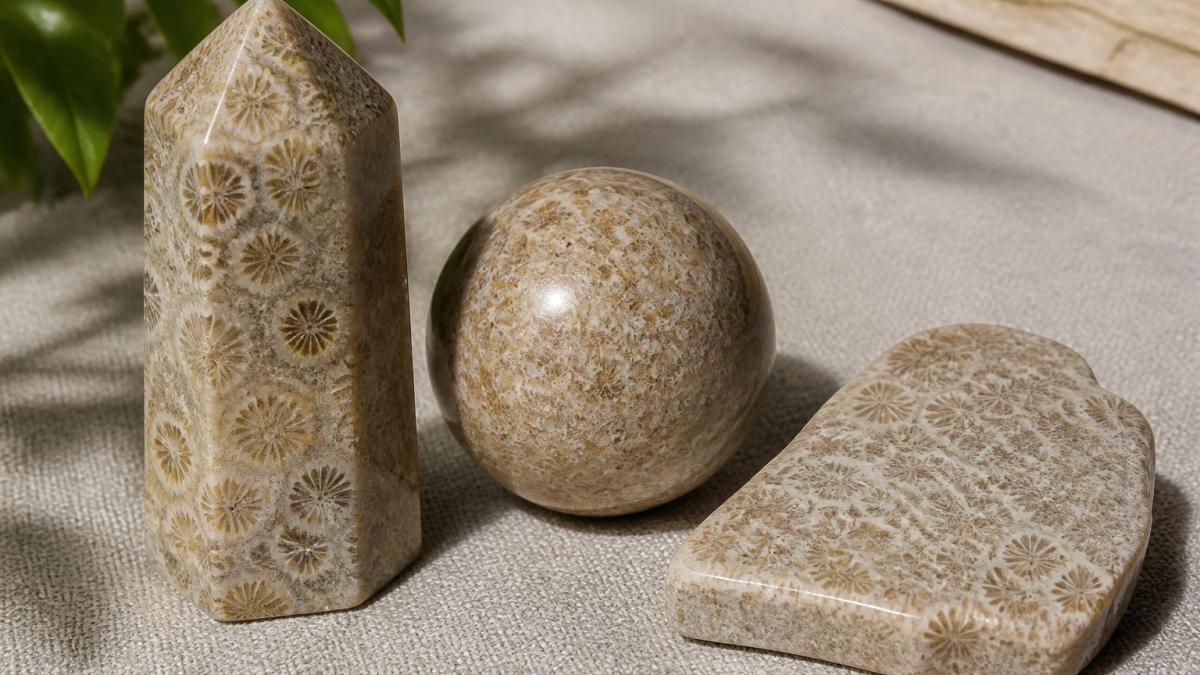
Here is how the main forms compare in practice:
| Form | What It Shows | Best Use | Handling Notes |
|---|---|---|---|
| Tower | Full pattern on six sides | Shelf and mantel display | Tall, tip-heavy; keep away from edges |
| Sphere | Pattern wraps continuously | Desk or pedestal display | Rolls easily; needs a stand |
| Flat slab or flatback | Wide, readable pattern | Framing, cabochon cutting | Thin edges chip if dropped |
| Polished dish | Pattern across a shallow bowl | Catchall or accent piece | Interior scratches with abrasive use |
| Matched pair | Mirroring pattern across two pieces | Bookends, symmetrical display | Keep together; patterns are paired |
The tower form is the one most people picture when they hear polished fossil coral. Our Polished Fossil Coral Tower runs about 9.5 inches tall, which is large enough to read the patterning from across a room.
A common mistake is judging these pieces from a single photo angle. Ask for views of more than one face before you buy. The pattern on the back is often the better one.
The Agatized Fossil Coral Difference
Agatized fossil coral is fossil coral in which silica has replaced the original skeleton in a translucent, banded form. That translucency is the difference between a good piece and a great one.
Plain silicified coral can look flat and chalky. Agatized material holds light at the surface, so the pattern appears to sit under a layer of glass. Hold a piece up to a window and you should see some glow through the thinner sections.
Color runs from cream and taupe to gray and warm brown. According to the Smithsonian National Museum of Natural History's mineralogy resources, fossilization conditions like these determine which minerals end up in the final stone, which is why pieces from different regions look so different.
Hardness sits around 6.5 to 7 on the Mohs scale for agatized material. That is hard enough for jewelry and display, but it will scratch if you store it loose with harder stones.
What Drives Fossil Coral Value
Fossil coral value comes down to four things: pattern quality, translucency, size, and condition. Price follows those factors, not the label on the shelf. Because top-ranking results show individual listings but rarely explain how those prices are set, here is a practical framework for reading value before you compare two pieces.
Pattern is the first thing to assess. A piece with a bold, symmetrical colony pattern and clear definition commands more than one with a muddled or faint surface.
Translucency and color come next. Agatized pieces with even, warm tones and some light transmission sit at the top of the range. Flat, opaque, grayish material sits at the bottom.
Size matters because large, clean pieces are harder to cut. A tall tower or a wide slab with no fractures is worth more than several small pieces combined.
Condition is the fourth factor. Chips, hairline cracks, and dull patches all reduce value. Check the base and the edges, where damage hides.
Workmanship adds a fifth factor that listings rarely spell out.
Because prices vary by size, pattern, and finish, compare pieces at similar dimensions rather than across categories. A small cabochon-grade slab and a large display tower are different products with different value drivers, and judging one against the other leads to bad decisions.
Fossil Coral Rarity: What Is Actually Hard to Find
Fossil coral rarity is not about the material being scarce overall. It is about specific combinations being scarce. Plenty of fossil coral exists. Large, clean, well-patterned, agatized pieces do not.
The common material is small, fractured, or dull. The hard-to-find material is a large block with an unbroken colony pattern and good translucency. That is why two pieces of similar weight can sit far apart in price.
Polished Fossil Coral Tower | Agatized Ocean Stone Décor (Approx. 9.5 inches) →
Species identification adds another layer. Rugose coral, an extinct order often called horn coral, shows a different structure than the colonial corals most display pieces come from.
Geographic origin matters too. Material from different regions shows different color ranges and pattern density. A seller who can tell you the origin and the period is a seller who knows the stock.
How to Spot Authentic vs. Treated Pieces
Authenticity checks for polished fossil coral are simple and mostly visual. You are looking for evidence that the pattern is internal and structural, not applied to the surface.
Dyed material is the most common issue. Dye settles in cracks and pores, so look for color that pools in lines rather than following the coral structure. Genuine fossil coral color is uneven in a natural way and follows the pattern.
Reconstituted or composite material is the second issue. If the pattern looks printed, repeats suspiciously, or stops abruptly at an edge, walk away.
Heat treatment and stabilization are less common but worth asking about. Stabilized material may feel slightly lighter or show a resinous sheen under strong light. A seller who discloses treatment is more reliable than one who does not.
Checks You Can Do Before You Pay
Run through this list before any purchase:
- Ask for photos of at least three faces of the piece
- Request a backlit photo to confirm translucency
- Look for dye pooling in cracks or along the base
- Confirm the pattern continues through the edges rather than stopping at the surface
- Ask for the origin and geological period
- Ask whether the piece has been dyed, stabilized, or repaired
- Check the return policy before checkout
That last item matters more than most buyers think. A no-return policy on a stone you have only seen in photos is a real risk.
Documentation is the final check. A seller who can name the region, the geological period, and any treatments is a seller who knows the stock. If the listing is vague on all three, treat the piece as unidentified material and price it accordingly.
Display, Lapidary, or Jewelry: Matching the Specimen to the Use
Matching a specimen to its use prevents the most expensive mistake in this hobby: buying a beautiful piece that does not fit how you live with it.
For display, size and stability matter most. A tall tower needs a shelf with clearance and a spot away from foot traffic. A sphere needs a stand.
For lapidary work, buy rough or slab material rather than finished display pieces. You want clean, unfractured sections with good pattern coverage.
For jewelry, cabochon-grade material is the target. That means thin, clean slabs with tight patterns and no fractures. Flatback cuts are the usual starting point.
Our Orthoceras Fossil Stone Starfish Set of 2 shows how fossil stone works as a small decorative pair rather than a single statement piece.

Care, Cleaning, and Durability
Care for polished fossil coral is straightforward: keep it dry, keep it soft, and keep it out of direct sun.
Dust with a dry microfiber cloth. For a deeper clean, use a barely damp cloth with plain water and dry immediately. Skip ultrasonic cleaners and steam.
Store pieces separately or wrapped.
Sun exposure is a slow problem. Display pieces kept in direct window light for years can shift in color. A shelf away from the window solves it.
Durability is good for display and occasional handling. It is not a stone for rings worn daily, and it is not a stone for the kitchen or bathroom.
Buying polished fossil coral is really a test of patience.
Frequently Asked Questions
Are fossilized corals worth money?
Yes, but the range is wide. Small polished pieces and carvings often sell for under $30, while large, well-polished display specimens with dense, clearly defined coral patterns can run well over $100. Value comes down to pattern density, size, polish quality, and how intact the original colony structure is. A 9.5-inch polished fossil coral tower, for example, sits at the higher end because large blocks of solid, pattern-rich material are harder to source and cut without flaws. Condition matters too: cracks, dull patches, and heavy filler all pull the price down.
Is fossilized coral rare?
Fossil coral itself is not rare in the way gemstones like tanzanite are. Deposits exist in several regions, and material is mined in commercial quantities. What is rare is good material: pieces with crisp, high-contrast colony patterns, no fractures, and enough solid mass to carve into a tower or sphere. Much of what is dug up is fractured or pale and ends up as tumbled chips. So the rarity question is really about grade, not species. Expect to pay more for specimens where the coral structure reads clearly across the whole face.
How can you tell if fossil coral is genuine?
Look at the pattern under magnification. Real fossil coral shows repeating, organic colony structures, the same flower-like or honeycomb shapes repeating with slight natural variation. Dyes tend to pool in cracks and look too uniform in tone. Ask the seller whether the piece is natural, heat-treated, or dyed, and whether it has been stabilized with resin. Reputable sellers will state this plainly and show the exact piece you will receive. Weight and temperature help too: stone feels cold and dense, while resin-heavy fakes feel light and warm.
How do you care for a polished fossil coral specimen?
Keep it dry and out of direct sun. Dust with a soft, dry cloth or a slightly damp one, then dry immediately. Skip ultrasonic cleaners and steam, and avoid acidic household cleaners, which can dull the polish over time. Fossil coral is softer than quartz, so store display pieces where they will not knock against harder stones. For a tower or sphere, a felt pad underneath prevents scratches on both the specimen and your shelf. Handle with clean hands; oils and lotions leave film on a polished surface.