Rare Mineral Treasures for Serious Collectors
Table of Contents
- What Makes a Mineral Treasure Investment-Grade?
- Rare Mineral Treasures for Serious Collectors: 10 Standout Specimens
- Evaluating Specimen Quality: A Mineral Specimen Appraisal Guide
- Provenance and Authentication: Verifying Rare Mineral Treasures
- Best Practices for Mineral Storage and Display
- Tax, Insurance, and Digital Collection Management
- Conclusion
- Frequently Asked Questions
Last Updated: September 15, 2026
What Makes a Mineral Treasure Investment-Grade?
A mineral treasure earns investment-grade status through four measurable qualities: specimen integrity, aesthetic value, documented provenance, and geological rarity. Miss one and you own a pretty rock, not an asset.
Rare Mineral Treasures for Serious Collectors: 10 Standout Specimens
Below are ten pieces showing what serious collectors should look for: strong crystal habit, clean integrity, and genuine one-of-a-kind character.
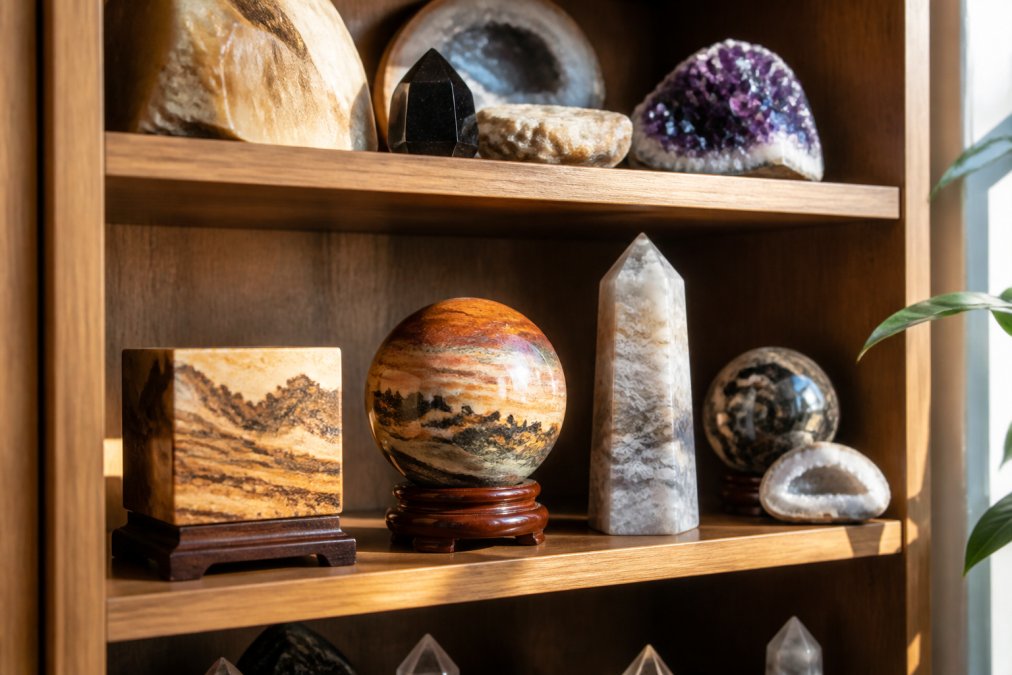
1. Picture Jasper Cube
The Rare Picture Jasper Cube ($49.99) is the best entry point for reading landscape patterning in stone. Every face reveals a different miniature scene, formed by iron and mineral inclusions rather than any hand.

2. Picture Jasper Diptych Pair
Sold as a matched pair at $35.99, the Nature Painted Picture Jasper Pair works like a geological diptych: together the two slices read as one desert horizon split across two stones.
3. Scenic Jasper Crystal Sphere
The Scenic Jasper Crystal Sphere ($120.99) holds landscape-like formations across its surface, so rotating it reveals new imagery each time.
4. Fossil Coral Tower
Agatized fossil coral preserves the polyp structure of an ancient reef colony. The Natural Fossil Coral Tower ($90.00) stands about 8 inches tall with hundreds of fossil patterns on a charcoal background.
5. Matching Lace Agate Tower Pair
The Matching Lace Agate Tower Pair ($129.99) is the strongest display set here: two roughly 11-inch six-sided points with mirrored lavender, cream, and taupe banding.
6. Citrine Geode Sphere
An open geode cavity inside a polished sphere is uncommon. The Citrine Geode Sphere ($49.00) shows golden druzy points against a dark matrix; the contrast sells it.
7. Smoky Quartz Cluster
Raw specimens belong in serious collections too. This Natural Smoky Quartz Cluster ($64.00) measures roughly 3 by 2.5 inches with multiple terminated points and genuine translucency.
8. Titanium Aura Quartz Cluster
Titanium Aura Quartz Cluster ($99.99) is treated, and we label it that way. Its iridescent violet, green, and blue flashes come from a titanium bonding process, not geology. Buy it for drama, not natural rarity.
9. Pietersite Sphere
Pietersite is a rare earth mineral composite, and the Natural Pietersite Sphere ($49.99) at 55mm shows the stormy gold, blue, and charcoal chatoyancy that makes the species hard to source.
10. XL Blue & Earth Tone Tower
At roughly 15 inches, the XL Blue & Earth Tone Crystal Tower ($119.99) is the statement piece: deep blue washes over olive and rust matrix, and no two sides look alike.
Evaluating Specimen Quality: A Mineral Specimen Appraisal Guide
A mineral specimen appraisal guide starts with physical characteristics: luster, transparency, crystal habit, and the absence of repair or restoration. Appraisers score these before market comparables, a repaired specimen with spectacular color is still repaired.
Most professional appraisers use a four-part framework:
- Condition, terminations, edges, and matrix attachment. Any grinding, polishing, or reattached crystal is a material defect.
- Aesthetics, color saturation, symmetry, contrast against matrix, and display orientation.
- Rarity, species scarcity, locality scarcity, and whether the specimen is a one-off or one of thousands from the same pocket.
- Documentation, labels, prior collection history, and any analytical work confirming identity or treatment status.
Work through this checklist before you buy or insure anything:
- Terminations are intact with no grinding or polishing to hide damage
- Luster is consistent across faces, not dulled in patches
- Transparency is even, with no cloudy zones from improper cleaning
- Matrix attachment is natural and stable
- Fluorescence, if present, is documented under UV
- No dye, coating, or fracture-filling is visible under magnification
- Weight and dimensions are recorded in metric and imperial
- Any repair or restoration is disclosed in writing, with the extent described
The most common mistake new buyers make is falling for color intensity alone. Dyed agate and coated quartz photograph beautifully and appraise poorly.
How to Actually Detect Treatment and Repair
Four field-usable methods cover most cases:
- Magnification (10x loupe or better). Dye concentrates in fractures and grain boundaries, so color that pools along cracks rather than sitting inside the crystal is a red flag. Coated specimens often show a subtle edge where the coating stops, usually near the base or along a cleavage.
- UV light. Many fracture-fillers fluoresce a different color than the host mineral. A longwave UV lamp is inexpensive and catches epoxy and resin fills that are invisible under normal light.
- Acetone swab. On an inconspicuous area, a cotton swab dampened with acetone will lift dye from a dyed specimen. Never do this on a specimen you have not yet purchased without the seller's permission, and never on a porous or soluble species.
- Thermal and weight cues. Glass and resin imitations feel warm to the touch and are noticeably lighter than the mineral they imitate. A specific gravity test, done with a scale and a beaker of water, will separate quartz from glass every time.
For anything above a few hundred dollars, independent verification through a recognized lab or a credentialed appraiser is worth the cost. The Gemological Institute of America's gem identification services remain the standard reference for treatment detection and origin work, and many regional gemological laboratories offer comparable services for mineral specimens specifically.
Appraisal Values vs. Market Values
Collectors often confuse two numbers. An appraisal value is what a credentialed appraiser writes for insurance or estate purposes, typically reflecting replacement cost.
Provenance and Authentication: Verifying Rare Mineral Treasures
Best Practices for Mineral Storage and Display
Ultraviolet Light: What It Actually Does
Practical controls:
Humidity: The Species-by-Species Problem
Physical Contact and Handling
Storage as Fraud Prevention
Tax, Insurance, and Digital Collection Management
| Field | Example Entry | Why It Matters |
|---|---|---|
| Specimen ID | IGC-0142 | Ties photos to records |
| Species | Pietersite | Classification and comps |
| Locality | Namibia | Provenance and rarity |
| Dimensions | 55 mm sphere | Insurance and shipping |
| Acquisition cost | $49.99 | Basis for tax and claims |
| Treatment status | Natural, untreated | Resale integrity |
| Storage location | Cabinet B, shelf 2 | Recovery after loss |
Conclusion
Frequently Asked Questions
What defines an investment-grade mineral specimen?
Investment-grade mineral specimens combine rarity, exceptional specimen quality, and strong provenance. Key factors include the mineral species, crystal habit, luster, transparency, and whether the specimen is naturally formed without treatment. A rare mineral treasure typically has documented origin, minimal damage, and aesthetic value that appeals to serious collectors. Appraisal by a qualified gemologist or mineralogist helps confirm both authenticity and market value before you commit to a purchase.
How do I verify the authenticity of rare mineral treasures?
Start by requesting provenance documentation and seller transparency about any treatments or enhancements. Look for natural crystal habit, matrix attachments, and fluorescence under UV light where applicable. Reputable sellers like IG Crystal Archive provide exact piece photos and detailed descriptions so you know what you are getting. For high-value specimens, a third-party appraisal from a credentialed mineralogist offers independent verification and can catch dyed, irradiated, or lab-grown fakes before you buy.
How should rare mineral specimens be stored and displayed?
Best practices for mineral storage include keeping specimens out of direct sunlight to prevent fading, especially for amethyst and fluorite. Use padded shelves or individual stands to avoid scratches and tip-overs. Control humidity to prevent oxidation on sulfide minerals. For delicate pieces like fossil coral or druzy clusters, consider a closed cabinet with silica gel packs. Label each specimen with its mineral classification and acquisition date to maintain a useful record for insurance and future appraisal.
What factors influence the value of a rare mineral?
Value depends on rarity index, specimen integrity, size, color saturation, and provenance. A rare earth mineral with perfect crystal habit and no repairs commands higher prices than a common species with damage. Aesthetic value, including how the piece displays as a natural sculpture, matters to collectors. Market demand for specific mineral species also shifts over time. Documented collection history from a known source adds measurable premium and makes appraisal more straightforward.
Where can I find reputable sources for rare mineral specimens?
Look for sellers who provide exact piece photos, disclose treatments, and offer returns. IG Crystal Archive hand-selects each specimen, inspects for quality, and ships with secure packaging. Their 30-day free returns let you evaluate a piece in person. For serious collectors, building a relationship with a curator who understands sourcing and can explain why each piece was selected adds confidence that online marketplaces rarely match.