Supporting Social Missions Through Crystal Shopping
Table of Contents
- Why Your Crystal Purchase Is a Vote for the World You Want
- Where to Buy Ethically Sourced Crystals: A Practical Guide
- How to Verify Ethical Crystal Sourcing: A Step-by-Step Framework
- Supporting Neurodiversity Through Retail: What It Looks Like in Practice
- Measuring Impact: How to Tell If a Crystal Shop Walks Its Talk
- From Quarry to Doorstep: The Supply Chain Transparency Checklist
- Building a Collection That Reflects Your Values
- Frequently Asked Questions
Last Updated: September 14, 2026
Why Your Crystal Purchase Is a Vote for the World You Want
Every dollar you spend is a small ballot. When you buy a crystal, you're casting that vote for a specific supply chain, a specific set of labor practices, and a specific set of values. Supporting social missions through crystal shopping means treating each purchase as a deliberate choice about the kind of world you want to fund.
At IG Crystal Archive, we built our entire business around that idea. We hand-select every specimen, and a portion of what we do goes toward supporting autistic adults and their families. This guide covers how to spot genuine mission-driven sellers, how to verify ethical sourcing, and how to measure real impact instead of marketing language.

Where to Buy Ethically Sourced Crystals: A Practical Guide
The best place to buy ethically sourced crystals is a seller who can name their supply chain, explain their sourcing standards, and show you documentation on request.
Look for sellers who publish their sourcing philosophy, work with known suppliers, and answer direct questions about provenance without deflection. The Federal Trade Commission's guidance on environmental marketing claims is a useful reference here: vague terms like "sustainable" or "ethical" mean little without specifics behind them.
Red Flags to Avoid When Shopping Online
- No sourcing information anywhere on the site
- Prices far below market rate for rare specimens
- Stock photos instead of actual product images
- Refusal to answer provenance questions
- Claims like "100% conflict-free" with zero explanation of how that's verified
Questions to Ask Before You Check Out
- Where was this specimen mined or sourced?
- Can you tell me who your supplier is?
- How do you verify working conditions at the source?
- What percentage of your revenue supports your stated mission?
- Do you offer returns if the piece isn't right for me?
A seller who welcomes these questions is usually a seller worth trusting.
How to Verify Ethical Crystal Sourcing: A Step-by-Step Framework
Verification is where most buyers stop short. Anyone can print "ethically sourced" on a product page. Actually confirming it takes a repeatable method, and a working knowledge of the standards that already exist in the gemstone trade.
Start With the Standards That Already Exist
You don't have to invent your own ethics rubric. Several established frameworks do most of the work for you:
- Kimberley Process Certification Scheme. A United Nations-backed framework the United States implements through the Clean Diamond Trade Act, requiring rough diamonds to move with government-validated certificates confirming they are conflict-free. It applies to rough diamonds, not to amethyst, quartz, or most tumbled stones, so don't let a seller imply it covers everything.
- Responsible Jewellery Council (RJC). A membership and certification body that audits supply chain practices, including labor and environmental standards, across the jewelry and gemstone trade (How to Become an RJC Certified Member • Responsible Jewellery Council). A seller who names an RJC-certified supplier is giving you something checkable.
- Fairmined and Fairtrade Gold standards. Relevant mainly to gold settings and findings, but useful when a piece combines a stone with metalwork.
- Federal Trade Commission (FTC) guidance. The FTC's Green Guides set the bar for environmental marketing claims. If a shop says "sustainable" or "eco-friendly" without qualification, that language is legally expected to be substantiated, and often isn't.
A seller who can name which of these apply to their supply chain, and which don't, is already ahead of most of the market.
The Four-Layer Verification Method
Layer 1: Documentation. Ask for supplier names, country or region of origin, and any third-party certification. If the answer is "our supplier prefers to remain private," treat that as a data point, not a dead end, some small-scale miners genuinely need anonymity, but a legitimate seller will explain why.
Layer 2: Consistency. Cross-check the seller's claims across their site, social media, and past customer reviews. Contradictions surface fast. A shop that says "direct trade" on its About page but can't name a single mining partner on its product pages is telling you something.
Layer 3: Specificity. Vague claims are the norm; specific ones are the signal. "Sourced from a family-run operation in Minas Gerais, Brazil" is verifiable. "Ethically sourced from around the world" is not. The more a seller narrows the geography and the relationship, the more likely the claim is real.
Layer 4: Direct conversation. Ask a specific question and see how they respond. Sellers with real supply chain transparency answer directly. Sellers without it get vague, defensive, or pivot to a mission statement.
What "Traceable" Actually Means
Traceability exists on a spectrum, and it helps to know where a seller sits:
- Country of origin only. The weakest useful claim. Better than nothing, but it tells you nothing about labor conditions.
- Region or mine-level origin. Stronger. This is where you can start cross-referencing known mining areas and their reputations.
- Named supplier or cooperative. Strongest for small sellers. You can often look the supplier up independently.
- Mine-to-market documentation. Rare for crystals outside the diamond and high-end colored stone trade. If a shop claims this, ask to see it.
Most ethical small sellers land in the middle two tiers.
A Quick Red-Flag Scan
- "100% conflict-free" with no explanation of how that's verified
- Certification logos with no certificate number or issuing body named
- Mission language on every page but no sourcing language anywhere
- Prices far below market rate for rare specimens
- Refusal to answer a specific provenance question
None of these is proof of bad faith on its own. A pattern of them is.
Supporting Neurodiversity Through Retail: What It Looks Like in Practice
Supporting neurodiversity through retail means more than a donation button. It means a business model where the mission shapes hiring, partnerships, and how revenue gets used.
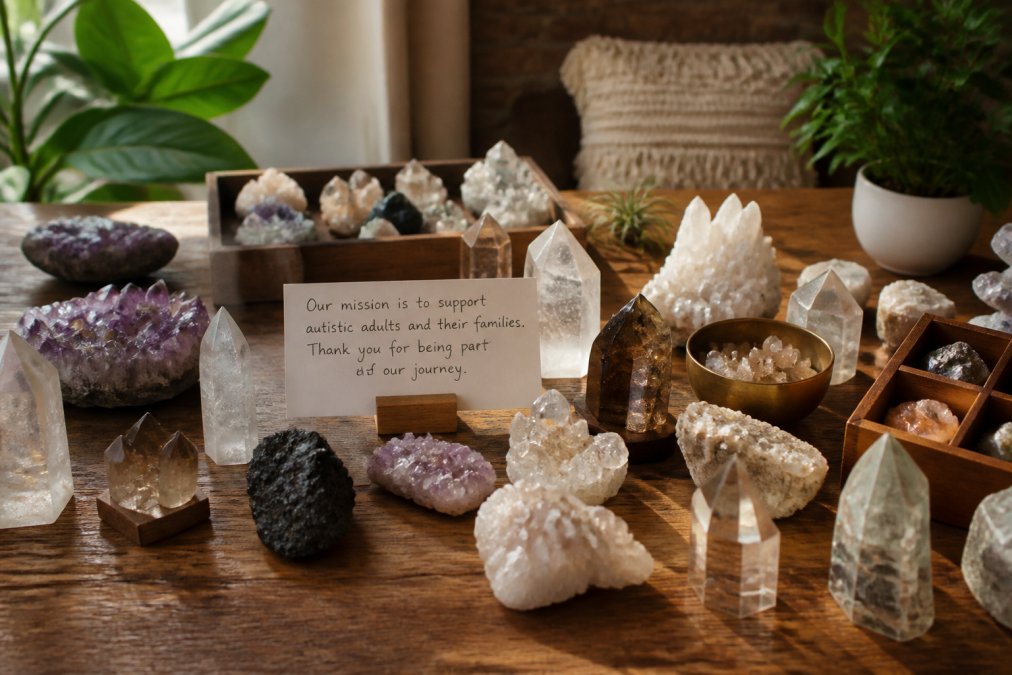
For a small family business, this often looks like direct support to autistic adults and their families. When you buy from a shop like that, your purchase becomes part of the mission rather than adjacent to it. As one verified buyer, Jessica T., put it: "Knowing my purchase supports such a heartfelt mission made this crystal even more special."
Measuring Impact: How to Tell If a Crystal Shop Walks Its Talk
A mission statement is easy. Impact measurement is harder, and it's the clearest signal of whether a shop means what it says. Most articles on ethical crystal shopping stop at "look for transparency."
The Four Questions That Separate Mission From Marketing
1. Who receives the support, and can the shop name them? A real mission names a specific population, partner, or program. "We support autistic adults and their families" is a start. "We fund a monthly sensory-friendly community event through [named local organization]" is a mission you can actually evaluate. If the beneficiary is always described in the abstract, "communities in need," "important causes", that's a signal.
2. Is the commitment structural or episodic? A one-time donation announced in a social post is not a business model. A structural commitment looks like: a fixed percentage of revenue, a set number of hours, a standing partnership, or a hiring practice. Ask which it is. The answer tells you whether the mission survives a slow sales month.
3. Is the impact described in outcomes or in inputs? Inputs are what the shop gives: dollars donated, items gifted, hours volunteered. Outcomes are what changed: how many families attended, what the funds paid for, what the partner organization was able to do because of the support. Small shops often can't produce formal outcome reporting, that's normal, but they can usually tell you a specific story about what their support made possible.
4. Does the mission shape the business, or sit beside it? This is the deepest test. A mission that shapes the business shows up in hiring (are neurodivergent people on the team?), in partnerships (who does the shop buy from?), and in product decisions (what does the shop refuse to sell?). A mission that sits beside the business shows up only in a donation line and a homepage banner.
A Practical Impact Scorecard
Score any shop you're considering on these five items. Two or three checks is a good sign. Zero or one is a warning.
- The shop names a specific beneficiary population or partner organization
- The commitment is described as ongoing, not one-time
- The shop can describe at least one concrete outcome, not just an input
- The mission shows up somewhere other than the About page (hiring, sourcing, partnerships)
- The shop shares updates with customers over time, not just at launch
What Small Shops Can and Can't Do
It's worth calibrating expectations. Large retailers can afford third-party impact audits and glossy annual reports. A family-run crystal shop usually can't.
What small shops can do is be specific, consistent, and reachable. They can name their partner. They can tell you what last month's support paid for. They can answer a follow-up question six months later.
Why This Matters More Than Certification
A shop can hold every certification in the trade and still treat its stated mission as decoration. Conversely, a small shop with no formal credentials can have a mission woven through everything it does.
From Quarry to Doorstep: The Supply Chain Transparency Checklist
Supply chain traceability separates serious sellers from the rest. Use this checklist when evaluating any crystal shop:
- Seller names the country or region of origin
- Seller can identify their supplier or sourcing partner
- Seller describes how specimens are inspected before shipping
- Seller discloses any treatments applied to the stone
- Seller has a stated policy on labor practices at the source
- Seller answers follow-up questions without deflection
The more boxes a seller checks, the more confidence you can have in the piece you're buying.
Building a Collection That Reflects Your Values
A collection is a reflection of what you care about. If ethical sourcing and social impact matter to you, let those values guide what you buy and who you buy from.
That might mean paying a bit more for a hand-selected piece over a mass-produced one. It might mean buying fewer crystals, but choosing ones with real provenance. It might mean favoring a small family business over a large retailer, even when the large retailer is cheaper.
The pieces you keep for years are the ones that meant something when you bought them.
Frequently Asked Questions
What does it mean to shop for crystals with a social mission?
Shopping with a social mission means your purchase directly supports a cause beyond profit. For example, IG Crystal Archive donates to organizations assisting autistic adults and their families. You get a beautiful specimen while contributing to real change. Look for shops that clearly state their mission, show how funds are used, and offer transparency reports. This turns a simple crystal purchase into an act of conscious consumerism.
How can I verify that a crystal shop is truly ethical and mission-driven?
Ask the shop for supply chain documentation, including mine names and working conditions. Mission-driven shops often publish impact reports showing donations or community programs. IG Crystal Archive, for instance, details its support for neurodiversity. If a shop can't answer basic questions, proceed with caution.
Why is it important to support small, mission-based crystal shops?
Small shops often have direct relationships with artisans and miners. They also reinvest in their communities. Plus, you get unique hand-selected pieces. As one IG Crystal Archive customer put it, 'Knowing my purchase supports such a heartfelt mission made this crystal even more special.' Your dollars help sustain ethical practices and social impact.
What are the benefits of buying from brands that support neurodiversity?
Buying from neurodiversity-focused brands like IG Crystal Archive helps create economic opportunities for autistic adults and their families. These brands often provide employment, fund therapies, or donate to advocacy groups. You also support a more inclusive economy. The crystals themselves are often curated with care, as the mission drives quality. Plus, you can feel good knowing your purchase has a tangible social impact beyond the product.
Crystal collecting gets more rewarding when your purchases align with your values. IG Crystal Archive, LLC exists to make that alignment easier, with hand-selected specimens, a mission to support autistic adults and their families, and a 30-day free returns policy so you can buy with confidence. Get started with IG Crystal Archive, LLC and build a collection that reflects what matters to you.