Aesthetic Crystals for Home Decor: 2026 Styling Guide
Table of Contents
- Aesthetic Crystals for Home Decor: What's Trending in 2026
- How to Display Crystals in Home Decor for Maximum Impact
- Best Crystals for Shelf Styling and Small Spaces
- Large Statement Crystals for Living Room Design
- Matching Crystals to Your Interior Design Style
- Safety, Ethics, and Caring for Your Crystal Collection
- Frequently Asked Questions
Last Updated: September 30, 2026
Aesthetic Crystals for Home Decor: What's Trending in 2026
Aesthetic crystals for home decor are natural mineral specimens chosen for how they look in a space: color, translucency, texture, and how light moves through them. This year's shift is away from crowded "crystal shelf" collecting toward fewer, larger, better-placed pieces that function as sculptural decor.
How to Display Crystals in Home Decor for Maximum Impact
Display crystals where they catch direct or angled light, at roughly eye level or just below, in odd-numbered groupings. Placement and lighting matter more than the specimen.
Lighting and Placement Science: Where Crystals Look Best
Light refraction is the whole game with translucent minerals. A polished agate or druzy surface scatters light across nearby surfaces, so one well-lit piece can do more for a room than five in shadow.
- North-facing rooms: lean toward warmer-toned minerals, since cool daylight mutes pale blues
- Direct afternoon sun: rotate pieces seasonally, because prolonged UV exposure can fade some dyed or treated stones
- Low ambient light: add a small dedicated lamp rather than relying on ceiling fixtures
Grouping and Layering for Visual Flow
Group in threes and fives, vary heights, and keep one clear focal point per surface. Even numbers and matched heights read as inventory, not design.
Best Crystals for Shelf Styling and Small Spaces
The best crystals for shelf styling are tumbled stones, spheres, and towers in the 2 to 4 inch range: they fit standard shelf depth, weigh little, and read clearly from across a room. But the mineral you choose determines whether the piece reads as decor or clutter.
Which Crystal Types Actually Work on a Shelf
Most minerals sold as decor fall into a handful of families, each behaving differently under shelf lighting:
- Amethyst. Purple quartz, usually sold as clusters, towers, or tumbled stones. Deep purple reads as a deliberate color accent; pale lavender can wash out against white walls. Clusters show natural point structure; towers show banded color.
- Clear quartz. Colorless and highly translucent, so it takes on the color of whatever is behind it. Best on dark wood or a colored wall where the refraction has something to grab.
- Rose quartz. Soft pink, opaque to semi-translucent, and the most forgiving mineral for warm-neutral rooms. Spheres are the strongest form because the color stays even from every angle.
- Selenite. White to pearly, often sold as charging plates, towers, or raw logs. It is soft, around 2 on the Mohs scale, so it scratches easily and should not sit where keys, coins, or jewelry get dropped on it.
- Fluorite. Banded green, purple, and blue in the same piece. Bands make it the best small-space mineral for a shelf that needs visual interest without size.
- Citrine. Yellow to amber, usually heat-treated amethyst in the commercial market. Warm tone balances cool daylight in north-facing rooms.
- Black obsidian and tourmaline. Near-black and glossy. They act as visual anchors on a light shelf the way a dark picture frame anchors a pale wall.
Tumbled Stones, Spheres, and Towers
Tumbled stones are the entry point: smooth, inexpensive, easy to scatter in a bowl or tray. Spheres show off banding and inclusions from every angle, best for a coffee table. Towers bring height to a flat shelf and work well in pairs of different sizes.
Shelf Depth, Weight, and the 2-to-4-Inch Rule
Standard residential shelving is about 11 to 12 inches deep, but usable display depth is closer to 8 inches once you leave breathing room at the front edge. A 2-to-4-inch piece sits comfortably with 3 to 4 inches of negative space in front, which makes it look placed rather than stored.
Large Statement Crystals for Living Room Design
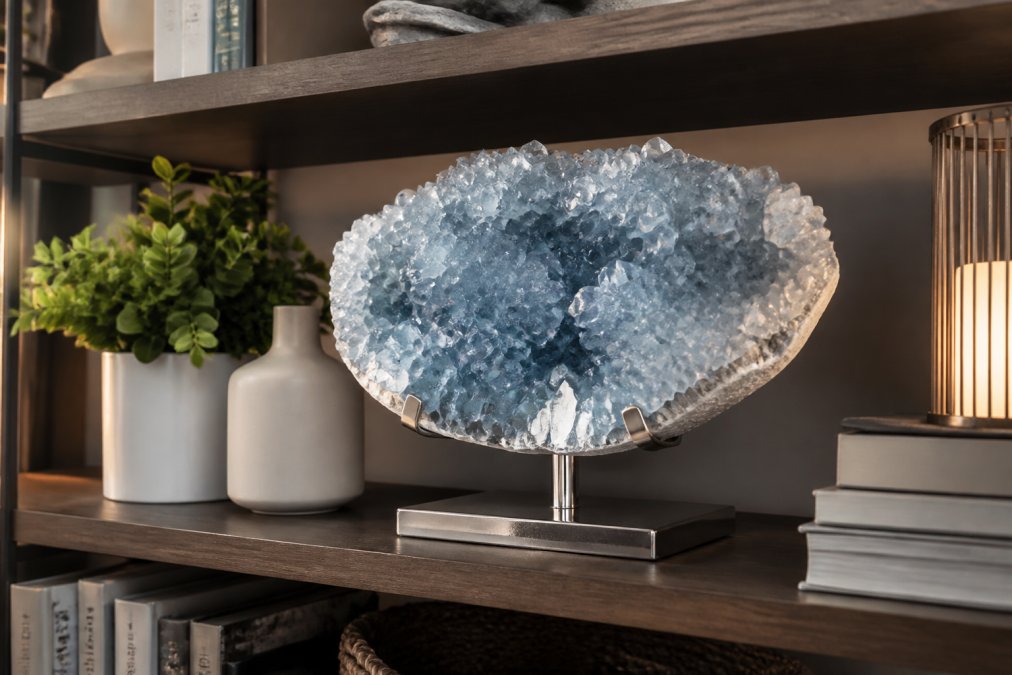
Large statement crystals for living room design are specimens over roughly 6 inches that function as sculptural decor rather than accents, placed on console tables, mantels, and open shelving where they can be seen from a seated position.
Geodes, Clusters, and Sculptural Pieces
Clusters and geodes bring raw texture that balances the polished surfaces most living rooms already have. A cluster on a stand is also the easiest large piece to place, arriving ready to display rather than needing a custom base.
Matching Crystals to Your Interior Design Style
Match crystals to your interior style by color temperature and finish: warm neutrals for traditional rooms, cool translucents for modern ones, raw textures for rustic and organic spaces. A crystal that ignores a room's rules about scale, negative space, and material honesty reads as a mistake no matter how beautiful the specimen is.
Pink Flower Agate Butterfly Wings on →
| Interior Style | Best Crystal Finish | Recommended Piece Type | Color Direction |
|---|---|---|---|
| Modern minimalist | Polished, translucent | Sphere, tower | Cool blues, clear, gray |
| Warm traditional | Polished, banded | Bowl, carved flower | Cream, rust, amber |
| Organic and natural | Raw, textured | Cluster, geode | Blue, green, earth tones |
| Eclectic maximalist | Mixed | Carved statement piece | Saturated, high contrast |
Modern and Minimalist Rooms
Minimalism is not about owning less, it is about every object earning its footprint. In a modern or minimalist room, a crystal should read as a single deliberate gesture, not part of a collection.
- Scale. One piece at 6 inches or larger beats three pieces at 3 inches. Small specimens in a minimalist room look like leftovers.
- Finish. Polished and translucent. Raw matrix texture fights the clean lines of the room.
- Color. Clear quartz, smoky quartz, gray agate, and pale blue celestite. Saturated purple or pink will dominate a neutral palette.
- Placement. Center a single piece on an otherwise empty surface. Negative space is the design element; the crystal is the punctuation.
Bohemian and Organic Rooms
Bohemian and organic interiors are built on layered texture, natural materials, and a slightly imperfect hand, the one aesthetic where raw, unpolished specimens outperform polished ones.

- Scale. Mix sizes deliberately, a large raw cluster as the anchor, two or three smaller tumbled stones scattered nearby.
- Finish. Raw matrix, druzy, and unpolished points. The rougher the exterior, the better it fits.
- Color. Earth tones, mossy greens, warm ambers, and muted blues. Fluorite and raw amethyst clusters are the strongest fits.
- Placement. Group with plants, woven baskets, and wood. A crystal sitting alone in a bohemian room looks unfinished; a crystal sitting among three other natural objects looks intentional.
Industrial and Modern Loft Spaces
Industrial rooms are dominated by metal, concrete, and glass, hard, cool, and reflective. Crystals work here because they add organic contrast without softening the room's edge.
- Scale. Large and architectural. A tall selenite tower or a substantial geode on a metal stand reads as sculpture.
- Finish. Polished or raw, but always on a metal base. A crystal sitting directly on concrete looks like debris; the same crystal on a black or brass stand looks curated.
- Color. Cool tones, clear quartz, gray agate, blue celestite, and black obsidian. Warm pinks and ambers clash with the industrial palette.
- Placement. Console tables, open metal shelving, and low coffee tables. Avoid glass surfaces that already reflect; the crystal's refraction gets lost.
Traditional and Transitional Rooms
Traditional rooms reward symmetry, warmth, and pieces that look collected rather than purchased. Crystals fit here as accents, not focal points.
- Scale. Medium, 3 to 5 inches. Large statement pieces compete with existing focal points like fireplaces and artwork.
- Finish. Polished and banded. Agate bowls, carved flowers, and spheres all work.
- Color. Cream, rust, amber, and warm browns. Cool blues and grays can feel clinical against traditional wood tones.
- Placement. Pair pieces symmetrically on either end of a mantel or console. Traditional rooms read even numbers as balanced, not as inventory, the odd-number rule is a modern-room convention, not a universal one.
Eclectic and Maximalist Rooms
Maximalism is the only aesthetic where more is genuinely more, but only if the pieces share a thread, usually color saturation or a repeated material.
- Scale. Vary widely. A 10-inch carved statement piece next to a 2-inch tumbled stone is a feature, not a flaw.
- Finish. Mixed. Polished, raw, and carved can coexist if the palette is disciplined.
- Color. Saturated and high-contrast. Carved agate, dyed specimens, and bold fluorite.
- Placement. Cluster densely on one surface rather than spreading thin across many. Maximalism fails when it looks accidental.
Safety, Ethics, and Caring for Your Crystal Collection
Two things most crystal guides skip: how to verify what you're buying, and how to keep it looking right for years. Both matter more than metaphysical claims.
Frequently Asked Questions
What are the best crystals for home decor?
The best aesthetic crystals for home decor depend on your space and style. Large statement pieces like celestite clusters or agate butterfly wings work well in living rooms, while tumbled stones, spheres, and small towers suit shelves and side tables. Agate bowls and carved roses add sculptural interest. Choose pieces that match your color palette and bring you joy every time you see them.
How do you style crystals in a modern home?
Modern styling favors clean lines and intentional placement. Group two or three crystals of varying heights on a floating shelf, or let one large statement piece anchor a coffee table. Mix raw stones with polished minerals for textural contrast. Keep colors coordinated with your existing decor, and use natural light to highlight light refraction and natural patterns.
Where should you place crystals in your home for the best visual impact?
Place large statement crystals where they catch natural light, such as near a window or on a console table in a bright hallway. Smaller pieces work well on bookshelves, nightstands, or bathroom counters. Visually, aim for spots where the crystal's color and shape can be appreciated without clutter.
How do you clean and maintain decorative crystals?
Dust crystals regularly with a soft, dry cloth or a gentle brush. Avoid harsh chemicals and prolonged sunlight, which can fade some minerals. Handle clusters and geodes carefully, as exposed points can be fragile. Proper care preserves the aesthetic appeal of the specimen.
What crystals are trending for home styling in 2026?
In 2026, expect to see more sculptural and organic shapes. Flower agate butterfly wings, druzy agate roses, and blue celestite clusters are popular for their unique patterns and calming colors. Agate bowls and hand-carved floral pieces are also in demand as functional art. Earthy tones, translucent minerals, and one-of-a-kind specimens that double as conversation pieces are leading the trend.
How can I tell if a crystal is authentic and not dyed or treated?
Authentic crystals often show natural variations in color, inclusions, and texture. Dyed stones may have uneven color concentration in cracks. Ask sellers for details on sourcing and treatment. Reputable shops like IG Crystal Archive provide exact piece photos and describe any enhancements. If a deal seems too good to be true for a rare mineral, it probably is. Trust your source and ask questions.