Authentic Crystal Shopping for Beginners: 2026 Guide
Table of Contents
- What You'll Need Before You Start Crystal Shopping
- How to Identify Fake Crystals: A Beginner's Checklist
- The Science of Synthetic vs. Lab-Grown vs. Treated Stones
- Best Places to Buy Authentic Crystals Online and In Person
- Ethical Crystal Sourcing: What to Ask Before You Buy
- Budget-Friendly Starter Kits for Authentic Crystal Shopping
- Common Mistakes Beginners Make When Buying Crystals
- Frequently Asked Questions
Last Updated: September 26, 2026
What You'll Need Before You Start Crystal Shopping
Authentic crystal shopping for beginners starts with three simple tools: a jeweler's loupe, a small flashlight, and a short list of what you actually want. This guide from IG Crystal Archive, LLC walks you through each one, so you can buy with confidence instead of hope.
Here is what to gather before you buy anything:
- A 10x jeweler's loupe
- A small LED flashlight
- A written list of 2-3 crystals you want
- A budget range, not a single number
- A phone for comparing listings
How to Identify Fake Crystals: A Beginner's Checklist
Learning how to identify fake crystals comes down to one habit: look inside the stone, then test what you see. Real minerals almost always show some imperfection. Glass and plastic copies usually look too clean, and they fail the same handful of physical tests every time.
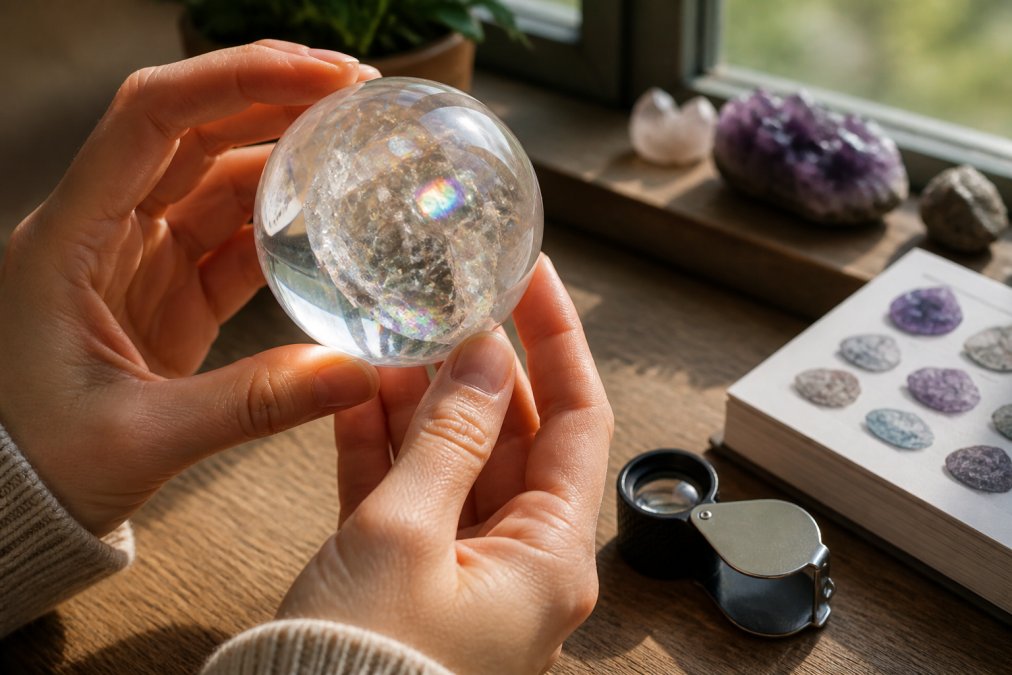
Run through this checklist before you pay:
- Inclusions and veils. Look for tiny bubbles, internal fractures, cloudy patches, or mineral deposits. Natural quartz almost always has some. Glass often has round bubbles instead of angular ones.
- Rainbow flashes that move. Tilt the stone under a lamp. Real quartz and many natural minerals throw rainbow flashes from internal fractures. Painted or coated fakes stay flat.
- Weight in the hand. Real stone feels denser than glass or resin of the same size. A resin sphere the size of a golf ball feels almost hollow by comparison.
- Temperature. Natural stone stays cool to the touch longer than plastic or resin, which warms to skin almost immediately.
- Scratch test on an inconspicuous spot. Glass scratches easily; quartz does not. Only do this on a hidden edge, and never on a finished or valuable piece.
- Color against a reference. Compare the stone to a photo of the natural mineral. Saturated, uniform color across a large piece is a red flag for dye or heat treatment.
- Light transmission. Hold the stone against a bright LED. Natural inclusions scatter light unevenly. Glass and resin pass light in a smooth, uniform wash.
Natural Inclusions vs. Lab-Created Perfection
Natural inclusions are the fingerprint of a genuine mineral. Lab-created stones are chemically identical but often flawless, which is the giveaway.

Fake vs. Treated: Two Different Problems
Beginners often lump 'fake' and 'treated' together, but they are not the same thing, and the fix is different for each.
- Fake means the material is not the mineral it claims to be, glass sold as quartz, resin sold as amber, dyed howlite sold as turquoise.
- Treated means the mineral is real, but its color or clarity was altered, heat-treated amethyst sold as citrine, dyed agate, irradiated quartz.
A Quick Field Test You Can Run in the Store
If you only have thirty seconds and no loupe, do this:
- Hold the stone up to the store light and look for internal structure.
- Weigh it in your palm against a similar-size stone you already own.
- Ask the seller one direct question: 'Is this natural, treated, or lab-created?'
The Science of Synthetic vs. Lab-Grown vs. Treated Stones
Synthetic, lab-grown, and treated stones are three different things, and sellers often blur them together. Knowing the difference protects your wallet.
Here is how they compare:
| Type | What It Is | How to Spot It | Should You Buy? |
|---|---|---|---|
| Natural | Mined mineral, unaltered | Inclusions, uneven color | Yes, if priced fairly |
| Lab-created | Grown in a lab, same chemistry | Too flawless, uniform | Yes, if disclosed |
| Heat-treated | Real stone, heated for color | Color looks flat or uniform | Yes, if disclosed |
| Dyed | Real stone, color added | Dye collects in cracks | Usually avoid |
| Synthetic/glass | Different material | Bubbles, too light, too cheap | Avoid as "crystal" |
Best Places to Buy Authentic Crystals Online and In Person
The best places to buy authentic crystals are sellers who disclose origin, show real photos of the exact piece, and offer a clear return policy. That applies online and in person, but the way you verify those three things is completely different depending on where you shop.
Physical vs. Online Shopping Checklist
Most guides tell you to shop 'somewhere reputable' and stop there. That is not useful. Here is the side-by-side checklist you actually need, with what to verify at each step.
| Factor | In Person | Online |
|---|---|---|
| See the exact stone | Yes, inspect it in your hand | Only if the seller photographs the individual piece, not stock |
| Check weight and feel | Yes, compare against a known stone | No, ask for dimensions and weight in grams |
| Check temperature | Yes, natural stone stays cool | No |
| Run a scratch or light test | Yes, on an inconspicuous spot | No, you must rely on the seller's description |
| Compare prices fast | Limited to what is in the room | Easy, open three tabs and compare |
| Verify origin | Ask the seller directly | Should be listed on the product page |
| Return policy | Often none at shows | Look for a stated window, commonly 14-30 days |
| Risk of misrepresentation | Lower, you see the stone | Higher without real photos and a return policy |
| Best for | First purchase, high-value pieces | Building a collection, filling gaps |
How to Vet an Online Seller in Five Minutes
Before you check out, run this sequence:
- Look at the product photos. Are they of the exact stone, or a stock image used across multiple listings? If the same photo appears on five listings, it is stock.
- Read the description for the words 'natural,' 'treated,' or 'lab-created.' A seller who never uses these words is either uninformed or avoiding the question.
- Find the return policy. If there is no stated window, assume there is none.
- Check the origin field. 'Brazil,' 'Madagascar,' 'Arkansas', a real origin is a good sign. 'Earth' or a blank field is not.
- Look for a contact method. Email, chat, or phone. A seller with no way to reach them is a seller with no accountability.
How to Vet a Seller in Person
At a show or shop, you have an advantage: the stone is in your hand. Use it.
- Ask where the stone was mined. A seller who works directly with miners usually knows.
- Ask whether it is natural, treated, or lab-created. Listen for a clear answer.
- Ask why they selected this particular piece. Sellers who hand-pick have a story; resellers usually do not.
- Check the price against what you know. A 'natural' amethyst the size of your fist for a few dollars is almost certainly dyed or glass.
A Note on Price as a Signal
Price alone does not prove authenticity, but it is a useful filter. Natural, hand-selected specimens cost more to source than glass or dyed stone. If a listing is dramatically cheaper than every comparable listing you can find, the stone is probably not what it claims to be. That does not mean expensive equals real, it means suspiciously cheap deserves a closer look.
Ethical Crystal Sourcing: What to Ask Before You Buy
Ethical crystal sourcing means knowing where a stone came from and how it was obtained. Ask before you buy, every time.
Questions worth asking any seller:
- Where was this stone mined?
- Is it natural, treated, or lab-created?
- Do you work directly with miners or suppliers?
- Can you tell me why you selected this piece?
Budget-Friendly Starter Kits for Authentic Crystal Shopping
A solid starter collection does not require a big budget. Beginners do best with three to five pieces they actually display.
Here is a simple starter kit:
- One clear quartz sphere for a desk or shelf
- One raw specimen to study natural texture
- One polished piece for decor
- One small stone for a pocket or bag
Common Mistakes Beginners Make When Buying Crystals
The most common beginner mistake is buying on looks alone. Pretty photos hide a lot.

Watch for these traps:
- Trusting stock photos instead of the exact stone
- Skipping the return policy check
- Assuming "cheap" means a good deal
- Ignoring whether a stone is treated or dyed
- Buying too many pieces at once
Frequently Asked Questions
How can you tell if a crystal is authentic or fake?
Check for natural inclusions, internal fractures, and slight color variation. Real crystals rarely look perfect. Ask the seller for the stone's origin, whether it is heat-treated or dyed, and request close-up photos or video. A reputable seller will answer these questions without hesitation. If the price seems too low for a rare stone, or the listing uses vague terms like 'healing stone' with no mineral name, treat it as a red flag before you buy.
Are heat-treated or dyed crystals considered authentic?
Heat-treated stones are still genuine minerals, just enhanced for color. Dyed quartz, however, is often low-grade material altered to mimic pricier stones. The key is disclosure. A trustworthy seller states clearly whether a stone is natural, heat-treated, or dyed. If the listing hides this, you cannot make an informed choice. Ask directly before purchasing, and avoid sellers who dodge the question or claim every stone is '100% natural' with no documentation.
Where is the best place to buy authentic crystals online?
Look for shops that photograph the exact piece you will receive, list mineral names and origins, and publish a clear return policy. Check customer reviews for mentions of accuracy and packaging. Small, curation-focused shops often provide more detail than large marketplaces. IG Crystal Archive, for example, hand-selects each specimen and shows the exact item, so you know what arrives. Always verify the seller's reputation and return terms before checkout.
What should a beginner look for when buying their first crystal?
Start with a common, well-documented mineral like clear quartz. Check for natural inclusions, internal veils, or rainbow flashes, which signal genuine stone. Buy from a seller who provides multiple angles and exact measurements. Budget-friendly options like a clear quartz sphere set at $15 let you learn what real inclusions look like before spending more on rare specimens.
Building a collection you love takes patience, not a big budget. The real challenge is finding a seller who shows you the exact stone, explains its origin, and stands behind it. IG Crystal Archive, LLC hand-selects every specimen, ships the piece pictured, and offers fast shipping with 30-day free returns. Each purchase also supports the brand's mission to assist autistic adults and their families. Get started with IG Crystal Archive, LLC and build a starter collection you can trust.