Ethical Crystal Sourcing Transparency Explained
Table of Contents
- What Ethical Crystal Sourcing Transparency Actually Means
- Why Transparency Goes Beyond 'Conflict-Free' Labels
- Crystal Supply Chain Transparency: From Mine to Display Case
- How to Spot Fake Crystals and Misleading Ethical Claims
- The Ethical Crystal Shop Checklist: Vendor Vetting in Practice
- Verification Frameworks: How to Audit a Seller's Claims
- Lifecycle Analysis: The Environmental Cost of Your Crystal
- Conclusion
- Frequently Asked Questions
Last Updated: September 23, 2026
What Ethical Crystal Sourcing Transparency Actually Means
Ethical crystal sourcing transparency is the practice of publicly documenting where a mineral came from, who extracted it, and under what conditions, rather than relying on a single "conflict-free" sticker to imply good behavior. At IG Crystal Archive, we treat crystal sourcing as a chain of custody question, not a marketing label. The difference matters because most buyers never see the mine.
That gap between the mine and the display case is where nearly every ethical claim gets made or broken. A seller can honestly say a stone is conflict-free and still know almost nothing about the wages paid at the pit, the water used in processing, or whether the export paperwork was filed correctly.
Below, we'll show you exactly how to read a sourcing claim, what certifications can and cannot prove, and how to vet a vendor before you spend money. Most guides stop at "buy from reputable sellers." That advice is useless without a method.
Why Transparency Goes Beyond 'Conflict-Free' Labels
Conflict-free is a narrow legal standard, not a moral one. It generally means a stone did not finance armed conflict in a designated region. It says nothing about child labor, fair wages, land restoration, or whether the miner was paid at all.
A common mistake is treating any single certification as a complete ethical audit. In practice, certifications cover specific minerals, specific regions, and specific stages of the chain. A label on a quartz point from a small artisanal operation may simply not apply.
The U.S. Federal Trade Commission guidance on environmental marketing claims sets the baseline for how "eco-friendly" and similar claims can be advertised, and vague, unqualified environmental claims are exactly the kind of thing regulators scrutinize. Transparency, by contrast, is verifiable: it names the source, the handler, and the date.
Crystal Supply Chain Transparency: From Mine to Display Case
Crystal supply chain transparency means mapping every handoff a specimen passes through, from extraction to cutting, polishing, export, wholesale, and final retail. Each handoff is a point where provenance can be documented or lost.
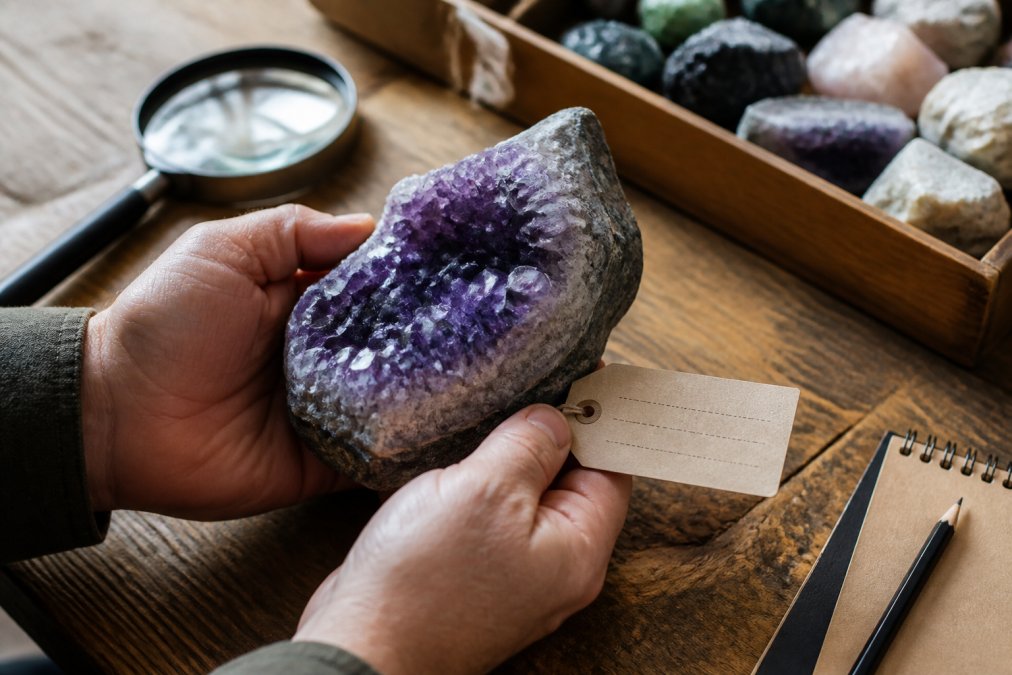
The Geopolitical Reality of Mineral Extraction
Mineral extraction is shaped by export controls, regional instability, and shifting trade policy, and those forces determine what documentation is even available to a seller. When a producing region restricts exports or changes licensing rules, small operations often sell through informal channels that leave no paper trail.
That is the geopolitical context most crystal guides skip. A stone's country of origin can be accurate while its specific mine remains unknown, because material is aggregated at regional markets before it ever reaches a wholesaler. Treat "origin: Brazil" the same way you'd treat "origin: imported." It is a starting point, not proof.
How to Spot Fake Crystals and Misleading Ethical Claims
Learning how to spot fake crystals starts with separating two different problems: a stone that is not what it claims to be, and a stone that is real but marketed with ethics claims no one can prove. Both are common online.
Watch for these red flags:
- Uniform color and zero inclusions in a stone type that almost always has natural variation
- Dyed or heat-treated material sold as "natural, untreated" without disclosure
- Vague ethics language like "responsibly mined" with no named source
- Stock photos reused across listings, which usually means a drop-shipper, not a curator
- No return policy, which removes your only practical recourse
Certification Limitations and What Labels Don't Tell You
Certification limitations are the industry's quiet problem: most gem and mineral certifications verify identity and treatment, not ethics. A lab report confirming a stone is genuine amethyst tells you nothing about labor conditions at the mine.
Even the strongest responsible-sourcing frameworks are voluntary and cover a limited set of minerals. Many crystal varieties sold to collectors fall entirely outside them. That is not a reason to give up on ethics. It is a reason to stop treating a certificate as the finish line and start asking for supply chain mapping instead.
The Ethical Crystal Shop Checklist: Vendor Vetting in Practice
An ethical crystal shop checklist turns vague good intentions into questions you can actually ask. But a checklist is only half a framework. The other half is knowing what a credible answer looks like and how to test it. Most guides hand you the questions and stop there. Here is the full loop.
Start with the questions themselves:
- Does the listing name the mine, region, or supplier?
- Is treatment or dyeing disclosed in plain language?
- Is there a written return policy with a clear window?
- Can the seller explain how they selected this specific piece?
- Do they publish anything about their sourcing ethics or community ties?
- Are photos of the actual specimen used, not stock images?
- Is there a real business behind the storefront, not an anonymous reseller?
Now the part almost no one teaches: how to verify the answers.
Cross-check the origin claim against public production data. If a seller says a specimen came from a region that does not produce that mineral at commercial scale, the claim is decorative. The U.S. Geological Survey mineral commodity information publishes country-level production data for major minerals, and it is free to consult. You do not need to be a geologist to notice a mismatch.
Ask for the next link up the chain by name. A transparent seller can name the wholesaler, cutter, or importer they bought from. A reseller cannot, because they never asked. The inability to name one upstream contact is the single most reliable red flag in this category.
Test consistency across listings. Pull up three or four items from the same shop.
This is where curation earns its keep. A hand-selected approach means someone physically handled the stone, inspected it, and can speak to its chain of custody. IG Crystal Archive builds every listing around that idea, and the verification steps above are the same ones we expect buyers to run on us.
Verification Frameworks: How to Audit a Seller's Claims
| Dimension | What to Check | Weak Signal | Strong Signal |
|---|---|---|---|
| Provenance | Named mine or region | Country only | Mine plus supplier |
| Disclosure | Treatment and dyeing stated | Silent | Written per listing |
| Accountability | Return policy and contact | None | Written, reachable |
| Consistency | Claims match photos | Stock imagery | Actual specimen photos |
Sellers who score well on all four rarely need to advertise their ethics. The paperwork speaks first.
Lifecycle Analysis: The Environmental Cost of Your Crystal
Here is the full chain, stage by stage:
1. Extraction. Pit mining, hard-rock mining, and artisanal hand-digging have very different footprints. Artisanal operations typically disturb less land per stone but often lack water management and site restoration. Industrial operations move far more material and consume more water and fuel, but are subject to permitting and reclamation requirements that small operations frequently are not.
The trade-off is real. A hand-selected specimen from a small operation may have a lighter extraction footprint but a longer, less efficient shipping path. A bulk lot may ship efficiently but come from an industrial mine with heavier land disturbance. There is no universally "green" crystal. There is only a documented chain and an honest accounting of each stage.
Conclusion
The hard part of ethical crystal sourcing is not caring. It is verifying. Labels are cheap; a documented chain of custody is not.
Frequently Asked Questions
What does it actually mean for a crystal to be ethically sourced?
Ethically sourced means the crystal was extracted without child labor, with fair wages for miners, and with minimal environmental damage. It also requires supply chain transparency so you can trace the specimen from mine to seller. In practice, ethical crystal sourcing involves due diligence on mining conditions, labor practices, and community impact. Without a transparency report or vendor vetting process, 'ethically sourced' is just a claim, not a verified fact.
How can I verify if a crystal shop is truly transparent about their supply chain?
Ask for a sourcing ethics statement that names specific mines or regions, not just countries. Request a transparency report or supply chain audit documentation. Check whether the seller can explain their vendor vetting process. A shop committed to crystal supply chain transparency will answer these questions directly. If they deflect or give vague answers, that is a red flag. Start with an ethical crystal shop checklist and compare responses across sellers.
Are there certifications for ethical crystal mining?
There is no universal certification for ethical crystal mining. Some organizations offer ethical certification for specific minerals, but coverage is inconsistent. Many crystals come from artisanal mining operations that fall outside formal certification systems. This is why certification limitations matter: a label does not guarantee fair labor practices or environmental stewardship. Instead, look for sellers who provide detailed mineral provenance and are honest about what they can and cannot verify.
What questions should I ask a seller to determine ethical sourcing?
Ask: Where was this crystal mined? Can you name the mine or region? What are the mining conditions? Do you have a supply chain map or transparency report? How do you verify fair wages and safe working conditions? What is your vendor vetting process? A seller committed to responsible sourcing will have clear answers. If they cannot provide mineral provenance or discuss their due diligence, consider that a sign to keep looking.