How to Verify Crystal Sourcing Transparency
Table of Contents
- Why Crystal Sourcing Transparency Matters Now
- What You'll Need Before You Start Asking
- Step 1: Request Provenance Documentation
- Step 2: Cross-Check Ethical Crystal Sourcing Standards
- Step 3: Learn How to Spot Fake Crystals and Treatments
- Step 4: Questions to Ask Crystal Sellers About Their Supply Chain
- Common Mistakes to Avoid When Verifying Transparency
- Conclusion
- Frequently Asked Questions
Last Updated: September 16, 2026
Why Crystal Sourcing Transparency Matters Now
Crystal sourcing transparency is the practice of documenting and disclosing exactly where a stone came from, how it was extracted, and what happened to it before it reached the shelf. It matters because the gap between what a label claims and what a supply chain actually did has never been wider. This guide walks through a repeatable process for verifying that information yourself.
What You'll Need Before You Start Asking
Verification is a paperwork exercise before it is a conversation. Gather these first so you can evaluate what a seller tells you.
- The seller's product listing, saved as a screenshot with the date visible
- Any certificates or origin cards included with the piece
- A notebook or spreadsheet for logging claims and their sources
- The name of the certification body printed on any label you see
- A basic understanding of which treatment terms describe a natural stone versus an altered one
Step 1: Request Provenance Documentation
Ask for provenance documentation in writing before you buy, and treat a verbal answer as no answer. Provenance documentation is the paper trail connecting a specimen to a specific mine, region, or supplier, and it should name a country, a supplier, and a date. If a seller cannot produce that, the honest response is "we don't have it," not a vague story about a family mine.
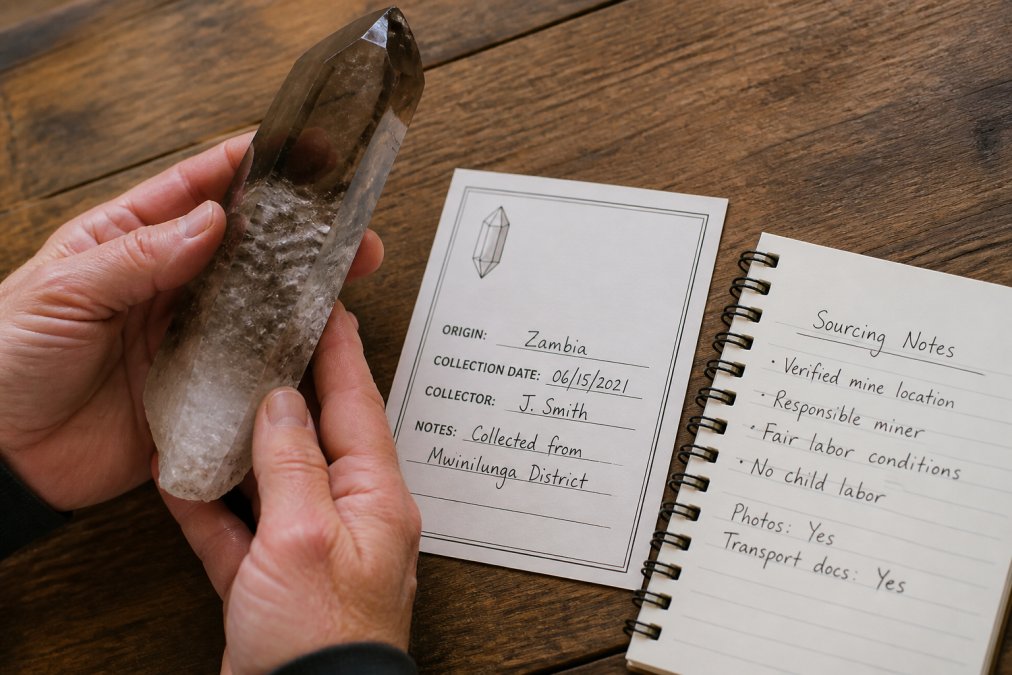
What Good Provenance Paperwork Looks Like
Strong documentation names the extraction region, identifies the supplier or intermediary, and carries a date. Weaker paperwork uses broad regional labels that could describe dozens of operations. A card that says "from Brazil" tells you almost nothing; one naming a specific mining region and supplier contact tells you something you can check. Small shops may have less formal paperwork but the same underlying facts: where, when, and from whom.
Step 2: Cross-Check Ethical Crystal Sourcing Standards
Ethical crystal sourcing standards are the published criteria that certification bodies and industry groups use to judge whether a stone was extracted and traded responsibly. Cross-checking means comparing what a seller claims against what a standard actually requires, rather than trusting the logo on the tag.
The Frameworks You Are Most Likely to Encounter
- OECD Due Diligence Guidance for Responsible Mineral Supply Chains, the most detailed public framework for tracing minerals from extraction to end market. It defines a five-step due diligence process (establish strong company management systems, identify and assess risks, design a strategy to respond, audit at identified points, and report annually). It was written with tin, tantalum, tungsten, and gold in mind, but the traceability logic applies to any mineral trade. OECD due diligence guidance for responsible mineral supply chains
- Fairtrade International's Fairtrade Standards for Gold and Precious Metals, covers small-scale mining cooperatives, fair pricing, and labor conditions. Relevant to crystal sourcing because many artisanal crystal operations sit alongside or inside the same small-scale mining communities. Fairtrade standards for gold and precious metals
- Responsible Jewellery Council (RJC) Code of Practices, a certification for jewelry supply chain businesses covering human rights, labor, environment, and business ethics. An RJC-certified retailer has been audited on its management systems, not on the origin of any individual stone.
- Kimberley Process Certification Scheme, a government-level scheme that applies only to rough diamonds. It is frequently mis-cited by crystal sellers as proof of ethical sourcing for non-diamond material. It does not cover quartz, amethyst, fluorite, or any other common crystal.
- Supplier-specific codes of conduct, large importers sometimes publish their own sourcing policies. These are not third-party verified unless the company also commissions an independent audit.
Where Certification Logos Fall Short
A logo proves a business paid for membership or passed one audit at one point in time. It does not prove the specific stone in your hand came from a covered operation. This is the biggest misunderstanding in the category, and why we treat certification as a starting point rather than a finish line.
Three specific failure modes are worth knowing:
- Scope mismatch. RJC certification covers a company's management systems, not that a particular amethyst cluster came from a particular mine. A seller saying "we are RJC certified, therefore this stone is ethically sourced" is conflating two claims.
- Point-in-time audits. Most certifications are renewed annually or every few years. A certificate dated three years ago tells you about the company then, not now.
- Logo misuse. Some sellers display logos for standards they do not hold, or for standards that do not exist. Before you trust a logo, search the standard's name and confirm the seller appears in the certifying body's public directory.
How to Actually Read an Audit Report or Supply Chain Map
If a seller offers to share an audit report or a supply chain map, here is how to evaluate it:
- Check the auditor. Third-party audits are conducted by named firms. If the report does not name the auditor, it is a self-assessment, not an audit.
- Check the date and audit period. An audit covers a defined window. A report from 2022 does not describe 2026 operations.
- Check the scope statement. Look for "scope of this audit." It tells you which entities, facilities, and processes were examined. If your supplier is not inside the scope, the report does not cover them.
- Check for findings and corrective actions. A credible audit lists non-conformances and corrective actions. Zero findings across a complex supply chain is a red flag, not a green one.
- On a supply chain map, look for named intermediaries. A map showing "mine → trader → exporter → importer → retailer" with no names is a diagram, not traceability. A real map names the entities and dates of transfer.
Step 3: Learn How to Spot Fake Crystals and Treatments
Learning how to spot fake crystals and treatments protects you from the most common sourcing dishonesty: a real stone with a hidden treatment, or a synthetic stone sold as natural. Both are widespread and detectable with basic observation.
- Heat treatment: common and often undisclosed; it can deepen color permanently.
- Dyeing: color pools in cracks and looks too uniform across the surface.
- Irradiation: can produce vivid tones that look unnatural under strong light.
- Lab-grown material: chemically similar to natural stone but formed in a reactor, not a deposit.
- Glass or resin fakes: show bubbles, uniform color, and no internal growth lines.
Step 4: Questions to Ask Crystal Sellers About Their Supply Chain
Questions to ask crystal sellers work best when they are specific enough that a vague answer is obviously vague. Ask in writing and keep the replies.
- Which country and region was this specimen extracted from?
- Who was the immediate supplier, and how long have you worked with them?
- Has this stone been treated, dyed, or irradiated in any way?
- Is this natural, synthetic, or assembled from multiple pieces?
- Can you share any third-party audit or verification report for this supplier?
- What is your return policy if the piece does not match its description?
What a Good Answer vs. an Evasive Answer Looks Like
The list only works if you can read the replies. Here are the same six questions with answer patterns that separate a real supply chain from a rehearsed one.
| Question | Strong answer | Weak answer |
|---|---|---|
| Origin region | Names a specific mining region and a supplier contact | "From Brazil" or "from a family mine" |
| Supplier relationship | Names the supplier and the number of years working together | "We work with trusted partners" |
| Treatment history | States treated or untreated, and which treatment | "All natural" with no documentation |
| Natural vs. synthetic | Confirms one or the other, offers to document it | Changes the subject or cites "natural variation" |
| Audit report | Sends a dated report with a named auditor, or says plainly they have none | Sends a certificate logo image with no report |
| Return policy | Written policy with a defined window and condition terms | "Final sale" or a policy that excludes natural variation |
In-Person Verification: A Store Visit Checklist
Most sourcing guides assume you are buying online. In a shop, you have verification tools an online buyer does not. Bring this list.
- Bring a loupe and a bright penlight. A 10x jeweler's loupe costs little and reveals dye pooling in cracks, glass bubbles, and growth lines a phone camera will not.
- Ask to see the piece out of the display case under neutral light. Display lighting is often warm and flattering; it hides color treatments.
- Ask staff to repeat the origin and treatment claims while you write them down. Watch whether the answer changes between two staff members. Inconsistency is a signal.
- Ask for the supplier name, not just the country. A shop buying from a named importer can usually tell you the importer's name on the spot.
- Ask what happens if the piece is not as described. Get the return window and condition terms in writing, even on a receipt.
- Photograph the piece and the tag before purchase. If the tag says "untreated" and the stone shows dye under the loupe, you have a documented mismatch.
- Ask whether the shop has visited the supplier or the mine. Very few have, and the ones who have will tell you at length. That is useful either way.
Red Flags in Crystal Marketing
Certain phrases signal that transparency is being performed rather than practiced.
- "Ethically sourced" with no named region or supplier
- Certification logos that do not match a real, named standard
- Prices far below what the material type typically commands
- No return policy, or a policy that excludes "natural variation"
- Refusal to answer sourcing questions in writing
- Claims that a stone is "untreated" without any supporting documentation
- A certificate logo displayed without a certificate number or issuing body
- A supply chain described only in adjectives ("sustainable," "responsible," "conscious") with no named entities
Common Mistakes to Avoid When Verifying Transparency
The most frequent error is accepting a certification logo as proof of origin. A logo is a claim, not evidence, and usually applies to a business rather than a specific stone.
When you request provenance in writing, ask for the supplier's name and the year of extraction, not just the country. Sellers who genuinely know their supply chain can answer both in a single message. Sellers who cannot will usually respond with a paragraph about their values instead.
Conclusion
Verifying crystal sourcing transparency takes more effort than reading a tag, and that effort is the whole point. The sellers worth your money can name a region, a supplier, and a treatment history without hesitation, and stand behind the piece if it does not match. That is the standard we hold ourselves to at IG Crystal Archive, LLC: every specimen is hand-selected and personally inspected, backed by a 30-day free return policy and careful packaging, and every purchase supports our mission to assist autistic adults and their families.
Frequently Asked Questions
How can I tell if a crystal shop is ethically sourced?
Look for a shop that openly shares where its crystals come from, names the mines or regions, and can provide provenance documents on request. Ask if they visit or communicate directly with suppliers. A shop committed to crystal sourcing transparency will answer these questions without hesitation. Avoid sellers who rely only on vague terms like 'ethically sourced' without any supporting detail or paperwork.
What questions should I ask a crystal seller about their supply chain?
Ask these five: Where was this crystal mined? Can you share the name of the mine or supplier? Is the stone natural, treated, or lab-grown? Do you have any third-party audit reports or provenance documents? How do you verify labor conditions at the source? Sellers who treat questions to ask crystal sellers as routine will give specific answers. Those who dodge or give generic replies are a warning sign.
Are there certifications for ethical crystal mining?
There is no single universal certification for ethical crystal mining. Some supply chains use fair trade certification, conflict-free minerals declarations, or third-party auditing through organizations that monitor mineral extraction. But certification logos alone do not guarantee ethical practices. Always ask to see the actual audit report or documentation behind any certification claim, and check whether the certifying body is independent.
How do I distinguish between mass-mined and artisanal crystals?
Artisanal crystals often show unique color variations, natural inclusions, and irregular shapes because they are extracted by hand from small deposits. Mass-mined stones tend to be uniform in size and color, sometimes polished to hide flaws. Ask the seller about the extraction method. If they cannot describe how the crystal was mined or who mined it, you cannot verify whether it came from responsible procurement or large-scale industrial extraction.