Why Are Hand-Selected Minerals Better? A 2026 Guide
Table of Contents
- The 'Hand-Selected' Quality Standard: What It Really Means
- How to Identify High Quality Crystals in Person
- What to Look for When Buying Crystals Online
- Natural vs Treated Mineral Specimens: How to Tell the Difference
- Verification Methods: Elemental Analysis and Purity Standards
- Sourcing Ethics and Environmental Impact
- Conclusion: Why Hand-Selected Minerals Are Better
- Frequently Asked Questions
Last Updated: September 11, 2026
The 'Hand-Selected' Quality Standard: What It Really Means
Hand-selected minerals are specimens a knowledgeable buyer has personally examined and chosen one piece at a time, rather than ordering by the crate, kilo, or pallet. The distinction matters once you see what bulk purchasing produces: mixed grades, hidden fractures, dyed surfaces, and pieces that look nothing like the listing photo.
This guide from IG Crystal Archive, LLC breaks down why that attention matters and what questions separate a serious seller from a reseller.
Bulk purchasing optimizes for volume and price per pound; hand selection optimizes for crystalline state, color saturation, structural integrity, and display quality. Those goals pull in opposite directions.
Curation vs. Bulk Purchasing: A Side-by-Side View
| Factor | Hand-Selected | Bulk Purchasing |
|---|---|---|
| Inspection | Every piece examined individually | Sampled or not at all |
| Grading consistency | High; rejects removed | Mixed grades in one lot |
| Fracture and damage | Caught before sale | Frequently shipped |
| Listing accuracy | Photo matches the exact piece | Representative photo only |
| Traceability | Often documented per specimen | Rarely tracked |
| Price per piece | Higher | Lower |
The trade-off is honest: hand selection costs more because someone examined each specimen and rejected the ones that did not meet the bar. In return, the piece arriving at your door is the piece you chose.
How to Identify High Quality Crystals in Person
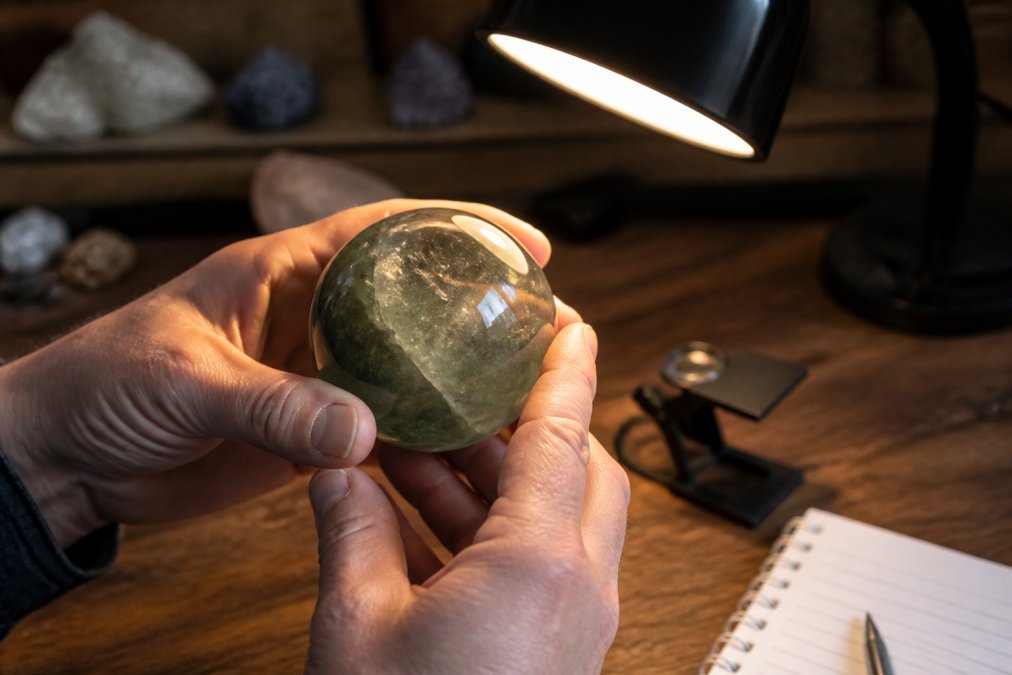
Learning how to identify high quality crystals in person means running the same short inspection sequence a hand-selector uses, five minutes of checks that separate a keeper from a reject.
The sequence uses only tools most collectors already carry: a loupe or phone macro lens, a small flashlight, a ceramic streak plate, a copper coin, a steel file or knife, and a glass plate.
Step 1: Look at the piece under raking light before you touch it
Angle a small flashlight so the beam skims the surface. Raking light reveals what direct light hides: hairline fractures, filled pits, uneven polish, and the ridge where a coating ends. Surface condition is the fastest disqualifier, a fracture through a display face is fatal.
Step 2: Test hardness, but test it where it will not show
Hardness describes how well a mineral resists scratching, and it is the most reliable field test available without equipment. The reference scale is the one published by the U.S. Geological Survey's Mohs hardness information. The practical version:
- Fingernail (about 2.5): scratches talc and gypsum, not much else.
- Copper coin (about 3.5): scratches calcite and softer material.
- Steel knife or file (about 5.5): scratches apatite and most common decorative material, but not quartz.
- Quartz (7): scratches glass. If a piece marked as quartz will not scratch a glass plate, it is not quartz.
Always test on an inconspicuous edge or the base, never the display face. A scratch you made is a scratch you own.
Step 3: Read tenacity and cleavage together
Tenacity describes how a mineral behaves under stress and is often confused with hardness. A hard mineral can still be brittle: diamond chips, quartz is hard and brittle, gypsum is soft and sectile. What matters is whether the piece is stable enough for how you intend to store and display it.
Cleavage is the related tell. Minerals that cleave along flat planes (calcite, fluorite, mica) split along those planes if knocked; minerals that fracture unevenly (quartz, garnet) chip at edges. A hand-selector checks the edges to see which failure mode a piece is prone to.
Step 4: Check crystalline state, not just color
Crystalline state refers to whether the internal atomic structure has produced visible, well-formed faces or a clean, consistent body. Color is the least diagnostic property in mineralogy, it varies with trace elements and is easily altered by treatment. Look for:
- Continuity: Does the internal structure run through the piece, or stop at a surface layer?
- Depth: A polished sphere should show depth and flow under a loupe, not a flat, painted look.
- Density: Highly porous material absorbs skin oils and dulls within months. Dense, tight specimens hold a polish for years.
- Faces: Well-formed crystal faces are a record of how the piece grew. They are also the first thing a hand-selector checks for damage.
Step 5: Run the streak test when color is suspicious
Streak, the powder color a mineral leaves on unglazed porcelain, is far more diagnostic than body color. Hematite can look metallic gray or earthy red but always streaks reddish-brown; pyrite streaks greenish-black (usgs.gov). If the streak does not match its claimed identity, stop there.
What most guides miss
These properties interact, and hand selection is largely weighing them against each other. A hard but brittle mineral can still chip; a soft but tough one can survive decades of handling; a beautifully colored piece with a hidden cleavage plane will break the first time it is dropped. The selector's job is not a perfect specimen but the one whose weaknesses will not matter for how it will be used.
What to Look for When Buying Crystals Online
When buying crystals online, the most important thing to verify is that the seller photographs the exact specimen you will receive, not a stock image.
Ask these questions before you buy:
- Is the listing photo of this specific piece, or a representative sample?
- Are dimensions and weight stated in metric units you can verify against your shelf or display case?
- Does the seller disclose treatments, dyes, or coatings?
- Can they tell you where the specimen was sourced?
- What is the return policy if the piece does not match the photo?
A seller who cannot answer the first question plainly is a seller who cannot guarantee what arrives.
Natural vs Treated Mineral Specimens: How to Tell the Difference
Natural vs treated mineral specimens is a distinction every collector eventually faces, and some treatments are undetectable without laboratory analysis. What separates a hand-selected piece from a bulk lot is not a guarantee of no treatment, it is that the seller knows and discloses what was done.
The treatments you will encounter most often
- Dyeing: Color concentrated in fractures and grain boundaries rather than distributed evenly through the stone. Under a loupe, dye often pools where the crystal meets its matrix.
- Heating: Common and often undisclosed. It can deepen color (amethyst to citrine is the classic example) but rarely leaves visible traces. Assume heat treatment unless the seller states otherwise.
- Irradiation: Used to darken or shift color in quartz and some beryls. Like heating, it is usually invisible to the eye.
- Coating: A lacquer or resin layer that adds shine or color. It dulls unevenly with wear, and the edge of the coating is often visible under raking light.
- Fracture filling: Resin or glass pushed into cracks to stabilize a piece. Look for a slight color or refractive difference along the break, or a flash that moves as you tilt the stone.
- Assembled or composite pieces: Two or more pieces joined, or a natural crystal set into a carved base. Look for a seam line and a mismatch in grain or polish across it.
Naturally colored specimens show color following internal structure; dyed material shows color following the cracks.
The disambiguation most guides skip: 'natural' is not the same as 'hand-selected'
These two claims get used interchangeably in listings, and they are not the same thing.
- Natural describes the origin of the material. It says nothing about how the piece was chosen, graded, or inspected.
- Hand-selected describes the selection process. A hand-selected piece can be natural, and a natural piece can be pulled from a bulk lot with no individual inspection at all.
A seller can truthfully call a dyed, fracture-filled specimen "natural" if the underlying material came out of the ground. A seller cannot truthfully call that same piece "hand-selected" if it was pulled from a sealed crate without being examined. Treat the two claims as separate questions.
How to verify a 'hand-selected' claim before you buy
This part of the market is almost entirely unregulated, so verification falls on the buyer. Hand selection leaves a paper trail that bulk purchasing does not. Ask for:
- A per-piece photo, not a stock image. If the listing photo is reused across multiple quantities, the piece was not individually selected for you.
- The exact weight and dimensions of the piece you will receive. Hand-selected sellers can give you numbers for the specific specimen. Bulk sellers give you a range.
- A treatment disclosure in writing. "Natural, no treatments" or "heated, undisclosed origin", either is fine, as long as it is specific.
- The source, at least at the region level. A hand-selector usually knows the dealer, the mine, or the country of origin. A reseller usually knows the wholesaler.
- A return policy that covers mismatch. If the piece that arrives does not match the per-piece photo, the seller should take it back without argument.
A seller who can answer all five is doing the work. A seller who can answer only the first is selling you a photo.
What to do when you cannot verify
If a seller cannot or will not answer these questions, price the piece as though it is treated and mass-graded. That does not mean it is bad, it means you are buying on appearance alone and should pay accordingly. The hand-selection premium is only worth paying when the seller can demonstrate that selection happened.
Ask a seller to describe the last specimen they personally rejected and why. Anyone who genuinely hand-selects will have a specific answer ready. Anyone who does not will give you a general one.
Verification Methods: Elemental Analysis and Purity Standards
Verification is where hand selection proves itself. A seller who personally selected a specimen can usually explain how it was checked, and the two methods that matter most are elemental analysis and visual grading against purity standards.
Elemental analysis uses techniques such as X-ray fluorescence to identify the chemical composition of a specimen. This is how you confirm that a piece is what it is claimed to be, and it is the standard approach used across the earth sciences, as described in the U.S. Geological Survey's mineral resources program.
Purity standards for collector specimens are largely a matter of disclosure rather than regulation. There is no federal grading body for decorative minerals, which is why seller reputation and transparency carry so much weight. Reputable sellers document what they know and state plainly what they do not.
The verification question to ask is not "is this certified?" It is "what did you check, and how?"
Sourcing Ethics and Environmental Impact
Sourcing ethics matter because mineral specimens come out of the ground, and how they come out affects the environment and nearby communities. A hand-selected supply chain is usually shorter, which makes these questions easier to answer.
Questions worth asking any seller:
- Where was this specimen collected, and by whom?
- Was it extracted as a byproduct, or specifically mined for specimens?
- Does the seller work with small, independent sources or anonymous bulk lots?
Shorter supply chains are not automatically ethical, but they are far easier to audit. A seller who knows the source personally can speak to it; one who bought a pallet at a wholesale lot cannot.
Conclusion: Why Hand-Selected Minerals Are Better
Hand-selected minerals are better because the selection process removes the failures before they reach you: the fractured, dyed, dull, and misrepresented. You pay for someone's judgment and time, and in return you get a specimen that matches its description and holds up on display.
At IG Crystal Archive, LLC, every specimen is chosen individually for its quality and natural character, inspected before it ships, and packed securely for transit. Our 30-day free return policy exists because we would rather you send something back than keep a piece you do not love. Knowing your purchase also supports autistic adults and their families makes the choice easier still.
Browse the collection and find the one-of-a-kind piece that belongs on your shelf.
Frequently Asked Questions
What is the difference between mass-produced crystals and hand-selected specimens?
Mass-produced crystals are pulled from bulk lots with little individual inspection, so quality varies from piece to piece. Hand-selected minerals are chosen one at a time for clarity, color, and structural integrity. A hand-selected specimen arrives with documented features and consistent quality, while bulk pieces often show chips, dull patches, or unclear origins. That difference in attention is what makes hand-selected minerals better for collectors and decorators alike.
How does hand-selection ensure better mineral quality?
Hand-selection means each specimen is physically inspected before purchase. A selector checks hardness, tenacity, crystalline state, and porousness. This process filters out pieces with fractures, dye treatments, or unstable crystal structure. The result is a mineral that holds its appearance and value over time, rather than one that fades or crumbles within months.
What should I look for when buying hand-selected mineral specimens online?
Look for clear, individual photos of the exact piece you will receive, not stock images. Check that the seller lists physical properties like hardness, tenacity, and crystalline state, and asks about purity standards or verification methods. A trustworthy listing will disclose any treatments, provide sourcing details, and offer a return policy. If a shop cannot answer where a specimen came from or why it was chosen, that is a signal to look elsewhere.
Does hand-selection impact the energetic or aesthetic value of a crystal?
Aesthetic value rises with hand-selection because the selector chooses for visual harmony, color depth, and natural pattern. Energetic value is a personal belief, but many collectors report that a piece chosen with intention feels more meaningful in a space. The practical benefit is that a hand-selected mineral displays better, matches a room's palette, and carries a story you can share, which no bulk-purchased item can replicate.