Buy Unique Geological Specimens Online in 2026
Table of Contents
- Why 2026 Is a Strong Year for Collectible Mineral Specimens
- Jasper Spheres and Cubes: Affordable Entry Points for New Collectors
- Fossil Coral Towers and Orthoceras Pieces: Ancient Geology for Display
- How to Start a Mineral Collection Without Overspending
- Investment Grade Mineral Specimens: What Separates Them From Decor Pieces
- Mineral Specimen Authentication Guide: Verifying Provenance Before You Buy
- Caring for Your Geological Specimens After They Arrive
- Conclusion
- Frequently Asked Questions
Last Updated: September 10, 2026
Why 2026 Is a Strong Year for Collectible Mineral Specimens
More buyers are shopping for geological specimens online than at any point in the past decade, and the reason is simple: the market has matured. What used to require a trip to a rock shop or a mineral show now happens from your couch, with better photography and more detailed listings than ever before. At IG Crystal Archive, we've watched that shift firsthand.
If you want to buy unique geological specimens online in 2026, you can now choose from thousands of one-of-a-kind pieces with exact photos of the piece you'll receive. That transparency is the biggest change in the hobby. It also raises the stakes: when every seller claims "rare" and "museum quality," you need to know what you're actually looking at.
Below, we'll walk through the entry-level pieces, the display fossils, and the investment tier, plus how to verify authenticity before you pay. Most guides skip that last part entirely.
Jasper Spheres and Cubes: Affordable Entry Points for New Collectors
Picture jasper is the best first purchase in this hobby, because the stone does the work for you. These are geological specimens where natural mineral inclusions form landscape-like scenes: mountain ranges, desert horizons, ink-wash skylines. No two are alike.
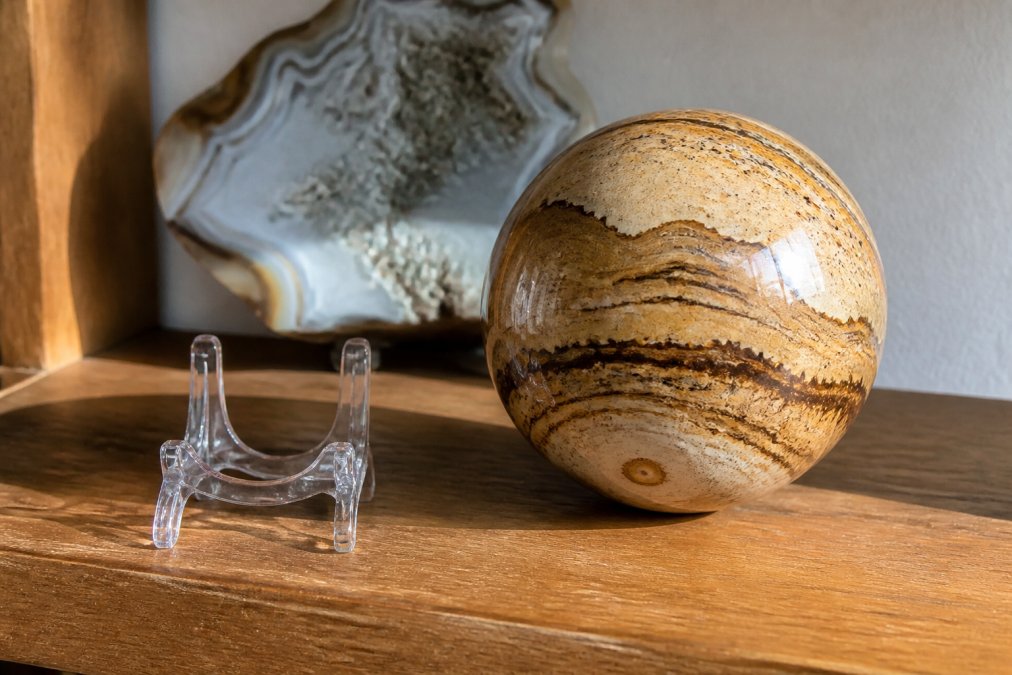
A few strong starting points:
- Rare Picture Jasper Cube ($49.99): a polished geometric form where each face reveals its own miniature scene.
- Nature Painted Picture Jasper Pair ($35.99): a matched diptych of freeform slices with display stands included.
- Natural Polychrome Jasper Sphere ($45.99): desert tones of caramel, rust, and honey in a 2.0-inch orb with an acrylic stand.
- Natural Picture Jasper Sphere ($54.99): a 2.3-inch sphere with black mineral veining that reads like river systems.
Spheres and cubes photograph beautifully and sit well on a desk or shelf. What most guides miss is that a sphere shows you a new scene with every rotation, which is why collectors rarely stop at one.

Fossil Coral Towers and Orthoceras Pieces: Ancient Geology for Display
Fossils give you something jasper can't: a direct record of earth's history. Agatized fossil coral formed when ancient coral colonies were replaced by silica over millions of years, leaving the polyp structures intact in stone (usgs.gov).
The Natural Fossil Coral Tower ($90.00) stands about 8 inches tall with hundreds of preserved coral polyps across a charcoal-gray background. The Polished Fossil Coral Tower ($75.00) runs about 9.5 inches in warm taupe and cream, which suits coastal and minimalist interiors better than the darker piece.

For smaller budgets, the Orthoceras Fossil Stone Starfish Set of 2 ($24.99) pairs polished carvings with naturally occurring fossil patterns. The Calligraphy Jasper Tower ($69.99) is the wildcard here: its natural patterning resembles flowing script, and each side is different.
How to Start a Mineral Collection Without Overspending
Start with a theme, not a shopping spree. Collectors who buy randomly end up with drawers of pieces they never display, which is a common complaint.
A practical framework:
- Pick one category (jasper, fossils, or spheres) and buy three pieces within it.
- Set a per-piece ceiling for your first year, then hold to it.
- Buy exact pieces, never "similar to photo" listings.
- Track provenance from day one. A simple note with the purchase date and locality pays off later.
- Add display infrastructure early: stands, a tray, and a dust cover.
| Collection Type | Typical Entry Price | Display Effort | Best For |
|---|---|---|---|
| Jasper spheres and cubes | $35-$60 | Low | New collectors, desk display |
| Fossil towers and carvings | $25-$90 | Low | Natural history fans, shelf styling |
| Investment grade specimens | Higher tier | High | Long-term collectors |
If you're coming from impulse crystal buying, expect the first month to feel slower. That's the point.
Investment Grade Mineral Specimens: What Separates Them From Decor Pieces
Investment grade status comes down to four factors: condition, rarity, aesthetics, and documented provenance. A decor piece can be beautiful and still not qualify. The difference is that investment grade implies a resale market, someone else, later, will pay more than you did, and they will pay on evidence, not enthusiasm.
Here is how each factor actually gets evaluated:
- Condition: no repairs, no excessive damage, polish intact. Repairs are the single biggest value killer. A stabilized or reattached crystal can look flawless in photos and still trade at a fraction of an unrepaired piece. Ask directly: "Has this been repaired, stabilized, or restored?"
- Rarity: uncommon localities or formations carry more weight than common material. A species that is abundant globally but rare from one specific locality is worth more than a common species from a common locality. Locality scarcity is the lever most new buyers miss.
- Aesthetics: how the piece reads from a normal viewing distance. Aesthetic grading is subjective, but the market converges on a few signals: symmetry, contrast, luster, and whether the piece has a clear focal point. Pieces that photograph well tend to hold value because they resell easily.
- Provenance: who found it, where, and when. This is the factor buyers undervalue most. A specimen with a documented chain, mine, dealer, prior collection, commands a premium because the next buyer can verify it.
How value actually accrues. Investment grade specimens appreciate on documentation and scarcity, not on how much you liked them at checkout. Three mechanisms drive resale value:
- Locality exhaustion. When a mine closes or a pocket is worked out, specimens from that locality become finite. Prices for material from closed localities tend to firm up over years, not months.
- Collection provenance. A piece that passed through a recognized private collection or a documented dealer carries a paper trail that raises buyer confidence.
- Condition stability. Pieces that survive handling and storage without damage retain value; pieces that chip or fade do not.
What investment grade is not. It is not a short-term flip. Mineral markets are thin and illiquid compared to equities, a piece may sit for months before the right buyer appears. Auction results are also not a reliable price index, because a single strong result at one sale does not establish a market. Treat any "guaranteed appreciation" claim as a red flag.
Where the draft's product examples sit. The Scenic Jasper Crystal Sphere ($120.99) sits at the top of the jasper range for exactly these reasons: one-of-a-kind landscape patterning, dramatic seam features, and a display presence that smaller spheres don't match. The Natural Brecciated Red Jasper Sphere ($62.99) is the value play, with brick-red jasper islands set in glossy black chalcedony. Neither is investment grade in the strict sense, decorative jasper is beautiful but abundant.

Mineral Specimen Authentication Guide: Verifying Provenance Before You Buy
Authentication is the process of confirming that a specimen is what the seller claims it is, including its mineral identity, any treatments, and its stated origin. Get this wrong and nothing else about the purchase matters. Most guides stop at "ask the seller", this section goes further.
Step 1: Confirm mineral identity, not just trade name. "Jasper," "agate," and "crystal" are trade and field terms, not strict mineral species. Picture jasper is a variety of chalcedony; orthoceras fossils are typically preserved in limestone or black marble matrix. If a listing uses a trade name, ask for the species or variety. A seller who cannot distinguish between a variety name and a species name may not have done the homework.
Step 2: Check locality signatures. Many minerals have recognizable locality signatures, color, matrix, associated minerals, crystal habit. A specimen claimed from one locality but showing the habit of another is a warning sign. This is where reference material matters: the Mineralogical Society of America's resources and the U.S. Geological Survey's mineral information pages explain how common species form and where they are found. Cross-check the claimed locality against what that locality is known to produce.
Step 3: Ask about treatments directly. Common treatments include dyeing (agate, jasper), heating (amethyst to citrine, some quartz), irradiation (some quartz and topaz), and stabilization or resin-filling (fractured material). A treated specimen is not necessarily a bad specimen, but it must be disclosed, and it should be priced accordingly. Ask the question in writing: "Is this piece dyed, heated, irradiated, stabilized, or otherwise treated?"
Step 4: Request documentation types. Provenance documentation comes in tiers, and knowing the tiers tells you how much to trust a claim:
- Weakest: seller's verbal description with no paper trail.
- Moderate: dealer label with locality and date of acquisition.
- Strong: prior collection label, auction record, or published reference to the specimen.
- Strongest: a documented chain from the mine or finder through one or more recognized collections.
Ask which tier the seller can provide. If the answer is "none," price the piece as undocumented.
Step 5: Verify the exact piece. Request photos of the actual specimen, ideally with a scale reference and from multiple angles. Catalog or stock images mean you are buying a category, not a specimen.
Step 6: Confirm the return window in writing before you pay. A return window is your only real remedy if authentication fails after delivery. Get the terms in writing, length, condition requirements, and who pays return shipping.
A note on certificates. Third-party gem labs certify cut stones, not mineral specimens. A "certificate of authenticity" from an unknown issuer carries little weight. What carries weight is a documented chain of custody, labels, records, and named prior owners. When in doubt, ask for the chain, not the certificate.
Caring for Your Geological Specimens After They Arrive
Care is simple, but it isn't nothing. Most damage to mineral collections comes from sunlight, dust, and handling, in that order.
- Keep pieces out of direct sun; prolonged UV exposure fades some materials and stresses others.
- Dust with a soft brush or microfiber cloth rather than sprays or polishes.
- Handle spheres and cubes with clean, dry hands; skin oils dull a high polish over time.
- Store smaller pieces in a padded specimen tray with dividers.
- Keep fossil pieces away from acidic cleaners, which can etch the surface.
A padded tray costs very little and prevents the chips that quietly reduce a specimen's value. For polished pieces, a quick monthly dust is enough. Skip the ultrasonic cleaners you'll see recommended online; they're built for jewelry, not mineral specimens.
Conclusion
Building a collection that holds its value takes patience, documentation, and a willingness to ask sellers hard questions before you pay. That's the standard we hold ourselves to at IG Crystal Archive: every piece is hand-selected, inspected for quality, and shipped in secure, professional packaging with a 30-day free return window. As verified buyer Amanda L. put it, "I've ordered crystals from many shops, and IG Crystal Archive stands out." Every purchase also supports our mission to assist autistic adults and their families, which makes the piece mean something beyond the shelf.
Frequently Asked Questions
How do I verify the authenticity of geological specimens bought online?
Ask the seller for the exact piece pictured, close-up photos of natural inclusions, and any treatment disclosure. Real mineral specimens show irregular color boundaries, natural pits, and fissures that dyed or lab-grown pieces lack. IG Crystal Archive sends the exact specimen shown and notes natural irregularities as part of the stone's character, not defects. A 30-day free return policy also lets you inspect the piece in person before committing.
What are the most sought-after mineral specimens for collectors in 2026?
Scenic jasper spheres, agatized fossil coral towers, and brecciated red jasper pieces are drawing steady interest because each one is one-of-a-kind. Picture jasper cubes and matched landscape pairs also sell quickly since their natural scenery cannot be replicated. Investment grade mineral specimens with documented origin and minimal damage hold value best, while decorative spheres in the $45-$65 range remain the most popular entry point for new collectors.
Is it safe to buy rare geological specimens from online auctions?
Auctions can work, but you lose the ability to confirm the exact piece and ask about provenance. Fixed-price listings from a curated shop may allow you to see the specimen you will receive, request extra angles, and use a return window if the stone does not match. For first-time buyers, a shop with clear photos, stated dimensions, and a 30-day return policy can remove some of the risk that auctions carry.
How are geological specimens priced for online sale?
Price reflects rarity, size, polish quality, and how distinctive the natural pattern is. At IG Crystal Archive, Orthoceras fossil starfish sets start at $24.99, picture jasper pairs at $35.99, polychrome jasper spheres at $45.99, and larger statement pieces like the scenic jasper orb reach $120.99. Fossil coral towers sit between $75 and $90 depending on height and fossil density. Each listing shows the exact piece, so you know what you are paying for.
What should I look for when starting a high-quality mineral collection?
Start with two or three pieces you genuinely want to display, not a bulk order. Look for sharp polish, stable stone with no crumbling edges, and a pattern that holds your attention from every angle. A 2-inch jasper sphere or a small fossil coral tower makes a solid first purchase. Add pieces over time rather than all at once, and keep a simple note of what you paid and where each specimen came from.
The hardest part of collecting isn't finding beautiful specimens. It's finding a seller who tells you exactly what you're buying and stands behind it afterward. IG Crystal Archive hand-selects every specimen, ships it in secure professional packaging, and backs each order with a 30-day free return window, all while supporting autistic adults and their families. Start your collection with a piece you'll still be proud to display years from now. Shop Crystals.