Crystabelle vs The Evolution Store: An Honest Review
Table of Contents
- Crystabelle vs The Evolution Store: Which One Deserves Your Money?
- Quick Comparison: Crystabelle vs The Evolution Store
- How We Evaluated Both Shops
- Authenticity and Sourcing Transparency: Who Tells You More?
- Shopping Experience: In-Store vs Online
- Price-to-Value Analysis on Real Specimens
- Best Places to Buy Authentic Crystals: Our Verdict
- Conclusion
- Frequently Asked Questions
Last Updated: September 7, 2026
Crystabelle vs The Evolution Store: Which One Deserves Your Money?
Choosing between Crystabelle and The Evolution Store comes down to what you value more: a polished, aesthetic presentation or a raw cabinet-of-curiosities feel. Both shops have loyal followings, but they serve different collectors. This crystabelle vs the evolution store review from IG Crystal Archive, LLC breaks down the real differences so you can spend confidently.
The short version: Crystabelle leans toward refined, decor-ready specimens with a consistent visual style, while The Evolution Store leans into natural history artifacts, fossils, and taxidermy that appeal to the serious collector. Neither is objectively wrong, but one will likely fit your space, budget, and collecting goals better.
Below, we walk through sourcing, the shopping experience, and where your money goes. If you are hunting for best places to buy authentic crystals, this breakdown gives you a clear decision framework.
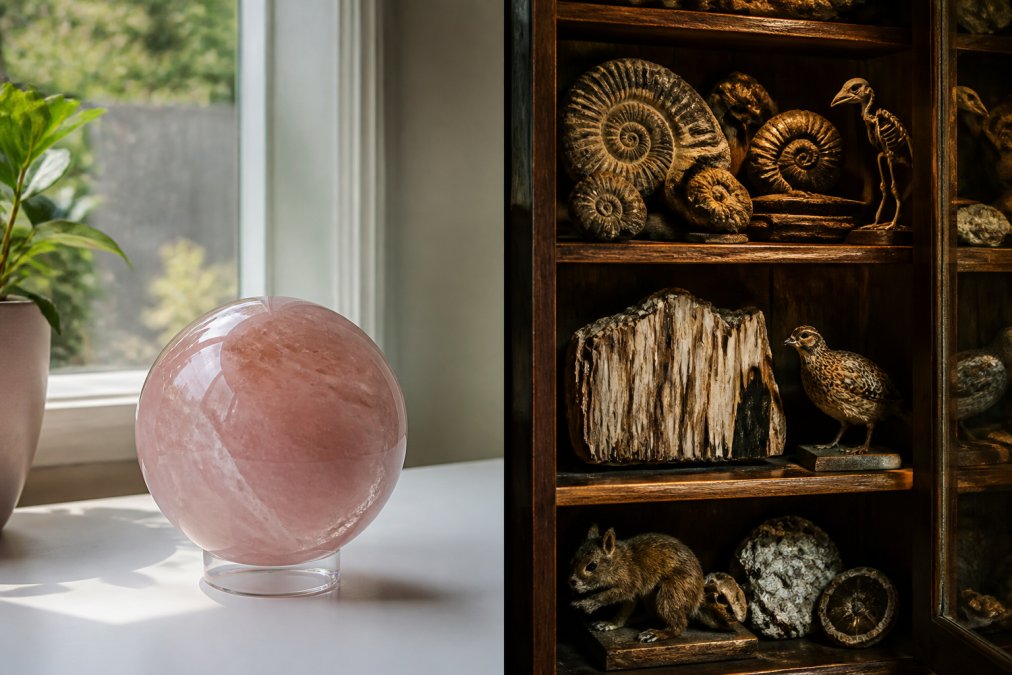
Quick Comparison: Crystabelle vs The Evolution Store
Crystabelle positions itself as a lifestyle brand where crystals double as home decor. Their catalog favors polished spheres, towers, and tumbled stones in soft, consistent color palettes. The Evolution Store, by contrast, reads like a natural history museum gift shop, stocking fossils, meteorites, taxidermy, and osteology specimens alongside minerals.

| Feature | Crystabelle | The Evolution Store |
|---|---|---|
| Primary focus | Polished decor crystals | Natural history artifacts |
| Typical inventory | Spheres, towers, clusters | Fossils, taxidermy, minerals |
| Visual aesthetic | Clean, modern, curated | Eclectic, museum-like |
| Sourcing transparency | Varies by listing | Varies by listing |
| Best for | Home styling and gifts | Collectors and curiosity seekers |
| Price range | Mid to high | Wide, entry to high |
The core difference is curation philosophy: Crystabelle curates for visual appeal and interior design compatibility, while The Evolution Store curates for rarity, scientific interest, and authenticity. Knowing which philosophy matches your intent will resolve most hesitation.
How We Evaluated Both Shops
We built a crystabelle vs evolution store comparison around four criteria that matter most when buying geological specimens online: sourcing transparency, shopping experience, price-to-value ratio, and authenticity guarantees.
Sourcing transparency covers whether a shop tells you where a specimen came from and how it was obtained. Shopping experience includes website usability, photography quality, and description depth. Price-to-value weighs what you receive against what you pay. Authenticity guarantees address treatment disclosure and return policies.
Each criterion carries equal weight; a shop can win on aesthetic appeal but lose on transparency, and that trade-off matters depending on your experience level.
Authenticity and Sourcing Transparency: Who Tells You More?
Authenticity is the single biggest concern for online crystal buyers. Treated, dyed, and mislabeled stones are common, making sourcing transparency the most reliable signal of a trustworthy shop, a verifiable chain of custody from the ground to your shelf.
What a transparent listing actually includes:
- Locality data: A specific mine or region (e.g., "Arkansas quartz" or "Morocco") rather than a vague "natural" label.
- Recovery method: Whether the piece was hand-dug, surface-collected, or sourced from a commercial mining operation.
- Treatment disclosure: Explicit statements about dyeing, heat treatment, oiling, stabilization, or fracture filling. For fossils, this includes whether restoration or composite assembly was used.
- Export/import documentation: For fossils and taxidermy, legitimate sellers can provide permits or certificates of origin, especially for CITES-regulated species.
How to verify ethical sourcing without a geology degree:
- Ask for provenance photos. A reputable seller can show you the specimen at the mine site, in the preparation lab, or during the packing process. If a listing lacks these, request them before purchase.
- Cross-check locality claims. If a listing says "Moroccan fossil," verify that the species is actually found in that region. A trilobite labeled as "Chinese" when it is clearly from Morocco is a red flag.
- Look for preparation notes. For fossils, honest sellers disclose whether the piece was hand-prepped or acid-prepared, and whether any gaps were filled with matrix or epoxy. A perfectly intact, 3-foot ammonite at a bargain price is almost certainly heavily restored.
- Check for CITES compliance. For any taxidermy or osteology specimen, ask if the item is CITES-listed and whether documentation accompanies the sale. The Evolution Store, given its natural history focus, generally provides this context; Crystabelle's decor-oriented catalog rarely touches this territory.
The treatment disclosure test:
A simple way to test a seller's honesty is to search their catalog for common enhancements. How many listings use the words "natural," "untreated," or "no dye"? How many explicitly state "color enhanced" or "stabilized"? The shops that score highest on transparency use these terms proactively, not just when asked.
The ethical sourcing angle competitors ignore:
Most reviews mention "sustainable" or "ethically sourced" without defining it. In practice, ethical sourcing for geological specimens means:
- Minerals: Sourced from operations that respect local labor laws and environmental regulations, or from deaccessioned museum and university collections.
- Fossils: Legally exported with proper permits from the country of origin. Morocco, China, and Brazil have specific export laws that reputable dealers follow.
- Taxidermy: Sourced from natural mortality, pest control, or regulated hunting, never from poached or CITES-protected species without permits.
A seller who cannot articulate where their specimens come from exposes you to legal and ethical risk. Both shops vary in this regard, which is why asking the right questions matters more than choosing a brand name.
Shopping Experience: In-Store vs Online
Crystabelle offers a polished online experience with lifestyle photography showing how each piece looks in a styled room. The Evolution Store provides a more utilitarian browsing experience, closer to scrolling through a museum inventory catalog.
Neither shop offers the tactile advantage of an in-person visit, so photography quality and description depth carry the weight. Look for shops that photograph the exact item you will receive rather than using stock images, the gold standard for buying unique specimens online.
A common mistake is assuming a larger catalog means better quality. Shops with thousands of listings often rely on generic photography and minimal curation; smaller, hand-curated collections typically offer more accurate images and thoughtful descriptions.
Price-to-Value Analysis on Real Specimens
Price-to-value analysis is rarely about finding the cheapest option; it is about whether the specimen justifies what you paid, accounting for size, quality, rarity, and presentation. Reviews tell you Crystabelle is "premium" and The Evolution Store is "wide-ranging," but none break down what those price points actually buy you.
Price bands and what they should deliver:
| Price band | Crystabelle expectations | The Evolution Store expectations |
|---|---|---|
| $20-$50 | Small tumbled stones, mini spheres (1-1.5 inches), polished palm stones. Should arrive flawless, with a consistent polish and no visible cracks. | Entry-level fossils (ammonites, small trilobites), tumbled minerals, small meteorite fragments. Expect matrix or natural pitting, this is normal and should be disclosed. |
| $50-$150 | Medium spheres (2-2.5 inches), towers, clusters. Should include multi-angle photos and honest notes on inclusions. | Prepared fossils (larger ammonites, fish, dinosaur bone fragments), mineral clusters, small taxidermy pieces. Restoration should be disclosed. |
| $150-$500 | Large display spheres (3+ inches), rare mineral specimens. Should include provenance or locality data, and a certificate of authenticity where applicable. | Significant fossils (mosasaur jaws, large ammonites), high-quality mineral specimens, articulated small skeletons. Expect full provenance documentation. |
| $500+ | Investment-grade decor pieces. Should include detailed condition reports and insured shipping. | Museum-grade specimens, complete skeletons, rare meteorites, exceptional mineral pieces. Should include full export documentation and provenance chain. |
The value benchmark test:
A common pattern among collectors is to compare three data points before purchasing: the asking price, the average market price for that specimen type and quality, and the replacement cost if damaged. Here is how to apply that test:
- Search for comparable sold listings on auction sites and dealer catalogs. If a 3-inch polished sphere is listed at $120, but comparable pieces sell for $80-$100, the difference should be justified by superior quality, rare color, or better provenance.
- Calculate the per-inch or per-gram cost. For spheres, a rough benchmark is $20-$40 per inch for common materials (quartz, calcite, amethyst) and $50-$100 per inch for rarer materials (fluorite, larimar, high-grade charoite) (minerals.net). For fossils, per-specimen pricing is more variable, but a prepared ammonite should cost 30-50% more than an unprepared one of the same size.
- Factor in presentation costs. A display stand, a wooden base, or a custom acrylic case adds $10-$30 to the value. If a shop includes these at no extra cost, that is real value.
Where each shop actually lands:
Crystabelle prices skew toward the premium end of each band, reflecting their decor-focused positioning. A 2-inch polished sphere might run $80-$120, while a comparable piece at a less curated shop might be $50-$70. The premium buys you consistency, the piece will match the photography and fit a styled room.
The Evolution Store spans a wider range, from affordable entry-level fossils to significant investment pieces. Their pricing is closer to wholesale for common items but can spike for rare specimens; the trade-off is that you need to do more of your own quality assessment.
The hidden cost of misrepresentation:
The investment angle competitors miss:
For high-intent buyers, certain specimens appreciate in value: complete vertebrate fossils, rare meteorites, and high-grade minerals from closed mines. Ask whether the shop can provide documentation that supports future resale. A specimen with full provenance and a certificate of authenticity will retain or increase its value; a decor piece without documentation is a depreciating asset (mindat.org). The Evolution Store is better positioned for investment-grade purchases; Crystabelle is better for immediate aesthetic value.
Best Places to Buy Authentic Crystals: Our Verdict
After weighing sourcing transparency, shopping experience, and price-to-value, the verdict depends on your collecting goals. If you want museum-quality natural history pieces, The Evolution Store offers the broader catalog. If you want hand-selected, decor-ready crystals where each piece is personally inspected and photographed, a curated shop delivers more confidence.
This is where the crystabelle vs evolution store comparison points toward a third option. For collectors who value knowing exactly what they are getting, IG Crystal Archive, LLC offers a curated collection where every specimen is hand-selected and inspected for quality. Each listing shows the exact piece you will receive, photographed from multiple angles, with natural characteristics honestly described.
The IG Crystal Archive, LLC team personally chooses each crystal for its exceptional quality and natural beauty, ensuring one-of-a-kind items. Every purchase supports a mission to assist autistic adults and their families. With secure packaging, fast shipping, and a 30-day free return policy, the experience is built around buyer confidence.
For those wondering how to identify high-quality mineral specimens, the curation process itself is the answer. A shop that photographs the actual item, describes inclusions honestly, and stands behind purchases with a clear return policy defines a trustworthy seller.
Conclusion
Finding a shop that balances authenticity, fair pricing, and genuine curation takes effort. The right choice depends on whether you prioritize scientific rarity or decor-ready beauty, and how much transparency you require.
IG Crystal Archive, LLC combines hand-selected specimens with honest, detailed listings and a mission-driven purpose, making it a strong choice for collectors who want confidence in every purchase. Get started with IG Crystal Archive and find a one-of-a-kind piece that fits your space and values.
Frequently Asked Questions
Is The Evolution Store worth visiting for serious crystal collectors?
For serious collectors, The Evolution Store offers an unmatched browsing experience. You can see specimens in person, inspect their weight and color, and walk out with your purchase same-day. However, the staff's focus is broad natural history, not deep crystal expertise. If you need guidance on quality or metaphysical properties, you may find more specialized help from online curators who hand-select each piece.
How do I know if an online crystal shop sells authentic, high-quality mineral specimens?
Look for shops that display photos of the exact item you will receive, not stock images. Ask about sourcing and whether treatments or dyes are used. A reputable seller will describe natural inclusions and variations rather than hiding them. Check for a clear return policy that lets you send back a piece if it doesn't match its description, and read reviews that mention quality and accuracy.
Why do hand-selected crystals cost more than what I see at big retailers?
Hand-selected crystals cost more because someone with experience has already filtered out low-grade material. You are paying for the time spent inspecting color, clarity, and structural integrity, plus the cost of secure packaging and a return policy that protects you. Mass retailers often sell uncurated lots where you might receive a piece with unexpected fractures or heavy treatment.
What should I look for when comparing crystal prices between Crystabelle and The Evolution Store?
Compare the exact specimen, not just the price tag. Check the size in inches or millimeters, and look for the same quality of polish and color saturation. A larger sphere with high clarity will naturally cost more than a smaller, included piece. Consider what is included, like a display stand, and factor in shipping costs and return policies before deciding which is the better deal.