Real Crystal or Fake? Curation vs Fast Shipping
Table of Contents
- Why Crystal Authenticity Depends on How You Buy
- How to Tell If a Crystal Is Real: Visual Clues That Matter
- Crystal Authenticity Tests You Can Run at Home (and Their Limits)
- How to Identify Dyed Crystals and Heat-Treated Stones
- How to Buy Authentic Crystals Online: A Seller Verification Checklist
- Curation-Led Trust vs Fast, Reliable Shipping: Which Matters More?
- A Decision Framework for Different Buyer Priorities
- Conclusion: Build Confidence Before You Buy
- Frequently Asked Questions
Last Updated: October 12, 2026
Why Crystal Authenticity Depends on How You Buy
Crystal authenticity is the degree to which a stone is what a seller claims: the same mineral, from the stated origin, with treatments disclosed.
Most buyers get this backwards, treating fast shipping as the main sign of a trustworthy seller. Speed tells you how quickly a package moves, not what is inside it.
Below, we explain the visual clues, at-home tests, and seller checks that separate a genuine specimen from a convincing imitation.
How to Tell If a Crystal Is Real: Visual Clues That Matter
Real crystals almost always show some imperfection. A flawless, perfectly uniform stone at a low price is a warning sign, not a bargain.
Look at the stone under bright, indirect light, then from several angles, because some imitations only fail when light hits them from the side.
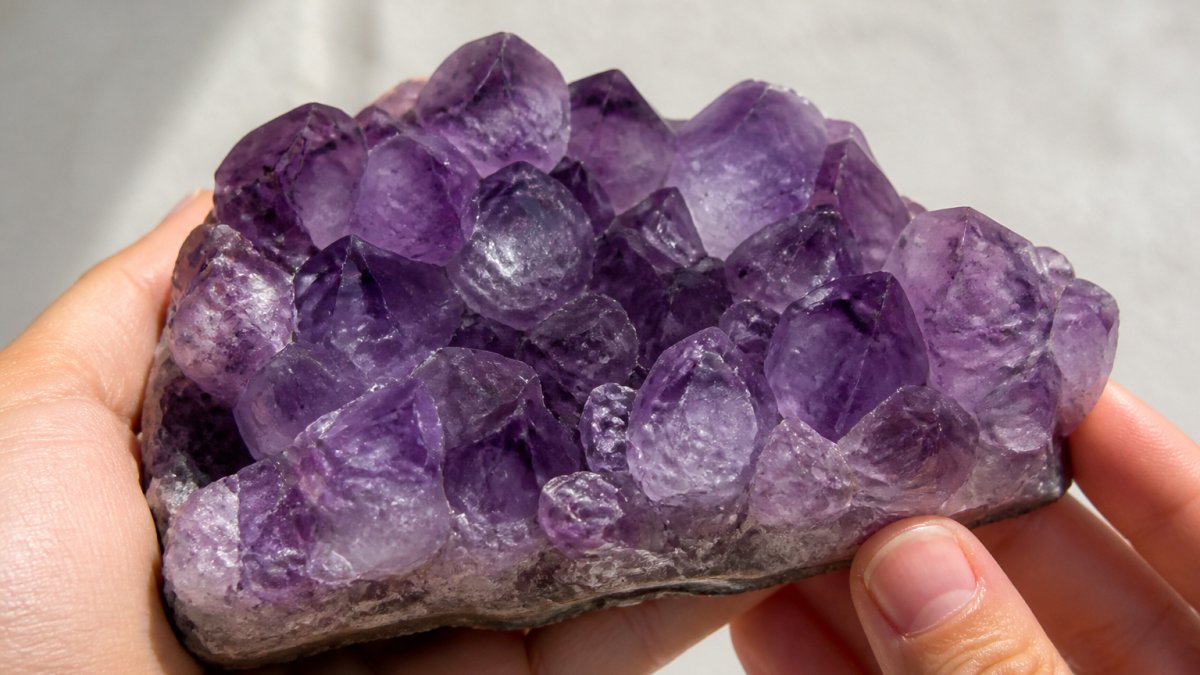
Natural Inclusions, Color Variation, and Surface Texture
Natural inclusions are tiny trapped minerals, bubbles, or fractures inside a stone, rarely following a neat pattern. Color variation means the shade shifts across the piece instead of staying flat. Surface texture refers to the small ridges, growth lines, and uneven faces on an unpolished specimen.
Glass imitations usually look too clean. Resin imitations feel too light and warm. Dyed stones often show color pooled in cracks rather than spread evenly through the material.
Spotting Glass, Resin, and Dyed Stone Imitations
Glass is the most common substitute because it is cheap and easy to shape. It usually contains round air bubbles rather than angular mineral inclusions, and its edges look smooth rather than naturally fractured. Resin feels lighter and warmer than stone and can scratch with a fingernail.
That covers what you can see. The next question is what you can test.
Crystal Authenticity Tests You Can Run at Home (and Their Limits)
At-home tests can rule out some fakes, but none of them prove authenticity on their own. Each test gives you one data point. You need several before you can draw a conclusion. The U.S. Geological Survey mineral resources program publishes background on how minerals form, which helps you understand why these tests work at all.
Temperature, Weight, and the Scratch Test
Hold the stone in your closed hand for a minute. Natural stone feels cool at first, then warms slowly; glass warms faster, and resin feels warm almost immediately.
The scratch test uses the Mohs scale of mineral hardness. Quartz sits at 7, so it can scratch glass. But the test can damage a specimen you intended to keep, tells you nothing about treatments, and a hard fake can pass it. Skip it on any finished piece.
UV Light and Other Simple Tools
A UV light reveals dyes and some treatments: many dyed stones glow in ways natural material does not, and some resins fluoresce under longwave ultraviolet. A jeweler's loupe or phone macro lens helps inspect inclusions up close, and a kitchen scale lets you compare density against a known reference.
How to Identify Dyed Crystals and Heat-Treated Stones
Treatment disclosure is the line between an honest seller and a misleading one. Dye and heat treatment are common and not automatically dishonest; the problem is silence. A heat-treated amethyst sold as natural citrine is a misrepresentation, even though the stone itself is real.
Here is how to spot the most common enhancements:
- Dyed crystals: color concentrates in cracks and pits, and a white cotton swab with a little acetone may lift pigment from the surface
- Heat-treated stones: color looks unusually uniform, and the piece may lack the zoning you would expect from the mineral
- Irradiated material: often shows an intense, even tone that natural specimens rarely reach
- Coated or "aura" pieces: a thin metallic film sits on the surface and can flake at the edges
If a listing does not state the treatment, ask directly. A seller who cannot answer is telling you something useful.
How to Buy Authentic Crystals Online: A Seller Verification Checklist
Buying authentic crystals online comes down to evidence, not enthusiasm. A seller who documents provenance and answers hard questions is safer than one who ships overnight and says nothing about origin. Use this checklist before you commit:
- Does the listing name the mineral, the locality, and any treatment?
- Are the photos of the actual piece, not a stock image?
- Is there a stated return policy with a clear window?
- Do customer reviews mention accuracy of the photos?
- Does the seller answer questions about origin in specific terms?
- Is the certificate of authenticity, if offered, tied to a named lab or appraiser?
- Does the protective packaging suit a fragile specimen?
Evidence Standards for Authenticity Claims
Not all proof is equal. A generic "100% natural" badge means nothing; a lab report with a report number and named testing body means something. A photo of the exact specimen beats a catalog shot every time. When a seller offers a certificate, check whether it identifies the specific stone and test. Vague paperwork is decoration.
Curation-Led Trust vs Fast, Reliable Shipping: Which Matters More?
These two signals answer different questions, and only one is checkable before you pay. Treat them as separate columns of evidence, not competing philosophies.
| Factor | Curation-Led Trust | Fast, Reliable Shipping |
|---|---|---|
| What it proves | Provenance, selection, disclosure | Logistics and fulfillment competence |
| When it is verifiable | Before you pay | After you pay |
| Reversible? | Yes, you can walk away | No, the stone is already yours |
| Failure cost | You skip a bad listing | You file a return or claim |
| Strongest evidence | Named locality, treatment disclosure, exact-piece photos | Dispatch time, tracking, packaging, damage-claim record |
| Weakest evidence | A "100% natural" badge | A fast checkout page |
Where shipping risk is crystal-specific. Crystals are brittle, often cleaved, and frequently shipped as clusters with thin terminations.
Where curation can be faked. A curated-looking storefront is not proof of curation.
The verdict, stated plainly. Curation is the foundation because it is the only signal you can verify before money changes hands.
A Decision Framework for Different Buyer Priorities
Most guides tell you to "choose a trustworthy seller" without saying how. The framework below turns that advice into a repeatable scorecard you can run against any listing in minutes, and shows which criteria matter most depending on what you are buying.
The Seller Verification Scorecard
Score each line 0, 1, or 2: 0 means the seller does not address it, 1 means they address it vaguely, 2 means they address it specifically.
| Criterion | 0 points | 1 point | 2 points |
|---|---|---|---|
| Mineral and locality | Not stated | Mineral named, locality vague | Mineral and named locality both stated |
| Treatment disclosure | Silent | "May be treated" | Specific treatment named, or "none" stated |
| Image accuracy | Stock photos only | Mixed stock and real | Photos of the exact specimen |
| Return terms | None stated | Window stated, conditions unclear | Clear window and condition |
| Authenticity evidence | Badge or claim only | Generic certificate | Report tied to a named lab or appraiser and the specific stone |
| Shipping and packaging | Not described | Standard shipping mentioned | Dispatch time, tracking, and protective packaging described |
| Damage remedy | Not stated | "Contact us" | Stated replacement or refund process |
A total of 10 or higher is a strong signal; below 6 is a warning. The scorecard is not a guarantee, but it forces the seller to put claims in writing, which makes them checkable later.
Evidence Standards: What Proof Can and Cannot Establish
Not all proof is equal, and each type has limits.
- A seller's own guarantee establishes what the seller is willing to stand behind. It does not independently verify the stone.
- A certificate of authenticity establishes that someone signed a document. It only becomes useful when it names the specific stone, the specific test, and the testing body.
- A gemological lab report establishes that a named lab examined a stone and reported findings. It is the strongest common form of evidence, but it applies to the stone that was submitted, so confirm the report matches the piece you receive.
- Supplier or provenance records establish a chain of custody. They are useful for origin claims but are only as reliable as the supplier.
- Exact-piece photographs establish what the seller is offering to ship. They are the cheapest and most immediately useful evidence, and they are the easiest for a buyer to request.
A single document rarely proves authenticity. The pattern to look for is consistency across several forms of evidence.
Matching the Framework to What You Are Buying
- If you are new to collecting: weight the mineral, locality, and image-accuracy lines most heavily. You do not need to know the terminology yet, and a seller who answers questions in specific terms will guide you.
- If you are buying a gift on a deadline: weight shipping, packaging, and the damage remedy alongside image accuracy. Confirm the return window before you order, because a deadline removes your ability to re-shop.
- If you are a serious collector: weight locality detail, treatment disclosure, and authenticity evidence above all else. Speed is irrelevant if the provenance is wrong.
- If you are decorating a space: weight image accuracy and return terms, since color matching matters more than rarity, and a generous return window protects you if the piece reads differently in your room.
The pattern is consistent. Score the seller before you score the stone. Speed is a tiebreaker between sellers who already pass the curation checks.
Conclusion: Build Confidence Before You Buy
The hard part of buying crystals is not finding a seller who ships quickly, but one who can tell you exactly what you are holding and why they chose it.
At IG Crystal Archive, we hand-select and carefully inspect every specimen, pack it securely, and stand behind it with 30-day free returns.
Get started with IG Crystal Archive and buy with confidence in the quality of what arrives.
Frequently Asked Questions
How can I test the authenticity of my crystals at home?
Start with visual inspection: look for natural inclusions, uneven color, and surface texture that glass or resin lacks. Check temperature (real stone feels cool longer), weight relative to size, and use a UV light to spot dye treatments. A scratch test on the Mohs scale can help, but it risks damaging softer stones, so only try it on a hidden area. No single test is definitive; combine several and compare against known reference specimens.
Can you tell if a crystal is real from a photo?
Photos can reveal some clues like color zoning or unnatural uniformity, but they cannot confirm authenticity. Lighting, editing, and angles can hide treatments or imitations. Ask sellers for unedited, natural-light photos from multiple angles, close-ups of inclusions, and disclosure of any treatments. A certificate of authenticity or provenance documentation adds more confidence than a photo alone.
What should a crystal seller disclose about a specimen?
A transparent seller should disclose the mineral type, origin if known, any treatments (heat, dye, irradiation), and whether the piece is natural or synthetic. They should also provide clear return policies and authenticity guarantees. If a seller avoids these details or cannot explain how they source and inspect pieces, treat that as a red flag before buying.
What should I do if a crystal I ordered seems inauthentic?
First, document your concerns with clear photos in natural light. Contact the seller with your findings and ask for their authentication evidence. If the piece was misrepresented, request a return or refund under their policy. Reputable sellers stand behind their curation. If the seller is unresponsive, consider a chargeback through your payment provider and leave a factual review to help other buyers.