How to Display Crystals in Home: 7 Stylish Ideas
Table of Contents
- Start with a Plan: Choosing a Spot and a Style
- Best Crystals for Home Interior Decor
- How to Display Crystals in Home: 7 Ideas That Work
- Crystal Display Shelf Ideas for Every Room
- How to Arrange Crystals on a Shelf (Step by Step)
- Organize by Size, Shape, and Type
- Keep It Safe: Child, Pet, and Cleaning Basics
- Conclusion
- Frequently Asked Questions
Last Updated: September 17, 2026
Start with a Plan: Choosing a Spot and a Style
How to display crystals in home spaces starts with two choices: where the pieces will live and what look you want. This guide from IG Crystal Archive, LLC covers both, plus seven display ideas for real rooms.
Before you buy anything, ask three questions:
- Which room do I see most often?
- Do I want a calm, minimal look or a full, layered one?
- How much surface can I give up?
Best Crystals for Home Interior Decor
The best crystals for home interior decor fit your space, your light, and your taste. There is no single right stone, but some types display better than others:
| Crystal Type | Best For | Display Tip |
|---|---|---|
| Polished spheres | Shelves, coffee tables | Use a stand so it does not roll |
| Amethyst clusters | Focal points, altars | Place at eye level |
| Geodes | Statement pieces | Open side facing the room |
| Polished stones | Trays, small bowls | Group by color |
| Slabs and tiles | Bases and risers | Layer under smaller pieces |
How to Display Crystals in Home: 7 Ideas That Work
These seven setups cover most rooms and budgets, each with what to buy, the effort involved, and the mistake that ruins it.

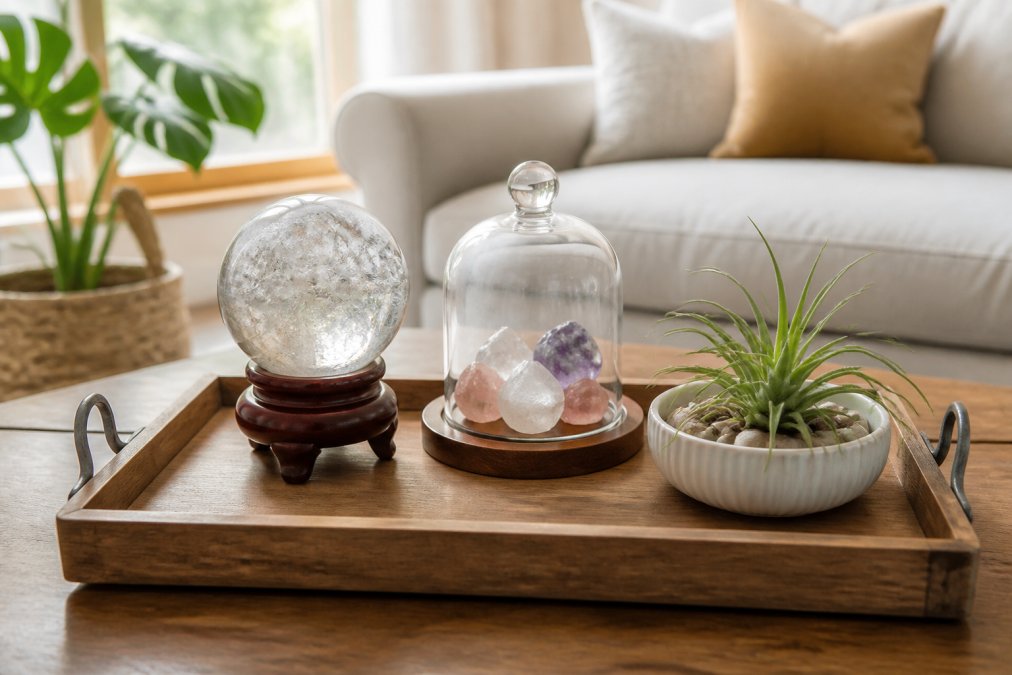
Use Display Stands and Risers for Height and Focus
A display riser lifts a piece so it reads as the focal point of a shelf. Acrylic risers are cheap, nearly invisible, and easy to wipe down, but they scratch; a microfiber cloth and a drop of mild dish soap in warm water keeps them clear, while paper towels haze them over time. Wooden risers hide scratches and add warmth, but can leave oil marks on porous stones if the finish is not fully cured.
Create a Crystal Altar or Sacred Space
A crystal altar is a small, intentional arrangement of stones placed together for focus, calm, or spiritual practice, usually on a tray, low table, or dedicated shelf. Keep it simple: choose three to five pieces that mean something to you, add a candle or small dish, and let it be a sacred space rather than a storage spot.
- Pick a footprint first. A standard 12-by-16-inch tray holds three medium pieces plus a candle without crowding. Anything larger starts to read as a shelf.
- Choose one anchor stone. A cluster or geode at the back gives the arrangement a natural center. Everything else supports it.
- Leave negative space. Empty tray surface is part of the design, not wasted room.
- Keep flame away from raw edges. If you use a candle, place it on a heat-safe dish and keep it at least a few inches from any fibrous or friable specimen.
Showcase Pieces Under a Glass Cloche or Dome
A glass cloche turns a single specimen into a museum piece and keeps dust off the stone, which matters, since deep cluster pockets are the hardest part of any collection to clean. It works best with one standout item, like a geode or large sphere. Skip it for clusters with sharp points, which can be awkward to fit and can chip the glass if the dome shifts.
A few sizing notes:
- Leave at least an inch of clearance between the tallest point of the stone and the inside of the dome.
- A dome with a wooden or stone base gives you a stable footprint and hides the bottom edge of the specimen.
- Glass domes fog if they sit in direct sun next to a plant. Keep them in indirect light.
- Lift the dome straight up when you dust. Tilting it is how most chips happen.
Add Crystals to Floral Arrangements
Tuck small polished stones into the base of a vase or around a plant. The mix of natural texture and color makes both look better.
Two ways to do this without risking the stone:
- Dry base method. Fill the bottom third of a vase with polished stones, then set a smaller water-tight vessel inside for the stems. The stones never touch water.
- Tray method. Set a small dish of stones next to the vase rather than inside it. You get the color pairing without any moisture exposure.
Build on Wooden Trays and Natural Bases
A decorative tray corrals a group of stones into one clean unit. Wood, slate tile, and marble slab all work as bases.
Material matters more than style here:
- Wood is warm and forgiving, but soft finishes can transfer oil to porous stones. A sealed or lacquered tray avoids that.
- Slate is naturally non-slip and hides dust, but it is heavy and can chip if you drop it.
- Marble reflects light and makes polished spheres pop, but it stains. Wipe spills immediately.
- Felt or cork liners under the tray protect the furniture and stop the whole arrangement from sliding when you move it.
Go Vertical with Wall-Mounted Shelving
Wall shelves free up table space and put small pieces at eye level; floating shelves are one of the best space-saving solutions for small apartments.
Large Natural Polished Crystal Sphere →
A few rules keep wall displays safe and stable:
- Anchor into studs or use rated drywall anchors. A shelf holding stone is heavier than it looks. A single medium cluster can weigh several pounds.
- Add a lip or ledge. A shelf with a raised front edge stops pieces from sliding off when a door closes hard or a pet bumps the wall.
- Keep the deepest pieces on the lowest shelf. That way, if something does fall, it has the shortest drop.
- Use museum putty under small polished stones on upper shelves. It holds them in place without leaving residue on most finishes.
Pair Crystals with Terrariums and Air Plants
A terrarium or small air plant adds life next to stone, and the green softens the look. Keep water separate from your crystals: mist the plant, not the stone. The simplest setup is a closed or semi-closed terrarium with the plant inside and the crystals on the outside of the glass, the visual pairing with zero moisture risk.
Crystal Display Shelf Ideas for Every Room
Crystal display shelf ideas change by room: the same stones can look calm in a bedroom and bold in a living room.
How to Arrange Crystals on a Shelf (Step by Step)
Arranging crystals on a shelf takes about 15 minutes once your pieces are picked out:
- Clear the shelf and wipe it down.
- Sort pieces into large, medium, and small groups.
- Place your largest piece first, off-center.
- Add a medium piece to balance the other side.
- Fill gaps with small stones and a riser or two.
- Step back and check the height flow.
- Adjust until the group feels even.
Organize by Size, Shape, and Type
Organization keeps a large collection from turning into clutter. Group by size first, then shape, then type:
- Large statement pieces: one per shelf
- Medium spheres and clusters: grouped in threes
- Small polished stones: kept in bowls or on trays
- Flat slabs: used as bases under other pieces
Keep It Safe: Child, Pet, and Cleaning Basics
Safety and cleaning are the two things most display guides skip, and both matter in homes with kids or pets.
Child and Pet Safety
The core problem is simple: crystals are heavy, some are sharp, and a few are toxic if chewed or handled. A display that looks safe on a shelf can still be a hazard in a home with a toddler or a cat.
Cleaning and Maintenance
Dust is the slow killer of a crystal display: it dulls polish, fills cluster pockets, and makes even a well-styled shelf look tired. The fix is a routine, not a deep clean.
Conclusion
Building a display that lasts takes a little planning, but the payoff is a space that feels calm and personal. The hardest part is usually choosing pieces that fit your room and your light.
Frequently Asked Questions
Where should I not put crystals in my home?
Keep crystals out of constant direct sunlight, since amethyst, rose quartz, and fluorite can fade over time. Avoid bathrooms and kitchens, where steam and grease dull polished surfaces. Skip unsecured windowsills in homes with cats or small children, and don't store soft stones like calcite loose in a drawer with harder quartz, which can scratch them.
How do I organize a large crystal collection?
Sort by size first, placing large statement spheres and geodes on lower, stable surfaces and smaller points on upper shelves. Group by color family or mineral type so the display reads as a curated collection rather than clutter. Rotate pieces seasonally, and keep a simple inventory note of what you own so you don't rebuy duplicates. Vertical shelving and risers add capacity without crowding.
What are the best display stands for raw mineral specimens?
Acrylic stands and wooden holders work well for raw specimens because they cradle uneven bases without hiding the stone. For spheres, a ring-style wooden or acrylic stand keeps the piece from rolling. A marble slab or slate tile underneath adds contrast and protects the shelf. Match stand size to the specimen so it doesn't tip, and use museum putty for extra stability.
How do I keep my crystal display safe around kids and pets?
Anchor shelves to the wall with furniture straps, and place heavy geodes and spheres on lower shelves or inside a cabinet with glass doors. Use museum putty under stands to stop sliding, and skip any display at a height a cat can reach with a paw. Keep small tumbled stones and sharp raw points in a closed container, and check the display monthly for wobbles.