Why Hand Selected Crystals Beat Bulk Buys Every Time
Table of Contents
- What Hand Selected Crystals Actually Mean
- How to Spot Fake Crystals and Treated Stones
- Raw vs Tumbled Crystals: Benefits of Each Form
- Quality Signals: Clarity, Cut, Color, and Light Refraction
- Best Places to Buy Authentic Crystals Online
- What Bulk Crystals Cost You in the Long Run
- Frequently Asked Questions
Last Updated: September 17, 2026
What Hand Selected Crystals Actually Mean
Hand selected crystals are specimens that a person has physically examined, one at a time, before they reach a buyer. At IG Crystal Archive, LLC, every sphere and specimen is chosen by hand for clarity, color, and natural character, not pulled from a mixed wholesale lot. That distinction matters more than most buyers realize, and below we break down exactly why hand selection changes what arrives at your door.
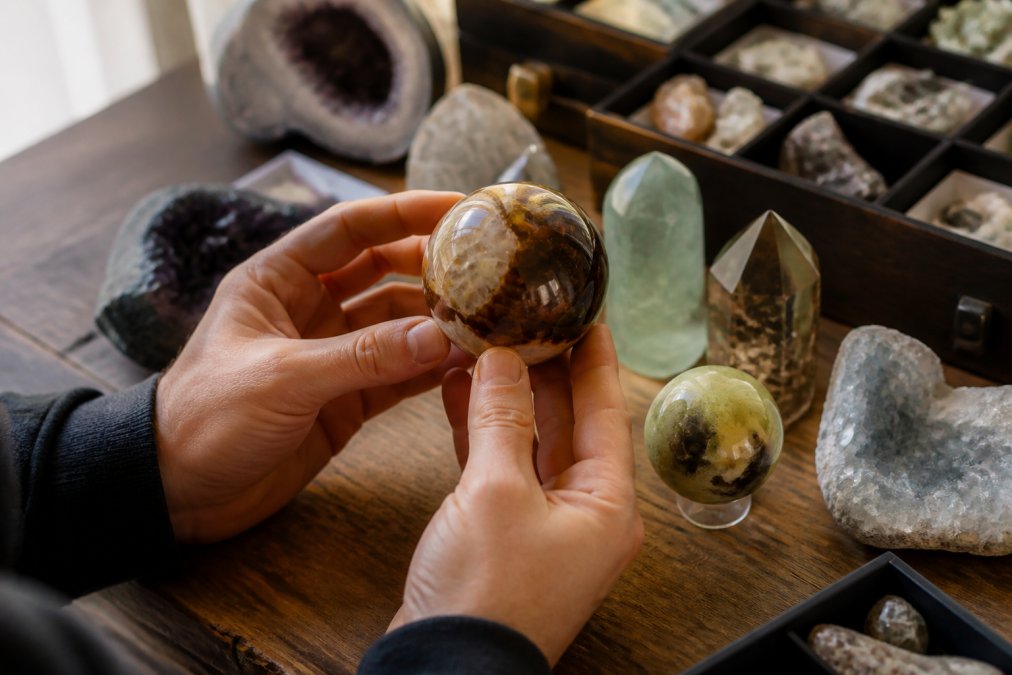
Bulk wholesale crystals are bought by the box, sight unseen or graded in loose categories. Hand-picked stones are chosen individually, which means someone actually looked at the surface texture, the light refraction, and the mineral composition before deciding it was worth offering.
The Difference Between Hand-Picked and Wholesale Bulk
Wholesale lots are priced by weight and volume. The seller moves inventory fast, and quality varies wildly from piece to piece because nobody is stopping to evaluate each one. You get what you get.
| Factor | Wholesale Bulk | Hand-Picked |
|---|---|---|
| Selection method | By weight, mixed lots | Individually examined |
| Quality consistency | Highly variable | Consistent per piece |
| Uniqueness | Repeated patterns | One-of-a-kind specimens |
| Buyer confidence | Uncertain until arrival | Photos show exact stone |
How to Spot Fake Crystals and Treated Stones
Spotting fake or treated crystals comes down to physical inspection: look for natural inclusions, uneven color, and surface texture that a genuine mineral develops over millions of years. Glass and resin fakes tend to look too uniform, too perfect, and too evenly colored to be real.
Physical Inspection: Inclusions, Cracks, and Matrix
Inclusions are trapped minerals or gas pockets inside a stone. They are evidence of natural formation, and they are extremely difficult to fake convincingly.
- Inclusions: Look for tiny internal features that catch light differently than the surrounding stone.
- Natural cracks: Fine internal fractures are normal in many minerals. Uniform, glassy smoothness is suspicious.
- Matrix: Remnants of host rock on the base or surface signal a genuine specimen.
- Color saturation: Real minerals often shift tone across the surface. Dyed stones look flat and even.
Raw vs Tumbled Crystals: Benefits of Each Form
Raw and tumbled crystals are not competing categories so much as different stages of the same material. A raw specimen is the mineral as it came out of the ground, minus loose dirt. A tumbled stone is that same mineral after weeks in a rotary or vibratory tumbler with progressively finer abrasive grit, which is why the surface feels smooth and the edges are rounded.
What Raw Specimens Preserve
Raw crystals keep the features that formed them: crystal faces, growth striations, matrix (the host rock still attached), and internal fractures. For a collector, those features are the provenance. A raw amethyst point with visible chevron zoning tells you more about how it grew than a polished tumbled stone ever will.
What Tumbling Changes
Tumbling removes surface imperfections and softens sharp edges, which makes stones easier to hold, carry, and place in a pocket or grid. It also removes evidence. Inclusions that were visible on a rough face may be polished over, and a stone that looked promising in the rough can come out of the tumbler looking flatter and less dimensional than expected.
How to Choose Between Them
| Goal | Better Form | Why |
|---|---|---|
| Display and collection | Raw | Preserves crystal faces, matrix, and growth features |
| Handling, carry, grids | Tumbled | Rounded edges, uniform surface, less chipping risk |
| Judging natural formation | Raw | Inclusions and zoning stay visible |
| Judging polish quality | Tumbled | Surface evenness is the whole point |
A practical rule: buy raw when you want to see how the mineral formed, and buy tumbled when you want a stone that survives daily handling. Neither is higher quality by default. What separates a good specimen from a filler stone in either form is whether someone actually inspected it before it was listed.
Quality Signals: Clarity, Cut, Color, and Light Refraction
The four signals that separate specimen-grade crystals from ordinary ones are clarity, cut precision, color saturation, and light behavior. A high-quality piece scores well on all four. A hand selector is checking each one in sequence, in person, before the stone is listed.
Clarity: What Is Actually Inside
Clarity describes how much internal material blocks or distorts light passing through the stone. In mineral terms, that material includes fluid inclusions, mineral inclusions, growth zoning, and internal fractures.
Cut Precision: Geometry Over Gloss
Cut precision matters most for faceted pieces. A well-cut facet has flat, evenly angled faces that meet at clean edges, so light entering the stone reflects internally and returns to the eye. A poorly cut stone has uneven facet angles, rounded edges where the lapidary rushed, and windows, which are flat spots that let light pass straight through instead of reflecting.
Color Saturation: Depth, Not Brightness
Color saturation is about how much color the stone carries per unit of volume, not how bright it looks under a ring light. A deeply saturated stone holds its color in shade and in direct sun. A pale or dyed stone looks vivid under one lighting condition and washed out under another.
Light Refraction: The Physical Tell
Refraction is the bending of light as it passes from one medium into another, and it is governed by a mineral's refractive index. That is why a quartz sphere and a glass sphere of the same size do not look alike: quartz bends light differently than glass, and the difference shows up as sharper internal reflections and a brighter return of light from the back of the stone.
How Hand Selection Tests All Four
A hand selector runs the same sequence on every piece: loupe for internal fractures and inclusions, rotate under directional light for color shift, check facet or sphere geometry for flat spots, and confirm light return against a known reference. Stones that fail any step are set aside. That is the mechanism behind the claim that hand-selected crystals are better: not a vibe, but a repeatable inspection sequence applied one stone at a time.
Best Places to Buy Authentic Crystals Online
The best places to buy authentic crystals online are sellers who show the exact stone you will receive, disclose sourcing, and offer a clear return policy. That combination is rarer than it should be.
When evaluating a seller, check these things:
- Does the listing show the actual specimen, not a stock photo?
- Is the mineral composition and origin described, or just a generic name?
- Is there a stated return window in case the stone is not what you expected?
- Does the seller explain how they select and inspect pieces?
What Bulk Crystals Cost You in the Long Run
For buyers who have been burned before, the reassurance matters. As verified buyer Amanda L. said, "I've ordered crystals from many shops, and IG Crystal Archive stands out." That kind of consistency is the point of hand selection.
Frequently Asked Questions
What is the difference between hand selected and bulk crystals?
Hand selected crystals are individually inspected for quality, natural inclusions, and visual appeal before purchase. Bulk orders are bought by weight or lot, often sight unseen, which means you may receive dyed, cracked, or low-clarity stones mixed in. Hand selection means each piece is chosen for its specific characteristics, so you know exactly what you are getting before it ships.
How can you tell if a crystal is high quality?
Check for natural inclusions and matrix rather than perfect uniformity, which can signal synthetic or treated stone. Look at light refraction through the piece; genuine crystals show depth and internal structure. Ask the seller for exact photos of the stone you will receive. A hand selected crystal from a reputable source will come with clear photos and details about its natural features.
Are raw crystals better than tumbled crystals?
Neither is better; they serve different purposes. Raw specimens preserve natural geometry, matrix, and surface texture, which collectors value for display and study. Tumbled stones offer smooth handling, consistent shape, and are easier to place in decor or carry. The right choice depends on whether you want a display specimen or a tactile piece for daily use.
How do I know these crystals are authentic and not treated or dyed?
Authentic hand selected crystals show natural color variation, inclusions, and surface features that dyes and treatments cannot replicate. Ask for exact photos of the piece you will receive, not stock images. Reputable sellers describe any treatments honestly and provide details on origin and selection. If a listing shows dozens of identical stones at a low price, that is a red flag for bulk or treated material.
Bulk buying optimizes for volume, and volume is not what makes a crystal collection worth displaying. If you want specimens chosen with a real eye for quality, backed by fast shipping, 30-day free returns, and a mission that supports autistic adults and their families, IG Crystal Archive, LLC is built for exactly that. Get started with IG Crystal Archive, LLC and find a one-of-a-kind piece you will actually want to show off.