How to Avoid Impulsive Crystal Buying: A 2026 Guide
Table of Contents
- Why Crystal Shops Are Designed to Make You Buy on Impulse
- Set a Crystal Budget Before You Browse: Budgeting for Crystal Collections
- How to Identify Fake Crystals Before You Commit
- Best Places to Buy Authentic Crystals (and What to Check First)
- A 7-Step Pause-and-Decide Framework for Every Crystal You Want
- Build a Starter Collection You'll Actually Display
- Frequently Asked Questions
Last Updated: September 27, 2026
Why Crystal Shops Are Designed to Make You Buy on Impulse
Crystal shops are built to trigger quick decisions, not careful ones, which is why impulsive crystal buying happens so easily. Soft lighting, rows of sparkling specimens, and a "one of a kind, grab it now" feeling all push you toward the register. Learning how to avoid impulsive crystal buying starts with seeing the room for what it is: a sales floor.
The Triggers Behind Impulse Crystal Purchases
The biggest triggers:
- Scarcity pressure. "Only one left" or "last piece" makes waiting feel like losing.
- Mood lighting and staging. Warm light flatters dull or dyed stones.
- No price anchor. Without a budget in mind, any number feels reasonable.
- Social proof overload. A wall of five-star reviews quiets your own judgment.
- The instant-gratification pull. Crystals promise calm, luck, or healing, and you want that feeling now.
That explains the trap. Now let's set the guardrail that stops it.
Set a Crystal Budget Before You Browse: Budgeting for Crystal Collections
Budgeting for crystal collections works best when you decide the number before you see anything shiny. Pick a monthly cap, then split it into "one statement piece" and "a few small pieces." A written number beats a vague feeling every time.
A simple system:
- Set a monthly cap you can spend without stress.
- Split it: 60% for one quality piece, 40% for smaller finds.
- Keep a wish list. Wait 7 days before buying anything on it.
- Track every purchase in a notes app.
Try a budget worksheet like this:
| Budget Bucket | Share of Monthly Cap | What It Covers |
|---|---|---|
| Statement piece | 60% | One larger, hand-selected specimen |
| Small finds | 40% | Tumbled stones, small clusters |
| Wish-list hold | $0 until 7 days pass | Anything unplanned |
How to Identify Fake Crystals Before You Commit
Learning how to identify fake crystals comes down to a few physical tests you can run in seconds, plus one distinction almost every guide skips: "fake" is not the same as "treated." A stone can be a genuine mineral and still have a color that never formed in the ground. Knowing which category you are looking at changes what you should pay and what you should expect.
Start with the four categories:
-
Natural and untreated. Mined from the earth, cut and polished, no color or clarity added. Inclusions, color zoning, and internal fractures are expected.
-
Treated or enhanced. A real mineral whose color or clarity was changed after mining. Heat-treated amethyst sold as citrine and dyed agate are the classic examples. The stone is real; the color is not natural.
-
Lab-grown or synthetic. Chemically the same as the natural mineral but grown in a lab. Synthetic quartz and synthetic ruby are common. They are real minerals by chemistry, but they are not mined specimens.
-
Imitation. Glass, resin, plastic, or dyed howlite shaped to look like turquoise, lapis, or malachite. This is what most people mean by "fake."
-
Bubbles inside the stone. Glass and resin imitations trap round air bubbles. Genuine minerals rarely have them.
-
Uniform color. Dyed quartz often shows color pooled in cracks and along the drill hole.
-
Weight. Real stone feels dense for its size. Plastic feels light.
-
Temperature. Genuine minerals feel cool at first touch and warm slowly.
-
Price that's too low. A flawless large piece at a tiny price is a red flag.
-
Color that doesn't match the mineral. Bright orange "citrine" at a low price is usually heat-treated amethyst, not natural citrine.
Natural Inclusions, Fracture Patterns, and Other Signs of a Genuine Mineral
What to look for:
- Inclusions. Tiny lines, specks, or "snow" inside the stone.
- Fractures. Natural cracks that follow the stone's growth, not a clean slice.
- Color zoning. Bands or patches of slightly different color inside one piece.
- Translucency. Real stones vary from cloudy to clear across one piece.
- Surface texture. Raw specimens feel rough and uneven.
A quick rule of thumb: if a stone looks too perfect, too uniform, or too cheap for its size, assume it is treated, synthetic, or imitation until the seller proves otherwise.
Best Places to Buy Authentic Crystals (and What to Check First)
The best places to buy authentic crystals are sellers who answer hard questions and show real photos. That means small shops, specialty dealers, gem and mineral shows, and trusted online stores with clear return policies. Big-box gift shops and mystery grab bags are where fakes hide.
In-Person Checklist (Shops, Shows, Markets)
- Pick it up. Weight and temperature are your fastest tests. Real stone feels dense and cool.
- Look at it against a white card. Dyed stones often leave a faint color trace, and color pooled in cracks is easier to see.
- Use a loupe or phone macro lens. Look for round bubbles (glass or resin) and for the uniform, glassy interior of synthetics.
- Ask about treatment out loud. "Is this color natural, or is it heated or dyed?" A confident, specific answer is a good sign. A vague one is not.
- Check the label against the stone. If the tag says "citrine" but the color is the deep orange of heat-treated amethyst, ask.
- Compare prices across the booth or shop. One wildly cheap "flawless" piece next to fairly priced rough is a tell.
- Get a receipt. Even at a market, a written receipt with the stone name and any treatment noted protects you.
Online Checklist (Websites, Marketplaces, Social Sellers)
- Real photos, not stock images. Ask for a photo of the exact piece, ideally with a coin or ruler for scale.
- Video in natural light. Indoor warm light hides dye and flatters dull stones. Ask for a short clip near a window.
- A clear return policy. Look for a stated window, like a 30-day free return, and read the fine print on shipping.
- Sourcing details. A good seller can tell you the country or region a stone came from and whether it was treated.
- Reviews with photos. Real buyer photos beat generic praise, and they show what actually arrived.
- A named business. A real address, contact page, and business registration signal a real shop.
- Payment protection. Use a method with buyer protection rather than a direct transfer with no recourse.
At IG Crystal Archive, LLC, every specimen is hand-selected and checked for quality. Each piece is chosen one at a time, so you know what you're getting. Customers like Emily R. put it simply: "My crystal arrived exactly as pictured and was even more stunning in person."
A 7-Step Pause-and-Decide Framework for Every Crystal You Want
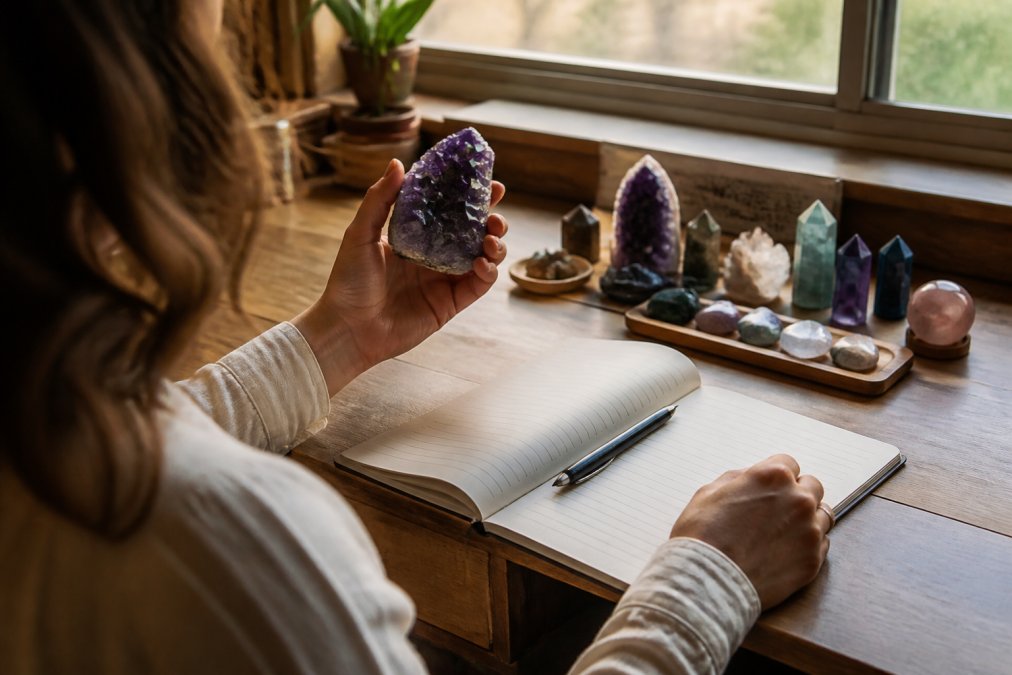
Use this 7-step framework before you buy any crystal. It takes about five minutes and stops most regret purchases cold.
- Name the trigger. Is it scarcity, mood, or a sale sign?
- Check your budget. Does this fit this month's cap?
- Run the fake tests. Bubbles, weight, color, temperature.
- Ask the seller. Request the source and any treatment.
- Wait 7 days. Add it to your wish list and walk away.
- Picture it at home. Where will it actually live?
- Buy with intent. If it still fits after a week, it's a real want.
Build a Starter Collection You'll Actually Display
Build around a theme:
- One anchor piece. A larger specimen for a shelf or table.
- Two or three small pieces. Tumbled stones or clusters for a desk.
- One "just because" piece. Something that simply makes you happy.
For buyers new to collecting, the Smithsonian's mineral sciences collection is a useful reference for seeing what genuine specimens look like up close.
Frequently Asked Questions
What triggers impulsive crystal buying?
Impulse crystal buying usually comes from emotional triggers: stress, boredom, excitement over a sale, or the pull of metaphysical properties that promise a quick mood shift. Social media feeds and live-selling events amplify this by creating urgency and scarcity. Recognizing your personal trigger, whether it's a rough day or a flash sale notification, is the first step to interrupting the pattern.
How can I tell if a crystal is authentic before buying?
Check for natural inclusions, uneven color distribution, and fracture patterns that look organic rather than uniform. Dyed quartz often shows color pooling in cracks, and heat-treated stones may have a metallic sheen. Ask sellers directly about treatments and sourcing. Reputable sellers will answer without hesitation and provide clear photos from multiple angles. If a listing only shows one heavily filtered image, that's a red flag.
How do I set a realistic budget for crystal collections?
Start with a monthly cap that fits after essentials, even if it's $20 to $50. Track every purchase for one month to see your actual spending. Then decide on a wish list and a rule: no more than one new piece per month, or only buy after selling or gifting an older piece. This keeps your collection intentional and prevents the pile of un displayed stones that many collectors end up with.
Why do I feel the need to buy crystals constantly?
The urge often ties to the same reward loop as any impulse purchase: browsing triggers anticipation, buying delivers a quick dopamine hit, and the feeling fades fast, prompting another search. Crystals add an emotional layer because they feel meaningful, personal, and tied to wellness goals. Naming that loop and replacing it with a slower ritual, like researching a stone for a week before deciding, breaks the cycle.
Crystal shops will always be designed to tempt you, but the choice stays yours. At IG Crystal Archive, LLC, we make that choice easier with hand-selected specimens, careful quality checks, and a 30-day free return policy. Every purchase also supports autistic adults and their families, so your collection carries real meaning. Shop crystals with IG Crystal Archive, LLC and build a collection you'll be proud to display.