How to Identify Authentic Mineral Specimens: 2026 Guide
Table of Contents
- What You'll Need Before You Start Testing
- How to Spot Fake Crystals: The Red Flags Collectors Miss
- Common Mineral Identification Tests You Can Do at Home
- Reading Crystal Habit, Luster, and Inclusions Like a Gemologist
- Identifying Heat-Treated Minerals and Synthetic Stones
- Provenance, Locality, and Ethical Sourcing Documentation
- Microscopic and Chemical Testing Protocols for Serious Collectors
- Conclusion
- Frequently Asked Questions
Last Updated: September 12, 2026
What You'll Need Before You Start Testing
You do not need a laboratory to learn how to identify authentic mineral specimens. A few inexpensive tools, used in the right order, will separate a genuine specimen from a convincing fake in under ten minutes.
Start with this kit:
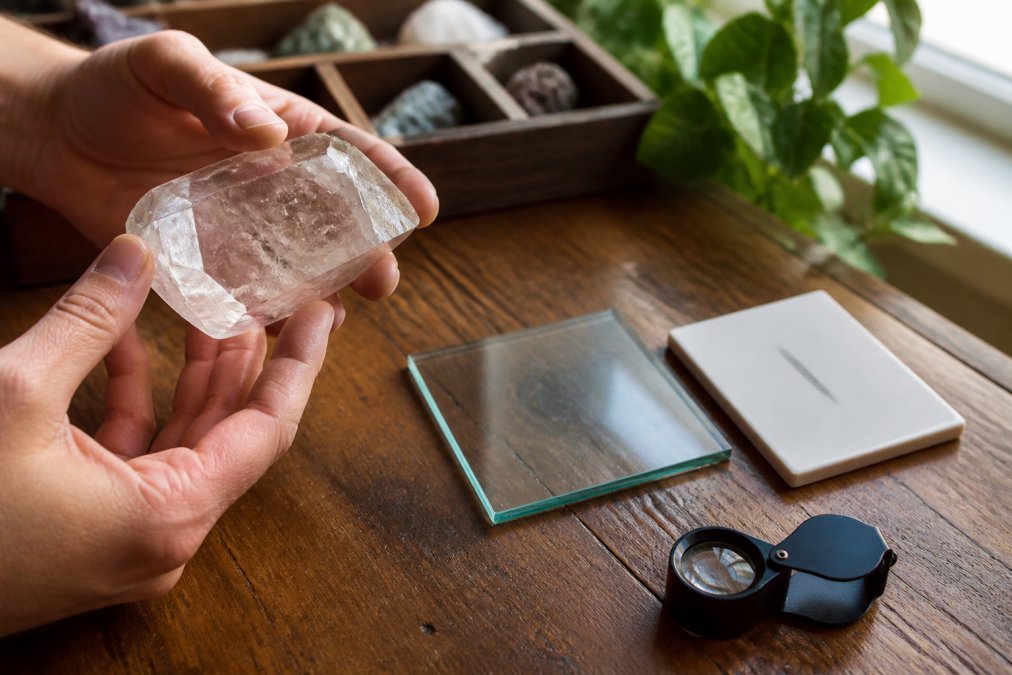
- A 10x jeweler's loupe or a hand lens
- An unglazed porcelain streak plate
- A steel nail, a copper coin, and a pocket knife
- A small glass plate for hardness testing
- A UV flashlight for fluorescence checks
- A kitchen scale and a graduated cylinder for specific gravity
- A magnet and a drop of weak acid, such as vinegar
A common mistake is buying a refractometer before learning basic observation. Most fakes give themselves away long before you need optical instruments.
How to Spot Fake Crystals: The Red Flags Collectors Miss
Most fake crystals fail on consistency, not on appearance. A specimen that looks perfect under shop lighting often reveals dye, glue, or a cast synthetic shape once you look closely.
Check these warning signs first:
- Color pooling in cracks and pits rather than even distribution
- Identical "one-of-a-kind" pieces listed in bulk
- A suspiciously low price for a rare species
- A matrix that looks poured rather than naturally attached
- Sharp color transitions with no geological reason
The U.S. Geological Survey mineral resources program maintains public reference material on how minerals form in nature, which helps you judge whether a specimen's color and structure make geological sense.
Dyed and Heat-Treated Specimens
Dye settles where the crystal is weakest. Look at fracture lines and the base of the specimen; if the color is darker in the cracks than on the surface, it was almost certainly dyed.
Heat treatment is harder to catch. It is often used to deepen amethyst into citrine or to clear cloudy stones. Genuine heat treatment leaves internal fractures and color zoning that a natural specimen would not show. A quick test: wipe the surface with a cotton swab dipped in acetone. If color lifts, the piece is dyed.
Artificial Repairs, Glue, and Assembled Matrix Pieces
Glue is the most common deception in the hobby. A broken crystal tip is reattached, or several small crystals are set into a matrix to look like one large find.
Examine the junction between the crystal and the matrix. Real growth shows interlocking grain. Glue shows a thin, glossy line, a slight misalignment, or bubbles trapped at the seam. A magnifier and a bright light make this obvious. When in doubt, hold the piece at an angle; glue reflects light differently than the mineral it joins.
Common Mineral Identification Tests You Can Do at Home
The most reliable home tests are the ones mineralogists have used for two centuries: streak, hardness, luster, and specific gravity. Each is fast and requires no special training. What separates a useful test from a wasted one is the order you run them in, a true decision tree, not a checklist.
The Interactive Decision Tree: Which Test First
Work top to bottom. Stop as soon as a result rules a candidate out.
Step 1, Luster: does the surface look metallic?
- Yes → go to Step 2A (metallic branch).
- No → go to Step 2B (non-metallic branch).
Step 2A, Metallic branch.
- Rub the specimen on an unglazed porcelain streak plate. A red-brown streak points to hematite; a greenish-black streak points to chalcopyrite; a black streak with a brass-yellow color points to pyrite.
- If the streak is colorless or white, the piece is probably not a metallic ore, return to Step 2B.
Step 2B, Non-metallic branch.
- Can a copper coin scratch it? If yes, hardness is below about 3.5, think calcite, halite, or gypsum.
- Can a steel nail (hardness ~5.5) scratch it, but the copper coin cannot? Hardness is roughly 4-5.5, think fluorite or apatite.
- Can the specimen scratch glass (hardness ~5.5)? Hardness is above 5.5, think quartz, feldspar, or topaz.
Step 3, Confirm with specific gravity. Weigh the specimen dry, then weigh it suspended in water. Divide the dry weight by the difference between the two. Quartz lands near 2.65; pyrite near 5.0; galena near 7.5. A reading far outside the expected range for the species is a strong fake signal.
Step 4, Fluorescence and acid as tiebreakers.
- Shine a UV light in a dark room. Calcite, fluorite, and some adamite glow; most silicates do not.
- Place one drop of weak acid (vinegar works) on a hidden corner. Calcite fizzes vigorously; dolomite fizzes weakly; quartz does nothing.
Reference Values to Keep on Hand
| Test | What it measures | Quick reference |
|---|---|---|
| Streak | Powder color on unglazed porcelain | More diagnostic than surface color |
| Mohs hardness | Scratch resistance | Talc 1 · fingernail 2.5 · copper coin 3.5 · steel nail 5.5 · glass 5.5 · quartz 7 · corundum 9 · diamond 10 |
| Luster | Light reflection | Metallic, vitreous, resinous, pearly, dull |
| Specific gravity | Density vs. water | Quartz 2.65 · pyrite 5.0 · galena 7.5 |
| Fluorescence | UV response | Species-specific; absence is not proof of a fake |
| Acid reaction | Carbonate presence | Calcite fizzes; silicates do not |
What Each Test Cannot Tell You
No home test proves a specimen is natural. Streak and hardness confirm species, not origin. A lab-grown quartz crystal has the same streak, hardness, and specific gravity as a mined one. Use these tests to confirm what a specimen is, then use the microscopy and provenance checks elsewhere in this guide to judge whether it is natural.
Reading Crystal Habit, Luster, and Inclusions Like a Gemologist
Crystal habit is the characteristic shape a mineral grows into, and it is one of the most reliable clues to authenticity. Quartz grows in six-sided prisms with pointed terminations. Pyrite forms cubes. Calcite grows in rhombohedra.
Inclusions tell a story. A genuine specimen may contain bubbles, other minerals, or fluid pockets trapped during growth. Synthetic stones often have perfectly uniform internal structure, or curved striae that no natural crystal produces. Gas bubbles in glass, for instance, are a giveaway that you are holding a manufactured piece.
Luster is the way light reflects from the surface. The terms gemologists use are metallic, vitreous, resinous, pearly, and dull. A real specimen will usually show a consistent luster across its faces. A polished or coated fake often shows a waxy sheen that does not match the mineral it claims to be.
Identifying Heat-Treated Minerals and Synthetic Stones
Heat treatment and synthesis are different problems. Heat treatment alters a real mineral; synthesis creates a new one from scratch.
Synthetic quartz, corundum, and spinel are common on the market. They usually show curved growth lines under magnification, and they lack the natural inclusions that form over geological time. Heat-treated specimens are harder to spot because they started as real minerals. Look for color zoning, a slightly cloudy appearance, or fractures that look "cooked" rather than fresh.
Where the piece matters to you, ask the seller for documentation. A reputable dealer will state whether a specimen is natural, treated, or synthetic.
Provenance, Locality, and Ethical Sourcing Documentation
Provenance is the documented history of a specimen, where it was found, when it was collected, and who handled it since. Locality matters because the same mineral can look dramatically different from different deposits, and collectors pay a premium for a known source. But "provenance" is also the single most abused word in mineral retail. Here is how to tell real documentation from marketing fluff.
What Real Seller Documentation Looks Like
A credible provenance record is specific and falsifiable. It names a mine, a quarry, or at minimum a named district, not a country. It gives a collection date or a range. It identifies the prior owner or dealer if the piece has changed hands. It states whether the specimen has been cleaned, repaired, or treated, and with what.
A marketing-fluff record does the opposite. It uses vague geography ("ethically sourced from South America"), leans on emotional language ("rare find," "one-of-a-kind"), and never names a person, place, or date that could be checked.
The Documentation Checklist
Before you buy, ask the seller for these five items. A reputable dealer will have most of them ready.
- Locality, mine, quarry, or named district, not just a country.
- Collection date or range, even "collected in the 1980s" is more useful than nothing.
- Treatment disclosure, natural, heat-treated, dyed, irradiated, or assembled.
- Repair disclosure, any glued or reattached pieces, stated plainly.
- Chain of custody, prior owners or dealers, if the piece has a documented history.
If a seller cannot answer items 1 and 3, treat the piece as undocumented regardless of what the listing says.
Why Locality Changes Value
Two specimens of the same species from different deposits can differ in color, crystal habit, and inclusion profile, and collectors track those differences. A fluorite from one district may be deep purple with sharp cubic faces; from another, it may be green and octahedral. When a seller claims a specific locality, the specimen's appearance should match the known material from that locality. If it does not, the locality claim is suspect.
The U.S. Geological Survey mineral resources program publishes public reference material on where and how minerals form, which is a useful cross-check when a locality claim does not match the specimen in front of you.
Ethical Sourcing and Advertising Claims
The U.S. Federal Trade Commission guidance on advertising claims sets out how sellers may describe products, including claims about origin and treatment. A dealer who is vague about provenance is a dealer worth questioning, and a dealer who makes specific origin claims without documentation is taking a legal risk they may not realize.
At IG Crystal Archive, LLC, every specimen is hand-selected and inspected before it ships, and each piece is chosen for its natural beauty rather than for volume. That selection process is why we can tell you where a piece came from and why it was chosen.
Microscopic and Chemical Testing Protocols for Serious Collectors
For collectors who want more certainty, microscopy and simple chemistry go a long way. A 30x to 60x loupe or a low-cost USB microscope reveals growth lines, cleavage, and inclusions that the naked eye misses.
Chemical testing at home should stay simple and safe:
- Use weak acid only on a small, hidden area
- Test for effervescence to distinguish carbonates from silicates
- Use a magnet to check for iron content
- Use a UV light to confirm fluorescence where the species is known to fluoresce
For anything valuable, send the specimen to a gemological laboratory for a refractive index reading and a formal report. The Gemological Institute of America's gem encyclopedia is a useful public reference for species descriptions and expected optical properties.
Conclusion
Learning how to identify authentic mineral specimens is a skill built on observation, not expensive equipment. Start with streak, hardness, and luster, then add microscopy and chemical tests as your collection grows.
If you would rather skip the guesswork, IG Crystal Archive, LLC offers hand-selected specimens that are inspected for quality before they ship, backed by fast and reliable shipping, 30-day free returns, and a mission to support autistic adults and their families. Every purchase carries the confidence of thoughtful curation and a meaningful impact. Shop Crystals and add a genuine piece to your collection today.
Frequently Asked Questions
What are the most common signs of a fake mineral specimen?
The clearest red flags are uniform color that pools in cracks, a waxy or plastic-like surface, perfect symmetry that looks machine-cut, and bubbles trapped inside the stone. Real authentic mineral specimens show irregular color zoning, natural fracture patterns, and slight variation across the surface. If the price seems far below market for a rare species, or the seller cannot name the locality, treat it as suspect until you test it.
How can I tell if a crystal is real using a flashlight?
Hold a bright LED flashlight directly against the stone in a dark room. Natural quartz and most transparent minerals show internal fractures, veils, and inclusions that scatter the light in uneven ways. Dyed stones often reveal concentrated color along crack lines. Glass fakes usually transmit light with no internal structure at all. Rotate the specimen slowly and watch for rainbow flashes, phantom growth lines, or cloudy zones that indicate genuine crystal growth.
What physical tests can be used to identify authentic minerals?
Start with the Mohs hardness scale: quartz scratches glass, gypsum does not. Then check streak color by rubbing the specimen on an unglazed tile, which often differs from the outward color. Luster tells you whether the surface is vitreous, pearly, or metallic. Specific gravity, cleavage, and fracture patterns narrow the identification further. Fluorescence under UV light helps with calcite, fluorite, and some agates. Combine at least three tests before concluding.
How do I distinguish between natural minerals and lab-grown or treated stones?
Lab-grown crystals usually have perfect crystal habit with no matrix attachment, no natural inclusions, and identical color from piece to piece. Heat-treated amethyst turned citrine shows a reddish-orange tint and sometimes a cloudy base where the original purple remained. Natural specimens carry geological structure: growth lines, vugs, pseudomorphs, and mineral companions on the matrix. Ask for provenance and locality documentation, and check whether the seller inspects pieces individually.