How to Buy Crystals From a Transparent, Ethical Seller
Quick Summary
The main benefit of buying from transparent crystal brands is knowing exactly what you are paying for: where a stone came from, whether it was treated, and who stands behind it. Clear documentation and honest answers to direct questions help you avoid misleading listings and mislabeled stones.
- Ask whether the stone is natural and whether it has been dyed, coated, or irradiated.
- Look for listings that give dimensions in both inches and millimeters and show the exact piece.
- Compare sellers using a checklist, where a score of eight or higher signals real effort.
- Good sellers answer origin and inspection questions directly rather than with vague claims.
- Check whether documentation quality stays consistent across the catalog, not just on featured listings.
Table of Contents
- How to Buy Crystals From a Transparent, Ethical Seller
- Why Transparency Matters When You Buy Crystals Online
- How to Tell If Crystals Are Ethically Sourced
- Questions to Ask Crystal Sellers Before You Order
- Crystal Sourcing Transparency: What a Seller Should Disclose
- How Mission-Driven Pricing and Purchase Impact Work
- Where to Buy Ethically Sourced Crystals: Comparing Options
- Choosing Your Next Piece From IG Crystal Archive
- Frequently Asked Questions
How to Buy Crystals From a Transparent, Ethical Seller
Last Updated: October 29, 2026
Buying crystals online means trusting a stranger with your money and a stone you cannot touch first. That trust is the real product. The benefits of buying from transparent crystal brands start with knowing exactly what you are paying for, where it came from, and who stands behind it.
Most listings show a stone, a size, and a price. Few explain how the piece was chosen or what separates an honest specimen from a treated or mislabeled one. Below, we cover the questions to ask, the warning signs to watch for, and the disclosures a trustworthy seller should make.
Why Transparency Matters When You Buy Crystals Online
Transparency is the difference between a purchase you enjoy and one you regret. When a seller explains a stone's origin, formation, and inspection process, you can judge the piece on its merits. When they do not, you are left guessing.
Many collectors have been disappointed by a stone that looked different in person or was sold under a misleading name. Read how this business's mission-driven approach to supporting social causes through crystal shopping works in practice. Clear sourcing details and honest descriptions reduce that risk.
How to Tell If Crystals Are Ethically Sourced
Ethical sourcing is hard to confirm from a product photo alone. Start by looking for a seller who describes how each piece is selected and who is responsible for it. Specific, consistent detail is a good sign. Vague claims like "naturally sourced" with nothing behind them are not.
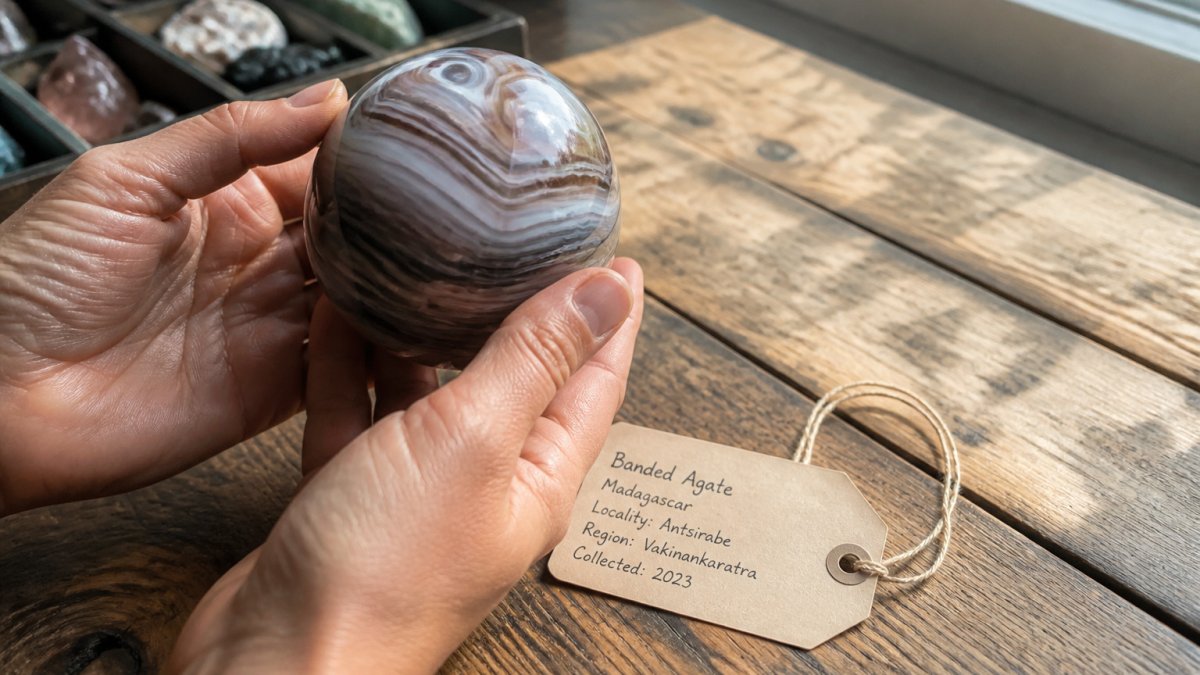
!Close-up of hands holding a polished banded agate sphere under soft window light, with a handwritten specimen tag resting on a wooden table
Signs a Seller Documents Its Specimens
A transparent seller documents what it sells. Look for the stone's common name and variety, its shape and dimensions, its finish, and whether it is natural or treated. Clear measurements, such as diameter in both inches and millimeters, show that someone actually handled the piece.
Good documentation also explains natural features. Inclusions, veils, and color variation are normal in natural stone. A seller who calls these out, rather than hiding them, is being honest about what you will receive.
Warning Signs of Treated or Mislabeled Stones
Watch for listings that use a stone's name loosely, promise perfect uniformity, or avoid mentioning treatment entirely. Unusually vivid color in a stone that is usually subtle can signal dye or coating. Use these practical tests to spot dyed crystals online before you commit. Bright, uniform color across a large sphere deserves a question before you buy.
Mislabeling is common enough to check. Compare the listed stone with photos of the same variety from reputable mineral references. If the description and the appearance do not line up, ask the seller to clarify.
Questions to Ask Crystal Sellers Before You Order
Before you buy, send a short list of questions. A good seller answers them directly and without pressure. The difference between a transparent brand and a thin affiliate store usually shows up in the first reply.
The Core Questions
- Is this stone natural, and has it been treated, dyed, coated, or irradiated in any way?
- Where was the specimen sourced, and how was it selected?
- Are the dimensions and finish described accurately, with photos of the exact piece I will receive?
- What is your return policy if the piece is not as described?
- How are packages protected in transit?
- Has anyone outside your staff examined this piece, and what did that examination cover?
How to Read the Answers
A transparent seller gives specific, checkable answers. An evasive one gives adjectives.
| What you asked | Strong answer | Weak answer |
|---|---|---|
| Treatment | "Natural, untreated; here is how we verified it" | "Our stones are high quality and natural" |
| Origin | A region, plus how the material was acquired | "Ethically sourced from around the world" |
| Photos | Photos of the exact piece, with dimensions | Stock photos reused across listings |
| Returns | A clear window and process in writing | "Contact us and we'll work something out" |
| Inspection | A described process or an outside report | Silence, or a change of subject |
A Buyer's Transparency Checklist
Use this as a scoring sheet when comparing two or three sellers side by side. Give one point for each item a seller clearly satisfies.
- Names the stone variety, not just a trade name
- States treatment status explicitly
- Gives dimensions in both inches and millimeters
- Shows the exact piece, not a representative photo
- Describes natural inclusions or color variation honestly
- Explains origin at least to the region
- Describes an inspection or verification process
- Publishes a written return policy with a clear window
- Describes packaging and transit protection
- Answers follow-up questions without pressure
A seller scoring eight or higher is doing the work. A seller scoring four or five is relying on you not to ask.
A seller who welcomes these questions is usually one worth trusting. Hesitation or evasion tells you something too.
Crystal Sourcing Transparency: What a Seller Should Disclose
Sourcing transparency means the seller shares enough detail for you to verify the claims, not just enough to sound responsible. At minimum, expect the stone type and variety, whether any treatment was applied, the physical dimensions, and an honest account of natural characteristics. Where a seller also explains how it inspects and selects inventory, you get a clearer picture of the care behind each order.
Large Banded Agate Sphere with Druzy | 3" Natural Polished Agate Crystal Ball →
Most listings stop there. A genuinely transparent brand goes one layer deeper into the supply chain.
The Supply Chain Questions Behind Every Stone
A crystal passes through several hands before it reaches a display shelf: the miner or quarry operator, a rough-stone dealer, sometimes a cutting and polishing shop, and finally the retailer. Transparency means the seller can describe that chain, at least in outline, for the categories it carries.
Ask specifically:
- Country or region of origin. "Brazil" is a start; "Minas Gerais, Brazil" is better. Origin affects both value and the likelihood of treatment.
- Who cut and polished the piece. Hand-carved and machine-tumbled stones carry different labor stories and different price floors.
- Whether rough material was bought directly or through a dealer. Direct relationships are not automatically ethical, but they are easier to document.
- How the seller handles known problem categories. Dyed agate, heat-treated amethyst, and irradiated stones are common in the trade. A transparent seller names these practices rather than avoiding the topic.
A common pattern among careful buyers is to treat vague origin claims the same way they treat vague treatment claims: as a reason to ask a follow-up question before paying.
Independent Verification and Third-Party Testing
Marketing language is cheap. Independent verification is not, which is why it separates serious sellers from affiliate funnels.
For crystals, meaningful verification usually takes one of three forms:
- Gemological identification. A lab report or gemologist's note confirming the species and variety, especially for higher-priced pieces.
- Treatment disclosure backed by testing. For stones where treatment is common, a seller should be able to say whether the piece was tested and what the result was.
- Consistent in-house inspection standards. If a seller does not use an outside lab for every piece, it should at least describe a repeatable inspection process: how stones are checked for dye, coating, fractures, and mislabeling before listing.
Disclosure Should Be Consistent Across the Catalog
One detailed listing and ten vague ones is a red flag, not a courtesy. Transparency is a standard, not a highlight. Pick three or four listings from the same seller at different price points and compare them. If the documentation quality collapses as the price drops, the seller is documenting for marketing rather than for accountability.
At IG Crystal Archive, LLC, we describe each specimen's stone type, dimensions, finish, and natural features, and we welcome direct questions about origin and inspection before you order.
How Mission-Driven Pricing and Purchase Impact Work
Mission-driven sellers often ask whether their prices reflect the cause they support. That is a fair question. Transparency here means explaining how a purchase connects to the mission, rather than relying on the cause as a marketing angle.
IG Crystal Archive, LLC is mission-driven, supporting autistic adults and their families. Customers who want to understand the mission-related impact of a purchase should ask us directly.
Where to Buy Ethically Sourced Crystals: Comparing Options
Not every seller meets the same standard, so compare them on the criteria above: documentation, honesty about treatment, clear return terms, and a sourcing story you can follow. Price matters, but a lower price from a seller who cannot describe a stone is a poor trade.
Our Natural Moss Agate Crystal Tower at $34.99 offers a six-sided polished point with clear dimensions, and our Labradorite Crystal Heart at $48.00 includes its own black metal stand. Compare these listings against any other seller you consider.


Choosing Your Next Piece From IG Crystal Archive
Once you know what to look for, the choice becomes personal. Before deciding, you can browse other unique geological specimens available online. Our Large Banded Agate Sphere with Druzy at $119.99 is a display centerpiece, while our Natural Labradorite Crystal Bracelet at $18.00 offers an accessible entry point.

Every piece we sell is hand-selected and carefully inspected, and it ships in secure, professional packaging. We offer 30-day free returns, so you can order with confidence. If you have questions about any specimen before you buy, contact us and we will help you find the right piece for your collection.
Frequently Asked Questions
What does transparency mean when buying crystals?
Transparency means a seller tells you what you are actually buying. That includes the stone type, the approximate size in inches and millimeters, whether the piece is polished or natural, and any visible inclusions or fractures. A transparent seller also describes condition plainly, such as noting that internal veils in a clear quartz sphere are natural characteristics rather than damage. Clear, specific listings let you compare pieces before you pay, which is the main protection against surprises after delivery.
How can I tell if crystals are ethically sourced?
No listing can guarantee a stone's full supply chain, but you can judge how openly a seller answers. Look for a named shop, a physical contact address, and descriptions of how each specimen was personally inspected. Be cautious with listings that use only generic stock photos or vague claims like 'sourced from around the world.' Ask the seller directly where a piece was obtained and whether it has been treated, dyed or coated. A seller that answers specifically is usually easier to trust than one that does not.
Are ethically sourced crystals more expensive?
At IG Crystal Archive, the current prices range from $18.00 for a natural labradorite stretch bracelet to $119.99 for a 3-inch banded agate sphere with druzy. Price alone does not prove ethical sourcing, so compare what each seller discloses along with the cost. A higher price should come with visible quality, clear specifications and a return policy that stands behind the piece.
What should a crystal seller disclose about a specimen?
A good seller discloses the stone type, the approximate dimensions in inches and millimeters, the finish, whether a display stand is included, and any natural inclusions or variations. It should also state whether the item is one-of-a-kind and whether the photos show the exact piece you will receive. These details let you verify that the stone you receive matches what you chose, and they make returns and disputes far easier to resolve.