Why Authentic Crystals Cost More: Real Value Explained
Table of Contents
- The Real Reasons Authentic Crystals Command Higher Prices
- How to Spot Fake Crystals Before You Buy
- Natural vs Synthetic Crystals: What Changes the Price
- Ethical Crystal Sourcing and Supply Chain Transparency
- Grading Standards and What They Mean for Value
- How Market Manipulation Inflates Crystal Prices
- Why Hand-Selected Authentic Crystals Are Worth the Investment
- Frequently Asked Questions
Last Updated: October 2, 2026
The Real Reasons Authentic Crystals Command Higher Prices
Authentic crystals cost more because their price reflects genuine geological rarity, the labor and risk involved in extraction, and the verification work that separates a real specimen from a synthetic or dyed imitation. A crystal that formed over thousands of years underground cannot be mass-produced, and that scarcity sets the floor for everything else. This guide from IG Crystal Archive, LLC breaks down where your money actually goes, how to spot fakes before you buy, and why hand-selected pieces are worth the premium.

The gap between a real specimen and a convincing fake is wider than most buyers expect. A treated or lab-grown piece can look nearly identical in a photograph, but it carries none of the geological rarity, mineral composition, or collector value of a natural formation.
Here is the part most guides skip: price is not just about beauty. It is about extraction costs, sourcing ethics, and the certification work that proves a stone is what a seller claims it is.
How to Spot Fake Crystals Before You Buy
The fastest way to spot a fake crystal is to check three things at once: internal structure, color behavior, and documentation. Fakes usually fail at least one of these tests, and often two.
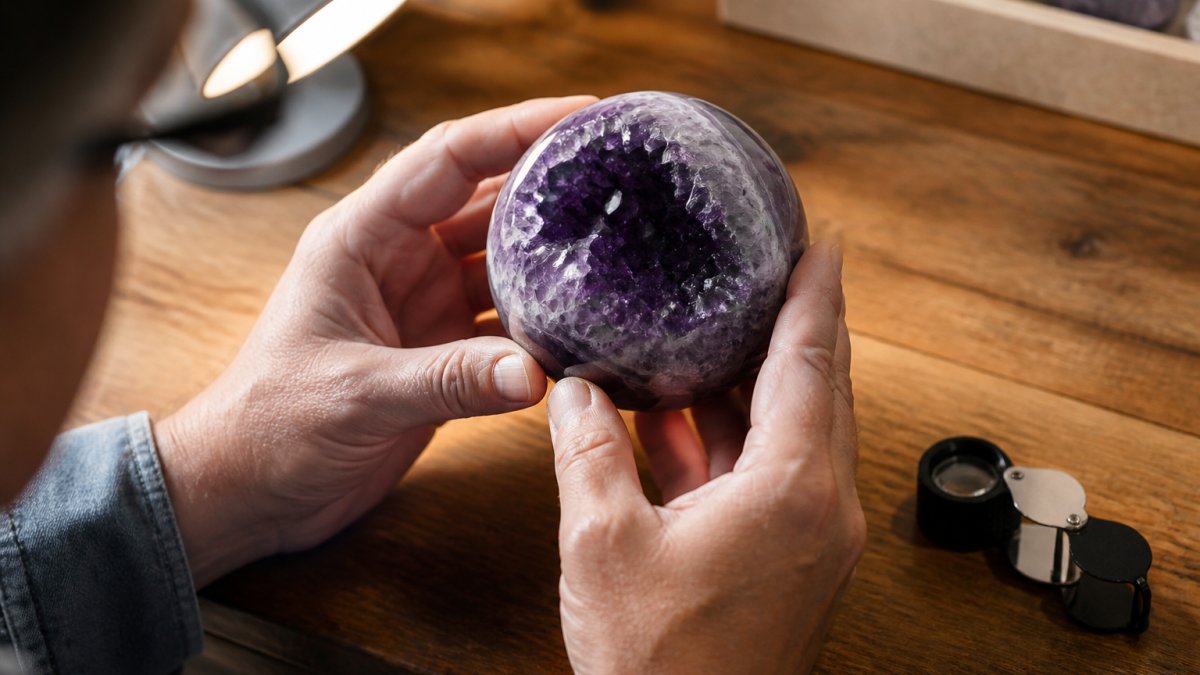
Visual Inspection: What to Look For
Natural crystals show irregular internal growth: bubbles, fractures, color zoning, and inclusions that formed as the mineral cooled. Glass and resin imitations tend to look too uniform, with perfectly even color and rounded edges.
A few quick checks:
- Refractive index and light behavior: Real quartz bends light differently than glass. Tilt the stone under a lamp and watch for double refraction or a dull, flat response.
- Temperature and weight: Natural stone feels cooler and denser than plastic or resin of the same size.
- Surface texture: Hand-carved and raw specimens carry tool marks, natural pitting, or matrix remnants. Imitations are often suspiciously smooth.
- Color consistency: Dyed pieces pool color in cracks. Look for darker lines along fractures.
Clarity is a useful signal too, but not in the way beginners assume. A perfectly clear, flawless specimen at a low price is a red flag, not a bargain.
Certification and Documentation
Certification turns a claim into evidence. A reputable seller can provide origin verification, a gemstone grading report where applicable, and honest disclosure of any treatment.
Ask directly: Where was this mined? Has it been heat-treated, dyed, or irradiated? Is it lab-grown?
At IG Crystal Archive, LLC, every specimen is hand-selected and carefully inspected before it ships, so you know what you are buying.
Natural vs Synthetic Crystals: What Changes the Price
Natural vs synthetic crystals is the single biggest price divider in the market.
That difference drives everything downstream:
| Factor | Natural Crystal | Synthetic / Imitation |
|---|---|---|
| Formation time | Thousands of years | Days to weeks |
| Internal structure | Irregular, unique inclusions | Uniform, predictable |
| Rarity | Limited by the deposit | Unlimited production |
| Collector value | High, one-of-a-kind | Low, repeatable |
| Typical price driver | Scarcity and extraction | Manufacturing cost |
Synthetic stones are not automatically "bad." They can be beautiful and affordable. The problem is when a synthetic or treated piece is sold as natural at a natural price.

Durability and aesthetic appeal also differ. Many dyed or coated imitations fade over time or lose their finish, while a genuine specimen holds its appearance for decades.
Ethical Crystal Sourcing and Supply Chain Transparency
Ethical crystal sourcing means knowing where a specimen came from, who extracted it, and under what conditions. Supply chain transparency is how a seller proves it.
This is where price and ethics connect. Responsibly sourced crystals cost more because the people doing the work are paid fairly, and because mining labor and transportation logistics are accounted for honestly rather than hidden.
What to look for in a transparent seller:
- Named origins or regions, not vague "from Brazil" claims
- Disclosure of mining labor practices and fair-pay commitments
- Clear origin verification and certification where available
- Willingness to explain the extraction costs behind a price
Buyers who care about sourcing ethics are not just paying for a rock. They are paying for a supply chain they can feel good about. That is part of the mission at IG Crystal Archive, LLC, where purchases support autistic adults and their families. As verified buyer Jessica T. noted, "Knowing my purchase supports such a heartfelt mission made this crystal even more special."
Grading Standards and What They Mean for Value
Gemstone grading is the system that translates a crystal's qualities into a value range. Even for non-jewelry specimens, graders look at clarity, carat weight, color saturation, and crystal structure. But most crystal guides stop there and never explain what those words actually mean on a price tag. Here is the part that moves money.
The Four Factors That Set a Price Tier
Gemologists have used the same four-factor framework for colored stones for decades, and it maps cleanly onto crystals even when they are sold as decor rather than jewelry:
- Color: Hue, tone, and saturation. A deeply saturated, evenly distributed color commands a premium. Pale or muddy tones fall to a lower tier. For amethyst, a rich violet with red flashes sits at the top; washed-out lavender sits at the bottom.
- Clarity: The absence of visible inclusions. Eye-clean specimens, no flaws visible without magnification, sit in the highest tier. Specimens with visible fractures, clouds, or matrix fall lower. Note that some inclusions (rutilated quartz needles, for example) are prized rather than penalized, so clarity is graded relative to the species.
- Cut and form: Precision faceting, symmetrical points, and clean terminations add value. Chipped, off-center, or poorly polished pieces lose it. For raw specimens, natural termination quality matters more than polish.
- Carat weight: Larger specimens are rarer and priced exponentially, not linearly. A 500-gram quartz point is not simply ten times the price of a 50-gram one, it can be twenty times or more, because large clean formations are far scarcer.
What 'Investment Grade' Actually Means
Investment grade is not a regulated term. It is a marketing shorthand, and it is used loosely. In practice, a seller calling a piece investment grade is claiming it sits in the top tier on color, clarity, cut, and size simultaneously, and that the species is one with a stable secondary market, such as high-quality amethyst, citrine, or aquamarine.
Citrine Quartz Geode Sphere | Golden Crystal Cluster | Open Cave Quartz Display →
A common pattern is that pieces labeled investment grade without a certification report behind them are simply the seller's better-looking stock. Ask what specifically qualifies the piece, and ask for the report.
Why Grading Only Works With Honesty Behind It
A grade means nothing without certification and origin verification behind it. Two specimens can look identical in a photo and grade differently in person, and a seller who grades their own stock has an obvious conflict of interest.
What most guides miss is that grading is only as good as the seller's honesty. A grade means nothing without certification and origin verification behind it.
How Market Manipulation Inflates Crystal Prices
Market manipulation is the practice of artificially driving up prices through scarcity claims, hype cycles, or coordinated buying. It is a real problem in the crystal market, and it cuts both ways: some prices are inflated, while genuinely rare specimens get undervalued when buyers stop trusting the market.
Most guides warn you to 'watch for hype' and stop there. The useful part is understanding the specific mechanisms, because each one leaves a different fingerprint on a price tag.
The Four Mechanisms That Inflate Prices
1. Manufactured scarcity. A seller claims a formation is 'almost mined out' or a 'limited edition' without any origin verification.
2. Trend-driven spikes. A crystal goes viral on social media, demand jumps, and prices climb within weeks.
3. Supply withholding. A wholesaler buys up a large share of a species or a specific mine's output and releases it slowly to keep prices high.
**4.
Signals Worth Taking Seriously
- Sudden 'limited edition' claims with no origin verification
- Prices that spike after a social media trend, unrelated to geological rarity
- Sellers who refuse to disclose mineral composition or treatment
- Imitation materials sold under a real stone's name
- A species that is simultaneously 'rare' and available in unlimited quantity
The Honest Counterweight
The honest counterweight is supply chain transparency. When a seller can show you the specimen, its origin, and its market valuation logic, you are not buying hype. You are buying a documented piece.
A useful habit is to compare a specimen's price against its actual rarity and size, not against what a trend says it should cost. A rare formation stays rare long after the trend fades, and a trend-priced stone usually does not stay expensive.
Why Hand-Selected Authentic Crystals Are Worth the Investment
Authentic crystals are worth the investment because you get three things a cheap imitation cannot offer: genuine rarity, verified quality, and a piece that holds its collector value over time.
Hand-selection adds a layer that mass listings cannot. When someone personally inspects a specimen for clarity, crystal structure, and aesthetic appeal, you skip the gamble of buying blind.
At IG Crystal Archive, LLC, every piece is chosen by hand and carefully inspected, from a natural smoky quartz crystal cluster to a one-of-a-kind citrine quartz geode sphere. Each ships in secure, professional packaging, with fast and reliable shipping and a 30-day free returns policy. Verified buyer Amanda L. put it plainly: "I've ordered crystals from many shops, and IG Crystal Archive stands out."
If you are new to collecting, you do not need to know everything on day one. Start with one piece you love, ask questions, and let the seller guide you. A good seller will.
Frequently Asked Questions
How do I tell if a crystal is real?
Check for natural inclusions, color zoning, and internal fractures that synthetic stones lack. Real crystals often have unique imperfections and temperature coolness. Ask for certification or origin details. Authentic specimens from reputable sellers include documentation. If the price seems too low for the size or clarity, it is likely lab-grown or imitation material.
Why are some crystals more expensive than others?
Geological rarity, extraction costs, and grading standards drive price differences. A flawless, large specimen with strong color saturation costs more because it is scarce. Ethical sourcing and supply chain transparency also add cost. Hand-carved or raw specimens with unique formations command higher prices than common tumbled stones.
What is the difference between heat-treated and natural crystals?
Heat treatment alters a crystal's color or clarity through controlled heating. Natural crystals form without human intervention, preserving original mineral composition and inclusions. Treated stones often cost less because the supply is more predictable. Natural specimens with vivid, unaltered color are rarer and carry higher market valuation.
Are real crystals worth money?
Investment-grade crystals with certification, exceptional clarity, and documented origin hold or increase in value. Collector value depends on rarity, aesthetic appeal, and provenance. Common quartz varieties have modest resale value, while rare specimens with unique crystal structure or historical significance can appreciate significantly over time.
The crystal market rewards buyers who ask questions and punishes those who do not. If you want specimens that are genuinely hand-selected, honestly described, and backed by a real return policy, IG Crystal Archive, LLC is built for exactly that: a curated collection, careful inspection of every piece, and a mission that supports autistic adults and their families with every purchase. Get started with IG Crystal Archive, LLC and add a piece to your collection you can feel confident about.