7 Signs of a Low Quality Mineral Specimen to Avoid
Quick Summary
A low quality mineral specimen shows weak signs like blunt or chipped crystal points, fresh breaks, glue lines on the base, and heavily edited photos. Check the terminations, base, and disclosure before you pay. Clear, specific seller answers are a good sign.
- Inspect crystal terminations for sharp, clean points rather than blunt or chipped tips.
- Ask for a close-up of the base, since repairs and composites show most clearly there.
- Treat heavy editing or a single dramatic photo as a warning sign and request natural-light images.
- Score integrity, surface, structure, disclosure, and appeal to compare specimens consistently.
- Save listing photos before buying so you have evidence if the piece arrives damaged.
Table of Contents
- Why Low Quality Mineral Specimens Are So Easy to Buy
- How to Evaluate Mineral Specimen Quality in Person
- How to Buy Mineral Specimens Online Without Guesswork
- Questions to Ask Mineral Sellers Before You Pay
- Identifying Mineral Specimen Damage and Repairs
- A Condition-Grading Rubric and Value Check for Your Next Purchase
- Choosing Your Next Specimen From IG Crystal Archive
- Frequently Asked Questions
7 Signs of a Low Quality Mineral Specimen to Avoid
Last Updated: October 31, 2026
Why Low Quality Mineral Specimens Are So Easy to Buy
Avoiding low quality mineral specimens starts with knowing how easily they slip into a collection. This is a question many collectors ask after being disappointed by an earlier purchase.
Low quality pieces usually look fine at first glance. The problem shows up later, once the stone is in your hand or on your shelf.
Common reasons weaker pieces get bought include:
- Photos taken with heavy editing or dramatic lighting
- Short descriptions that skip condition details
- Sellers who focus on size and color, not structure
A good first step is slowing down. For a fuller walkthrough, see our guide to identifying authentic mineral specimens, which explains what to check to confirm a piece is genuine.
How to Evaluate Mineral Specimen Quality in Person
If you are at a show, shop or friend's collection, give yourself a few minutes with each piece.
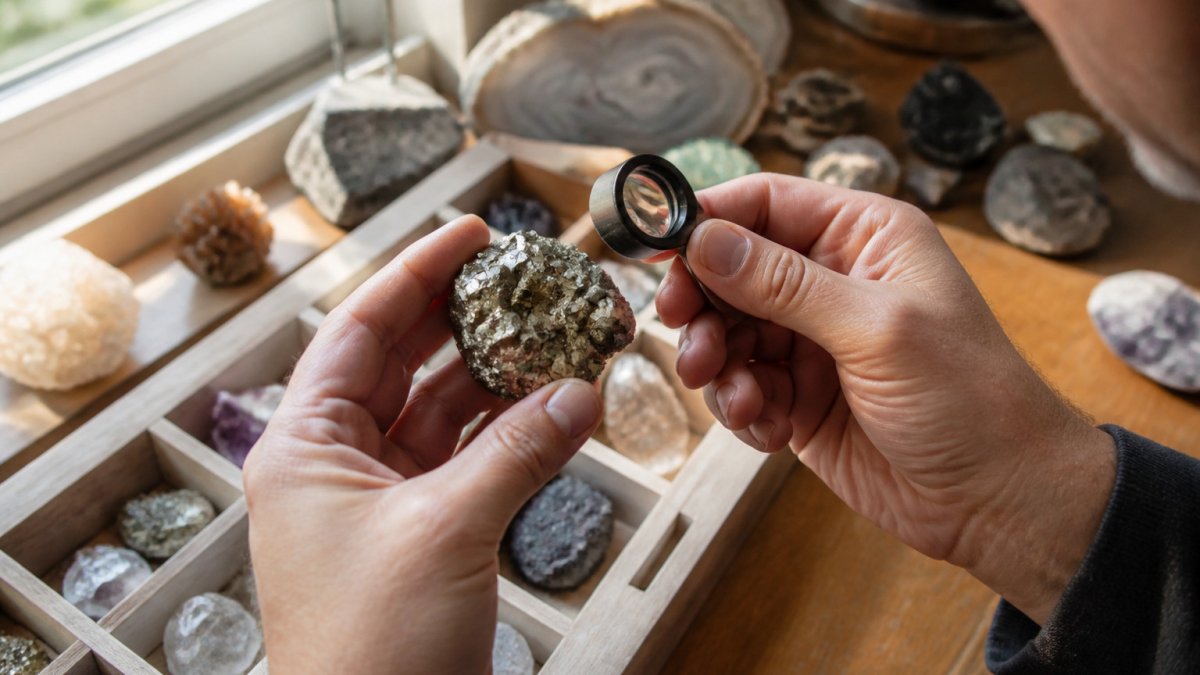
!Close-up of a collector's hands holding a raw pyrite cluster under a hand lens on a wooden desk near a sunny window
Start with the overall balance of the piece. Does it feel solid and well attached to its base? Loose crystals, cracked matrix and weak bonds are early warning signs.
Check Crystal Integrity and Termination
Crystal integrity means the crystals are whole and clearly formed. Look at each crystal point. Well-formed points come to a clean, sharp end, which is called termination.
Watch for these signs of weak integrity:
- Points that look snapped or blunt without a clear reason
- Crystals that are rubbed down or dull on every edge
- Clusters where most crystals look broken off at the base
Natural growth has small irregularities. Heavy, even wear across an entire piece can suggest handling, polishing or damage.
Look for Chips, Fractures and Cleavage Damage
Chips and fractures are the most common flaws in mineral specimens. Some minerals also have cleavage, which means they break along flat planes. Knowing the difference helps you tell natural breakage from new damage.
Check these areas carefully:
- Crystal tips and edges for fresh chips
- Flat, shiny breaks that look newer than the rest of the stone
- Hairline cracks running through the crystal body
A small natural flaw is normal. A large, fresh break on a valuable crystal is a reason to walk away or ask questions.
How to Buy Mineral Specimens Online Without Guesswork
Buying online takes more care because you cannot touch the piece. The good news is that a repeatable inspection process can protect you. Most of the work happens before you click buy, and the goal is to turn a listing into a set of answerable questions.
A Step-by-Step Listing Inspection Checklist
Use this sequence every time you evaluate an online listing. It takes about five minutes and catches most problems before you pay.
- Count the photos. A serious listing shows at least four angles: front, back, base, and a close-up of the terminations. One photo is a warning sign.
- Check the scale reference. Look for a ruler, coin, or hand in at least one shot. Without a scale, size claims are unreliable.
- Inspect the terminations. Zoom in on crystal tips. Sharp, clean points suggest good integrity; blunt or chipped tips suggest damage or heavy handling.
- Examine the base and matrix. Look for glue lines, color changes at joints, or crystals that appear to float on a flat surface. These can indicate repairs or composites.
- Compare lighting across photos. If one photo is dramatically brighter or more saturated than the others, ask for a natural-light shot. Heavy editing hides dull luster and surface wear.
- Read the description for what is missing. A listing that mentions size and color but not condition, origin, or treatment is incomplete. Absence of disclosure is itself information.
- Check the return policy before buying. A clear return window reduces risk; a no-return policy on a high-priced piece deserves extra scrutiny.
How to Evaluate Listing Photos and Request Useful Seller Images
Photos do most of the selling online, so study them closely. Look for multiple angles, a clear view of the crystal tips, and a shot against a plain background.
Ask the seller for images that answer your specific questions. A reasonable request includes:
- A close-up of the crystal terminations
- A photo of the back or base of the specimen
- A shot in natural light, not only under a strong lamp
Sellers who take this request seriously usually have nothing to hide. When you receive the images, compare them to the listing photos. Differences in color, shape, or apparent damage are a reason to ask follow-up questions or walk away.
Spot Treatments, Composites and Misleading Descriptions
Some listings describe a piece in ways that hide what it really is. Treated stones, glued pieces, and composite specimens can look convincing in photos. Careful reading helps you catch them.
Natural Pyrite Crystal Druzy Freeform | Metallic Cubic Crystal Cluster →
Watch for these red flags:
- Vague words like "enhanced" or "stabilized" with no explanation
- Bright colors that look unnatural for the mineral
- Clusters that seem to float or rest on a flat glued base
A common pattern is a listing that shows a single dramatic photo under strong light and omits the base entirely. Ask for the base shot before you buy; repairs and composites are most visible there.
Treat any unclear wording as a question to ask before buying. For more detail, see our guide on how to identify dyed quartz specimens and our article on natural vs dyed agate: how to identify real stones.
Questions to Ask Mineral Sellers Before You Pay
A short list of questions can reveal a lot about a seller. Good sellers answer clearly, and they do not get defensive when you ask. Here are questions worth asking before you pay:
- Where was this specimen sourced, and how do you know?
- Has it been treated, dyed, repaired or glued in any way?
- Can you send a close-up of the crystal tips and the base?
Pay attention to how the answers sound. Clear, specific replies build trust. Vague replies deserve a second look. To judge a seller's claims further, read our article on real crystal or fake: curation vs fast shipping and our guide on how to verify crystal sourcing transparency.
Identifying Mineral Specimen Damage and Repairs
Damage and repairs are not always obvious. A piece can look whole while hiding a repair underneath. Look at the base and the joints where crystals meet the matrix. Glue lines, uneven color or a dull seam can all point to a repair.
Repairs are not always bad, but they should be disclosed, and the buyer should know about them before paying.
Use these checks when looking at a suspected repair:
- Run your eye along the base for a thin line of adhesive
- Look for color differences where two pieces meet
- Check whether the crystals sit in a natural groove or a glued cradle
A Condition-Grading Rubric and Value Check for Your Next Purchase
A simple rubric makes comparisons easier and turns subjective judgments into a repeatable score. Score each specimen on a scale from 1 to 5 in each category below, then add the scores together. The total gives you a consistent way to compare pieces across sellers and listings.
| Category | What to Check | Score (1-5) |
|---|---|---|
| Crystal integrity | Sharp, whole terminations; no snapped points | |
| Surface condition | Few chips, fresh breaks, or cracks | |
| Structure | Solid attachment; no loose pieces or glued joints | |
| Disclosure | Clear, honest description and photos | |
| Visual appeal | Natural color and form; balanced composition |
How to Score Each Category
Use these anchors to keep scoring consistent:
- 5, Excellent. Terminations are sharp and complete; no visible chips or fresh breaks; crystals are firmly attached; the listing discloses condition and origin; the piece is visually balanced.
- 4, Good. Minor natural wear or one small chip away from the main point; solid structure; disclosure is adequate; overall appeal is strong.
- 3, Average. Noticeable chips or a dull area on a main crystal; structure is sound but the base shows handling; disclosure is thin; appeal is ordinary.
A total near 20 or above suggests a strong piece. A total in the 12-15 range suggests the price should be lower to reflect condition. Below 12, walk away unless the piece is being sold explicitly as a study or reference specimen.
A Value Check for Comparing Similar Specimens
Value comes from condition, not just size or color. To compare two specimens fairly, hold size and locality roughly constant, then compare scores. A slightly smaller piece in excellent condition often beats a larger one with fresh damage.
Use this quick comparison method:
- Score both pieces with the rubric above.
- Note the size difference and adjust your expectation: a piece that is 50% larger should score comparably, not lower, to justify a higher price.
- Check locality: a well-documented locality adds value, but only when the condition score supports it.
- Compare disclosure: a seller who answers questions clearly and shows the base is worth a premium over one who does not.
A common pattern is that beginners overpay for size and underweight condition. Scoring first, then comparing price, keeps the decision grounded in what the piece actually is.
Choosing Your Next Specimen From IG Crystal Archive
When you are ready to buy, IG Crystal Archive, LLC offers hand-selected pieces. Each specimen is personally chosen, and every listing shows the exact piece you will receive. As a small family business, we offer secure, professional packaging and 30-day free returns, so you can confirm the piece in your own space.
Here are three current options from our collection:
- Natural Pyrite Crystal Druzy Freeform, $79.00. A metallic cubic crystal cluster with a polished base, measuring approximately 2.5" tall by 1.5" wide. View the Natural Pyrite Crystal Druzy Freeform
- Natural Malachite Botryoidal Mineral Specimen, $159.00. A textured piece in deep green tones, approximately 4" wide, mounted on a black display stand. View the Natural Malachite Botryoidal Mineral Specimen
- Natural Smoky Quartz Crystal Cluster, $64.00. Multiple terminated points in smoky brown tones, approximately 3" tall by 2.5" wide. View the Natural Smoky Quartz Crystal Cluster
Each listing describes its natural variations and condition. Use the checklists above on any piece you consider, from our shop or anywhere else.


Frequently Asked Questions
How can you tell if a mineral specimen is good quality?
Start with crystal integrity. Look for well-formed, sharply defined crystal faces and clean terminations rather than rounded, worn or fused points. Check that the color and luster are consistent across the piece and that the matrix looks natural rather than glued or sculpted. Size matters less than condition: a small, intact, well-crystallized specimen often outperforms a larger one with chips or fractures. Use a hand lens at 10x if you can, and compare the piece against several photos of the same species from reputable sources before deciding.
How can you tell if a mineral specimen has been repaired?
Look for uneven luster on the break lines, adhesive residue in fine cracks, and color that changes abruptly at a join. Repairs often sit slightly proud of the surface or show glue under a lens. Ask the seller directly whether any part of the piece has been glued, filled, stabilized or recolored, and request close photos of any suspicious area under natural light. Undisclosed repairs are one of the most common reasons buyers feel misled by a specimen.
What should you look for when buying mineral specimens online?
Request multiple photos from several angles, including a close-up of the crystal terminations and any damaged areas. Confirm the specimen size, the locality if known, and whether the piece is natural, treated or stabilized. Read the return policy before ordering. A seller who describes flaws openly and shows them in photos is usually more trustworthy than one who uses only glamour shots. Be cautious of listings that give no dimensions or no condition details.
What questions should you ask a mineral seller before buying?
Ask whether the specimen is natural or treated, whether it has been repaired or stabilized, and what the locality is. Ask for actual dimensions and additional photos of any area you are unsure about. Ask what the return window is and who pays return shipping. A knowledgeable seller will answer these questions specifically rather than with general reassurances. Keep a record of the answers in your order confirmation in case of a dispute.