How to Identify Natural Amethyst Specimens?
Last Updated: November 1, 2026
Quick Summary
Natural amethyst specimens show uneven color zoning, irregular internal inclusions, and growth banding that continues into the stone rather than sitting on the surface. Checking these features with a 10x loupe, along with density and edge wear, helps separate genuine stones from glass or lab-grown imitations.
- Natural color shifts gradually, with deeper purple areas next to paler lilac zones.
- Use at least a 10x loupe to inspect internal inclusions and growth features.
- Glass imitations often show small round air bubbles arranged in curved rows.
- Quartz has a specific gravity near 2.65, so a very light piece is a warning sign.
- Avoid scratch tests on pieces you plan to keep or resell, since they can cause permanent damage.
Table of Contents
- Start With a Visual Inspection of Color Zoning
- How to Tell If Amethyst Is Real Using Inclusions and Flaws
- Examining Crystal Structure, Shape and Surface Luster
- Weight, Density and Hardness Observations You Can Make at Home
- Natural vs. Synthetic Amethyst: What Separates Them
- Spotting Amethyst Glass Imitation
- When to Use Amethyst Authenticity Testing and Appraisal
- Choosing a Verified Specimen for Your Collection
- Frequently Asked Questions
Start With a Visual Inspection of Color Zoning
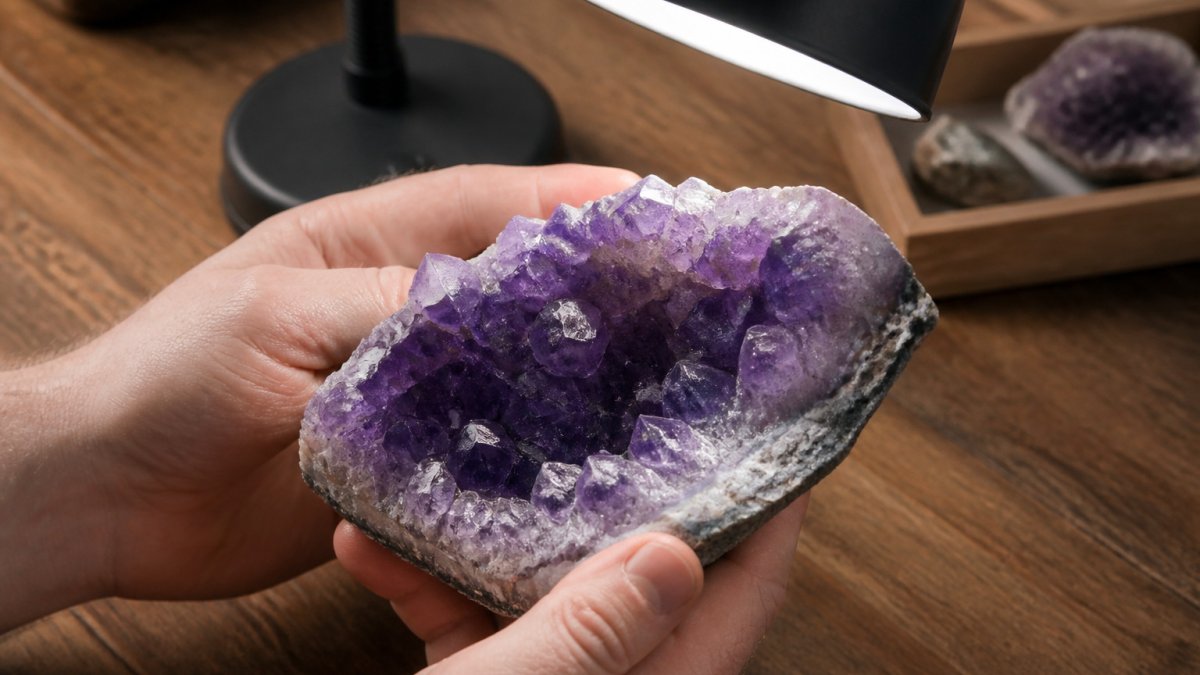
Natural amethyst specimens vary in color, and color is one of the first things to check. Natural amethyst rarely shows one even shade of purple. Its color usually shifts across the stone, and those shifts are one of the most useful clues a collector has.
Amethyst is a purple variety of quartz, and its color comes from trace iron impurities combined with natural radiation over long periods of time. That process is slow and uneven, which is why real specimens look varied.
Looking for Uneven Purple Saturation
Hold the piece up to a bright window and turn it slowly. Look for areas that are deeper purple next to areas that are paler lilac. Natural stones tend to fade or deepen gradually from one zone to the next.
Spotting Natural Color Banding
Many natural amethyst pieces show fine bands or growth lines where the color changes in layers. These bands often follow the crystal's growth direction.
- Look for straight or gently curved color lines inside the stone
- Check whether the banding follows the crystal points
- Be wary of color that sits on the surface but does not continue inside
How to Tell If Amethyst Is Real Using Inclusions and Flaws
Inclusions are the small internal features in a stone, such as tiny crystals, fluid bubbles, or mineral threads. Natural amethyst almost always has some. A flawless, glassy stone is a reason to look more closely, not less.
Many of these features are invisible to the naked eye, so a jeweler's loupe helps when examining natural amethyst specimens. Inexpensive versions are widely sold and are a good starting point.
What to Look For Under a 10x Loupe
Most guides stop at "look for inclusions." The real skill is knowing which internal patterns point to natural growth and which point to a fake. Set the stone on a clean, dark surface under a daylight-balanced lamp, hold the loupe close to your eye, and bring the stone toward it until the interior snaps into focus. Then rotate the piece slowly and examine it zone by zone.
Look for these natural signatures:
- Irregular internal features that do not repeat in a neat pattern. Natural inclusions are scattered and varied in size and shape.
- Growth zoning that continues into the stone. Color banding that follows the crystal's growth direction and is visible inside the stone, not just on the surface, is a strong natural indicator.
- Small surface pits or minor chips along the edges. Natural quartz often shows minor wear and tiny conchoidal fractures.
- Slight variations in clarity from one area to another. A natural stone is rarely uniformly clear or uniformly cloudy.
- Two-phase or three-phase inclusions. Tiny cavities containing both a liquid and a movable gas bubble are a classic natural quartz signature; the bubble shifts when the stone is tilted.
Inclusions That Suggest a Fake
Some imitations are made from colored glass. Glass often has tiny air bubbles arranged in curved rows or swirls, which is a useful difference from natural quartz. Under 10x magnification, glass bubbles are usually perfectly round and often line up along flow lines from the molding process. Natural quartz can contain bubbles, but they tend to be irregular and associated with fluid inclusions rather than neat rows.
Synthetic amethyst grown in a lab is still quartz, so it will not show glass bubbles. Instead, look for inclusions that repeat in a regular pattern, color that is too even, and a lack of the irregular growth features described above. A gemological lab can confirm origin with instruments, which home tests cannot do.
Examining Crystal Structure, Shape and Surface Luster
Natural amethyst grows as six-sided crystals that end in pointed terminations. Look at the points on a cluster or single crystal. Real points often show small steps or ridges along the faces, because the quartz grew in layers.
Surface luster matters too. Natural quartz has a glassy, slightly waxy shine. Polished pieces look smooth but should still show depth rather than a plastic-like surface. Be cautious if a piece looks too perfect in shape with identical faces, since machine-cut or molded items often do.
The table below summarises the visual cues the article describes for judging crystal structure and surface luster.
| Feature | Natural sign | Warning sign |
|---|---|---|
| Crystal shape | Six-sided crystals with pointed terminations | Identical, machine-cut faces |
| Termination surface | Small steps or ridges from layered growth | Perfectly smooth faces |
| Luster | Glassy, slightly waxy shine with depth | Plastic-like surface |
Weight, Density and Hardness Observations You Can Make at Home
You can make a few simple observations at home without damaging the stone. Hold the piece and compare its weight to your expectation for its size. Amethyst is relatively dense for its size, so a very light piece can be a warning sign.
Density and Specific Gravity
Quartz has a specific gravity of about 2.65, meaning it is roughly 2.65 times as dense as water (Natural Gemstones). Glass typically falls in the 2.4 to 2.6 range, so a glass imitation of the same size will usually feel slightly lighter in the hand.
A more reliable home check is a rough specific gravity estimate: weigh the stone on a small digital scale, then weigh it again suspended in water, and divide the dry weight by the difference. Natural quartz should land near 2.65. This method works best on clean, unmounted stones and requires a scale accurate to 0.01 grams.
Hand Carved Amethyst Elephant Figurine, Polished Crystal Stone, Spiritual Good →
Hardness on the Mohs Scale
Amethyst rates about 7 on the Mohs hardness scale, which means it scratches glass (about 5.5) but is scratched by harder materials such as topaz (8) or corundum (9). Do not test hardness by scraping a stone, since that can damage it and reduce its value.
Instead, use hardness as an observational clue:
- Edge wear. A natural amethyst that has been handled will show minor chips and abrasions along facet edges, but the faces themselves stay relatively crisp. Glass imitations tend to show rounded, frosted wear along edges.
- Surface scratches. Quartz resists scratching from everyday contact with softer materials. A stone covered in fine scratches from light handling is more likely to be glass.
- Feel against other stones. Quartz will scratch a copper penny and most window glass; if a piece cannot mark glass at all, treat that as a warning sign.
A home scratch test can ruin a valuable piece. Use the observations above instead, and reserve destructive testing for inexpensive rough where the loss is acceptable.
Thermal Conductivity
Quartz conducts heat differently than glass. A natural amethyst feels cool to the touch at first and warms slowly, while glass tends to warm quickly against the skin. This is a weak test on its own, but combined with density and edge wear it helps build a consistent picture. For a more definitive result, a gemologist can use a thermal conductivity tester, which reads the rate at which heat moves through the stone.
Natural vs. Synthetic Amethyst: What Separates Them
Synthetic amethyst is grown in a lab, so its structure and color can look very close to natural material. It is still quartz, but it usually lacks the natural growth patterns and irregular inclusions found in mined stones.
Lab-grown pieces often look more uniform, with color that is too even and inclusions that repeat in a regular pattern. A gemological lab can confirm origin with instruments, which home tests cannot do.
If you are weighing whether synthetic stones are worth buying, be clear about what you are paying for. Lab-grown pieces can make sense for certain uses, but collectors who want natural geological material should know the difference before they buy. Read our guide to natural versus synthetic amethyst for a fuller comparison.
Spotting Amethyst Glass Imitation
Glass imitations are one of the most common fakes on the market. Glass is softer than quartz, has a different feel, and often looks slightly too clean or bright.
Check for:
- Small round air bubbles, especially in curved rows
- Color that looks painted on or sits in streaks
- Sharp, glassy edges where a natural stone would show rounder wear
For a deeper look at testing dyed material, see our guide to identifying dyed quartz specimens. Many of the same tests apply.
When to Use Amethyst Authenticity Testing and Appraisal
Home observation covers a lot, but some purchases justify professional testing. A gemologist can use refractive index readings, microscopy, and UV fluorescence checks that are not possible at home. Appraisal is worth considering for high-value pieces or for any stone you plan to insure.
Authenticity testing is also useful when a seller makes strong claims about origin or treatment. If the story sounds too good, ask for documentation. Learn how to identify authentic mineral specimens with our full guide to see what professionals look for.
Choosing a Verified Specimen for Your Collection
Buying from a seller who explains each piece makes identification much easier. Look for descriptions that mention inclusions, color variation, and natural formation, not just a spec sheet.
Many buyers worry about whether a crystal is real or treated, and that concern is fair. See how curation differs from fast-shipping sellers. If you want to understand why verified stones cost more, read our explanation of authentic crystal value.
The hand carved amethyst elephant figurine is a natural purple stone with visible color variation, priced at $39.99. The amethyst geode sphere pair with stands is priced at $89.99 and shows natural druzy formations.
Our returns come with a 30-day free return policy, so you can check it at home before you decide.
Frequently Asked Questions
How can you tell if an amethyst specimen is natural?
Natural amethyst usually shows uneven color distribution, with deeper purple zones and paler areas that follow the crystal's growth. Look for internal inclusions such as fingerprint patterns, feathers or small mineral crystals, and check that the crystal points have irregular, natural terminations rather than perfectly uniform faces. Surface luster should look slightly varied rather than uniformly glassy. Because these checks are visual, a specimen that passes them can still be imitated, so verify the seller's claims and consider lab testing for high-value pieces.
Can glass be mistaken for amethyst?
Yes. Amethyst glass is a common imitation, and at a glance it can look similar to purple quartz. Glass often has a more uniform color, sometimes with swirl marks, air bubbles that are perfectly round, or a slightly softer, more even luster. Natural amethyst tends to show irregular inclusions and color zoning instead. Testing with a jeweler's loupe and checking for conchoidal fracture patterns can help separate the two, but a gemologist's examination is the most reliable way to confirm a suspect piece.
Are bubbles inside amethyst a sign that it is fake?
Not necessarily, but the type of bubble matters. Round, smooth bubbles that look like they were frozen in place are a common sign of glass, because glass traps air during manufacture. Natural amethyst can contain fluid inclusions and irregular cavities, but these are usually angular or irregularly shaped and are not evenly distributed. If you see many perfectly spherical bubbles, treat the specimen as suspect and look for other signs of imitation before buying.